
Key Takeaways
- Ocular migraines cause visual disturbances and can include symptoms like zigzag lines, blurry vision, and headaches.
- Acupressure for ocular migraines can help alleviate symptoms and reduce frequency by targeting specific pressure points.
- Common triggers include stress, irregular sleep, and bright lights, making lifestyle adjustments important for management.
- Differentiate ocular migraines from other conditions like retinal detachment or strokes, as they require immediate medical attention.
- Acupuncture is effective in managing migraines, and regular acupressure can support treatment between professional sessions.

Have you ever noticed a shimmering, zigzag line or a flickering blind spot in your vision that disappears after 20 or 30 minutes, sometimes with a pounding headache? This experience is commonly known as an ocular migraine. It can be quite frightening initially, particularly when it disrupts your ability to read, drive, or recognize faces for a period.
Ocular migraines are a form of migraine, with recognizable patterns and triggers that can be managed. Acupressure offers a gentle way to calm rising energy before an attack, reduce tension and light sensitivity during episodes, and support the body between attacks to decrease their frequency. The points listed below can assist with this.
What Is an Ocular Migraine?

“Ocular migraine” is a frequently used term rather than an official medical diagnosis, and it refers to two different conditions.
Most people understand it as migraine with visual aura. An aura is a wave of changing activity that gradually spreads across the visual area of the brain. Because it originates in the brain rather than the eye, it affects both eyes, even though many people perceive it as occurring in one eye. Covering one eye during an aura does not prevent it. About 25% of people with migraines experience auras, and some have auras without any headache, often called a silent migraine.
The second meaning refers to retinal migraine, a rare condition impacting only one eye. It involves repeated episodes of temporary vision dimming, blurring, or loss, sometimes accompanied by flashing lights. Since vision loss in one eye can also indicate a blocked blood vessel or early stroke, retinal migraine is only diagnosed after an eye doctor excludes other causes.
Common symptoms of an ocular migraine include:
- Shimmering, flickering, or sparkling lights
- Zigzag or jagged lines, often in a growing arc or horseshoe shape
- A blind spot that starts small and slowly expands
- Blurred or patchy vision, or difficulty reading
- Symptoms that build over five to twenty minutes and fade within an hour
- A throbbing headache, often on one side, that may follow the visual symptoms
- Sensitivity to light and sound, and nausea
- Tingling or numbness that spreads across the hand or face in some auras
- Fatigue, mental fog, and a drained feeling for hours afterward
What Causes Ocular Migraines and Who Gets Them?

Migraines often run in families and have a strong inherited component. During an aura, a slow electrical wave moves across the brain surface, causing visual symptoms to follow it across the visual field. Subsequently, nerves and blood vessels near the brain become more sensitive, potentially triggering the headache stage.
Migraines are three times more common in women than in men, and hormonal fluctuations during menstruation, pregnancy, and perimenopause can influence their progression. While ocular migraines typically begin in young adulthood, auras may appear at any age, including later in life.
Common triggers include:
- Stress, or the relief experienced after a stressful period concludes
- Lack of sleep, oversleeping, or irregular sleep
- Skipped meals and low blood sugar
- Dehydration and heat
- Bright light, glare, flickering light, and long hours of screen use
- Hormonal changes
- Alcohol, especially red wine, and certain aged or processed foods for some people
- Strong smells, such as perfume or smoke
- Changes in weather and air pressure
Most people with migraines encounter various triggers that often work together to intensify their effects. For example, a restless night, skipping lunch, and spending time in the sun might collectively trigger an attack, even if each factor alone wouldn’t. Keeping a straightforward diary of your episodes, sleep, meals, and activities can be an effective way to recognize your personal triggers.
How Ocular Migraines Differ From Other Vision Problems

Not every flash of light or episode of lost vision indicates a migraine. It’s important to distinguish them, as some visual symptoms may require immediate medical care.
- Retinal detachment typically results in a sudden rise in floaters, flashes of light at the periphery, or a shadow or curtain passing across part of the vision. It demands urgent consultation with an eye specialist on the same day.
- A stroke or mini-stroke usually leads to sudden vision loss rather than shimmering or zigzagging effects. It may also be accompanied by weakness, numbness on one side, slurred speech, or confusion. Immediate medical care is essential.
- Vestibular migraine causes episodes of vertigo and dizziness rather than visual auras. Acupressure for vestibular migraine covers that pattern.
- Eye strain causes tired, aching eyes and blurred vision after long periods of close work, without the moving patterns of an aura. Acupressure for eye strain addresses that problem.
- Migraine without aura causes a throbbing headache, nausea, and sensitivity to light, without visual aura. Acupressure for migraines covers migraine headaches more generally.
The clues that point toward a migraine aura are shimmering lights or zigzag lines that spread slowly over several minutes, last under an hour, follow a similar pattern each time, and often come with a personal or family history of migraines.
How Traditional Chinese Medicine Views Ocular Migraines
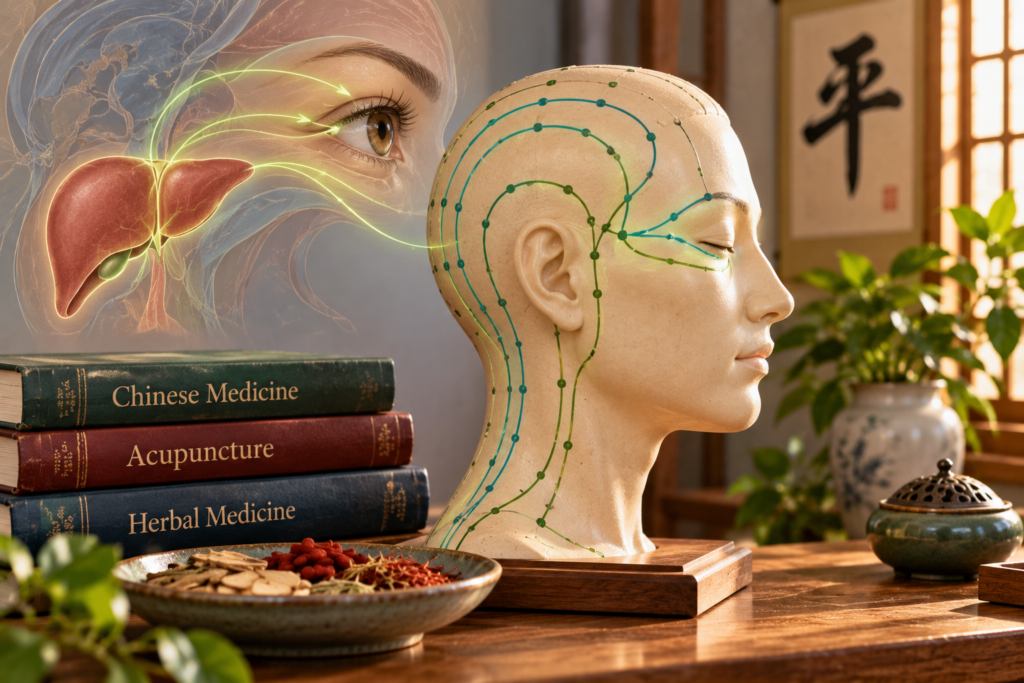
In Traditional Chinese Medicine, the Liver opens at the eyes, and the Gallbladder meridian runs along the side of the head, passing around the temple and reaching the outer corner of the eye. Ocular migraines are usually thought to result from disturbances in these two meridians, with energy rising excessively to the head and eyes. Many individuals display multiple patterns, which is why the treatment points are chosen to address each of these patterns.
- Liver Yang rising causes auras and one-sided, throbbing headaches triggered by stress, frustration, or overwork, usually accompanied by a flushed face, irritability, and tension in the neck and shoulders. The acupressure points LR3, GB20, GB41, and TE5 help calm rising energy and draw it back down.
- Liver wind refers to visual patterns that shimmer and flicker and may be accompanied by tingling or numbness; in Traditional Chinese Medicine, this is interpreted as the internal wind becoming active in the head. The acupressure points GB20 and LR3 are used to calm the wind.
- When Liver Blood cannot nourish the eyes, this may manifest as auras during menstruation or after blood loss, along with tired or dry eyes, blurred vision, and symptoms that appear after fatigue. The points GB37 and LR3 help to nourish and brighten the eyes.
- A head fog sensation, characterized by heaviness and cloudiness, often comes with nausea and attacks after eating rich or fatty foods. Stimulating acupressure points LI4 and GB20 can help clear the head, and maintaining regular, steady meals can prevent the buildup of phlegm.
- A lack of circulation around the eyes and temples can cause pressure behind the eyes, tension in the temples and brow, and sensitivity to light. Taiyang, BL2, and Yuyao move the Qi and Blood around the eyes.
The goal is to calm the rising energy and wind, clear the mind and eyes, nourish the eyes, and guide energy downward to help the head settle.
What the Research Shows
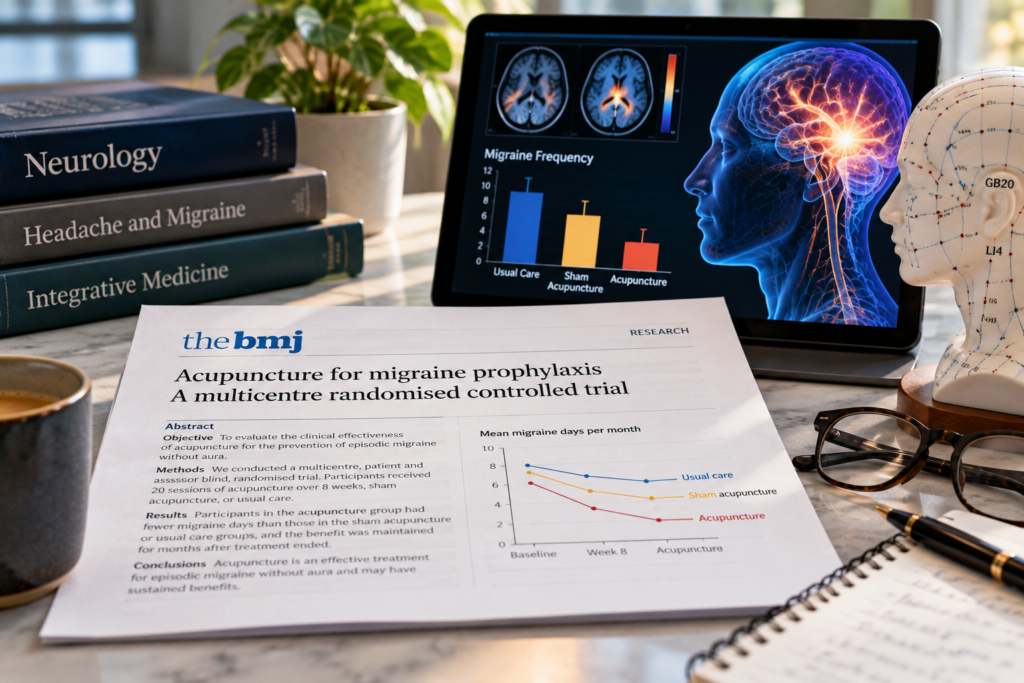
Acupuncture has one of the strongest research records of any treatment for migraine prevention.
In a multicenter randomized trial published in The BMJ, people with episodic migraine without aura who received twenty sessions of acupuncture over eight weeks had fewer migraine days than those who received sham acupuncture or usual care, and the benefit continued for months after treatment ended. Large reviews of the research have also found that acupuncture reduces how often migraines occur, with results comparable to commonly used preventive medications and fewer side effects.
Most research on migraines focuses on migraine without aura or migraines in general, with comparatively less attention given solely to migraine with aura. Because auras and migraines share the same underlying causes, the main goal for many individuals with ocular migraines is to decrease their overall migraine frequency. Additionally, acupressure targets the same points used in treatment, making it a convenient way to support daily migraine management between professional treatments.
Here are nine acupressure points that can help:
What Acupressure Points to Press and Why
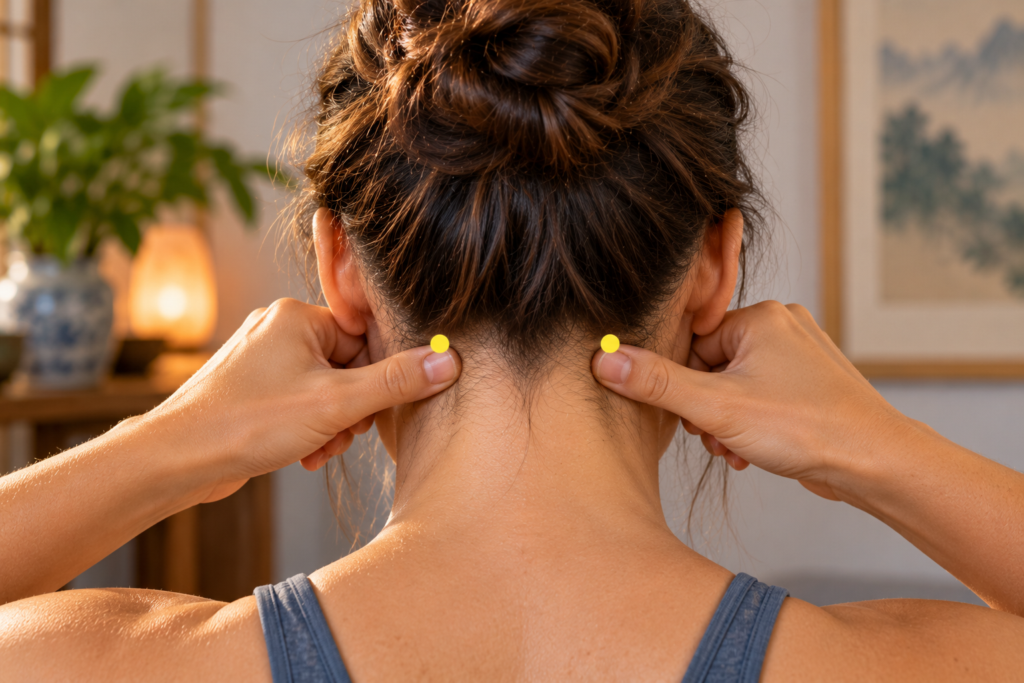
1. Press on GB20 at the base of the skull to calm the head and eyes. GB20 sits in the two hollows at the base of the skull, between the two large vertical neck muscles and the muscles along the side of the neck, roughly level with the earlobes. Press firmly up and inward with your thumbs for one to two minutes while breathing slowly. GB20 is called “Fengchi,” the “Wind Pool.”
GB20 is a key acupressure point for various types of migraine. It helps calm the wind and rising energy during an aura, relaxes tense neck muscles common before and during attacks, and is traditionally used to enhance vision. Simply pressing on it at the first sign of an aura, with your eyes closed and your head resting against a chair or wall, is one of the easiest self-help measures.
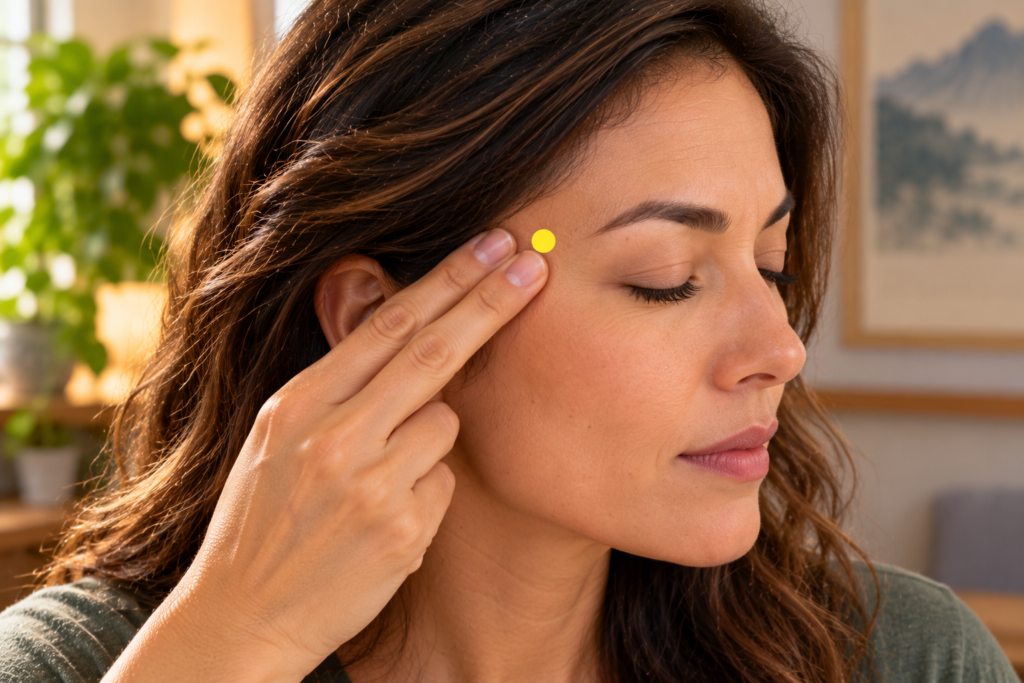
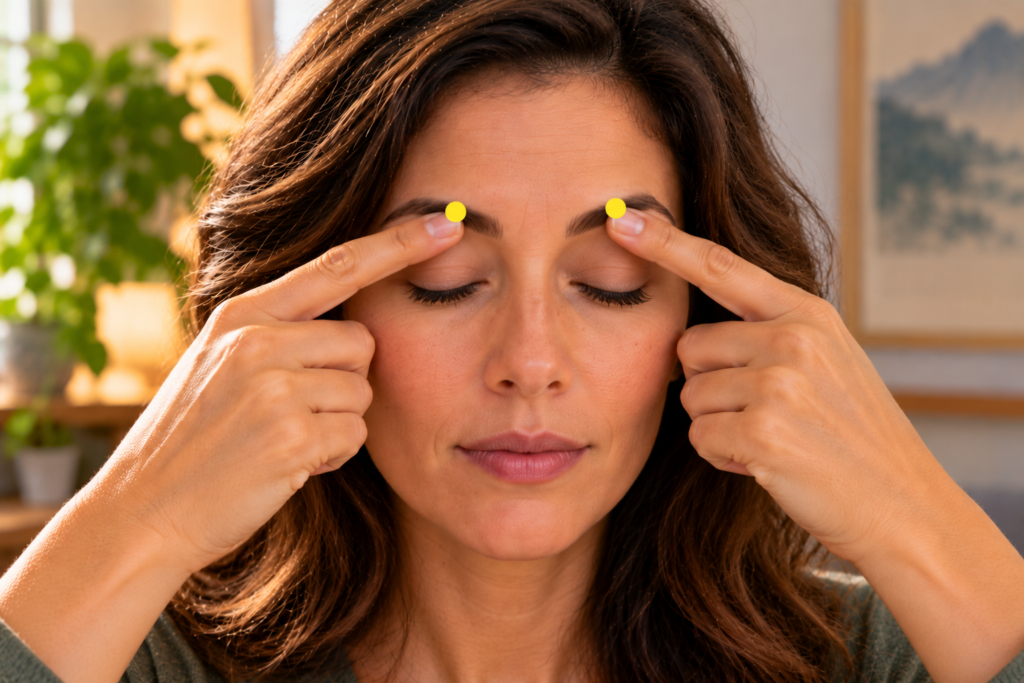
2. Press on Taiyang at the temple to ease pressure around the eyes. Taiyang sits in the soft hollow at the temple, about one finger-width behind the midpoint between the outer end of the eyebrow and the outer corner of the eye. Press gently, or make slow circles, with your fingertips on both sides for one to two minutes. Taiyang is an extra point whose name means “Supreme Yang.”
Taiyang is a frequently used acupressure point for relieving headaches, located at the temple and behind the eyes. It helps circulate Qi and Blood around these areas, reducing throbbing and light sensitivity often experienced after an aura. During an attack, apply gentle pressure, as the area can be tender.
3. Press on BL2 at the inner end of the eyebrow to clear the eyes. BL2 sits in the small notch at the inner end of the eyebrow, directly above the inner corner of the eye. Press gently with your thumbs or fingertips, pressing slightly upward into the notch, for one to two minutes. BL2 is called “Zanzhu,” the “Gathered Bamboo.”
BL2 is a popular acupressure point located on the eyes and forehead; it relieves brow and behind-the-eye pressure, soothes tired or strained eyes, and helps with light sensitivity often associated with migraines. It is especially beneficial when ocular migraines occur after extended periods of reading or screen use.
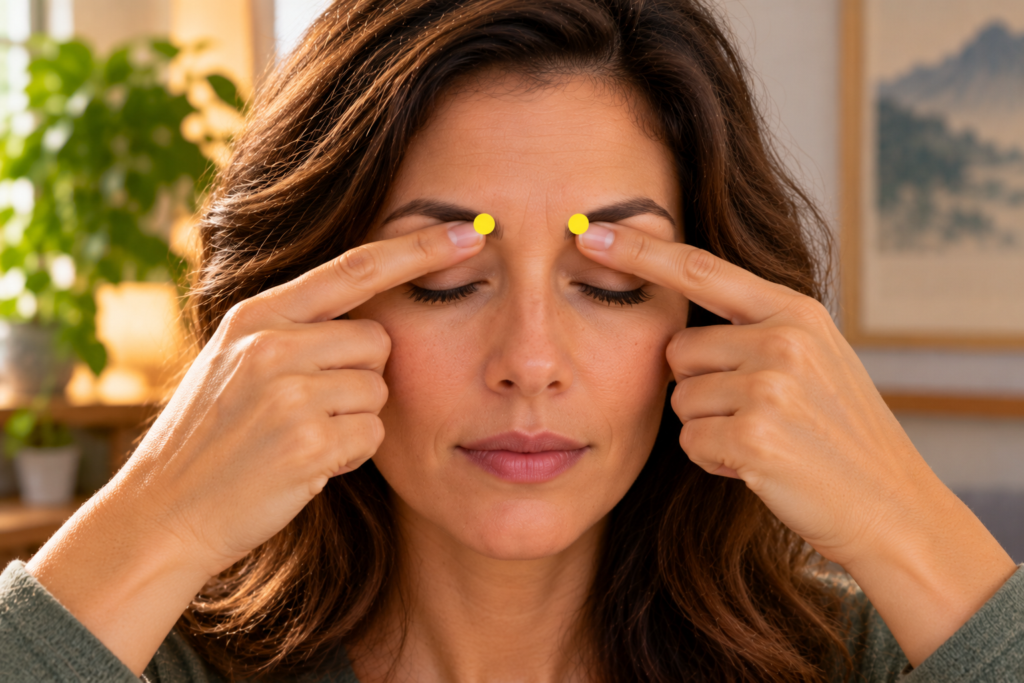
4. Press on Yuyao in the middle of the eyebrow to relax the eyes. Yuyao sits at the midpoint of the eyebrow, directly above the pupil when you look straight ahead. Press gently with your fingertips on both sides for one to two minutes. Yuyao is an extra point whose name means “Fish Waist.”
Yuyao relieves eye muscle tension and eases brow and eyelid heaviness that may persist after an aura. Gently stimulating the BL2, Yuyao, and Taiyang points along the brow from the inner corner to the temple creates a calming routine ideal for a dark, quiet environment.
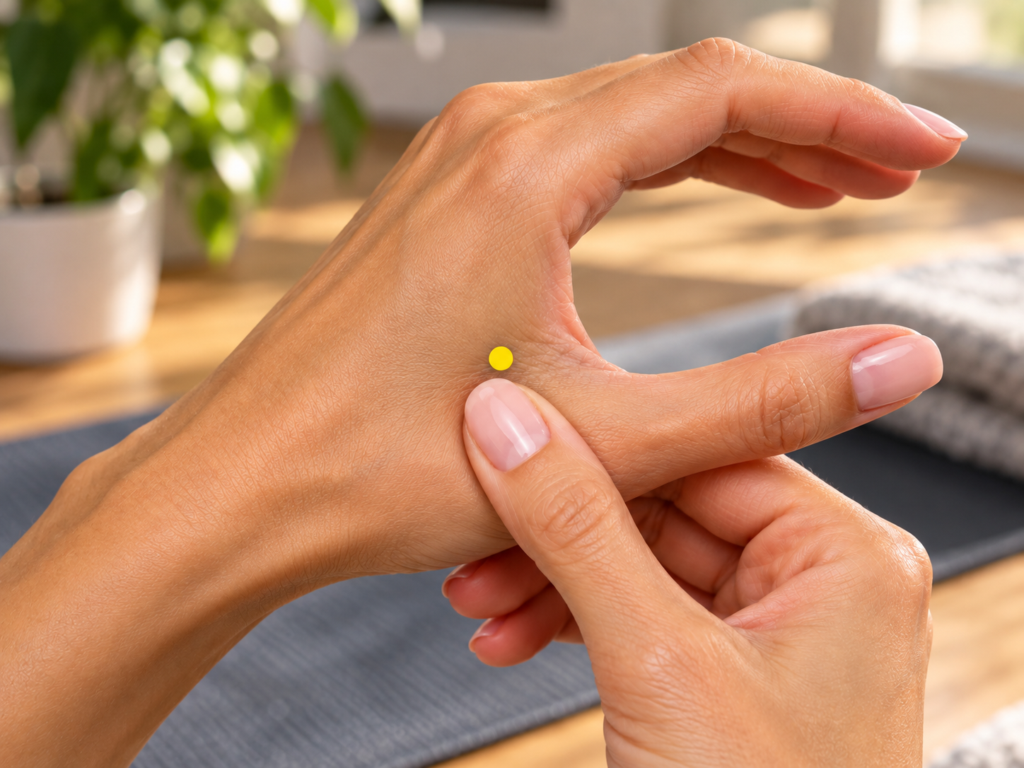
5. Press on LI4 in the hand to relieve head pain. LI4 sits in the webbing between the thumb and index finger, at the highest point of the muscle when you bring the thumb and index finger together. Press firmly with the thumb of your other hand for one to two minutes on each hand. LI4 is called “Hegu,” the “Joining Valley.” LI4 is avoided during pregnancy.
LI4 is a key point for the face and head, and it’s one of the most effective points for relieving pain throughout the body. It helps clear the head, alleviates headaches that may follow an aura, and eases nausea. Its accessibility in any situation makes it an ideal first point to target when an episode begins at work or in public.
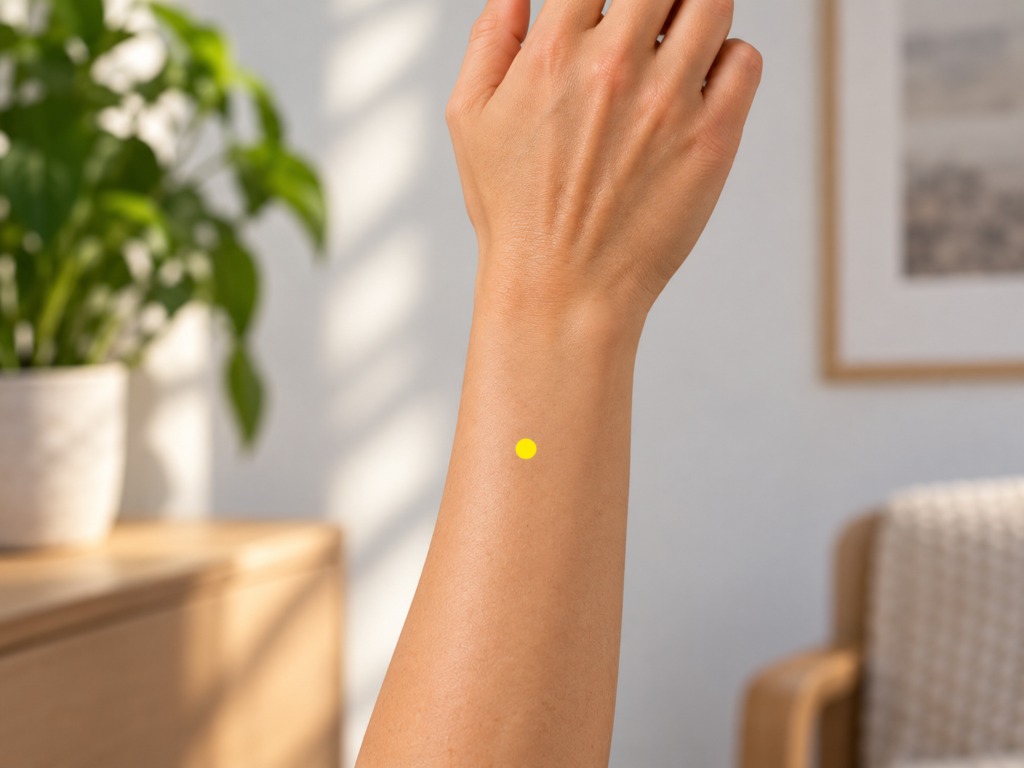
6. Press on TE5 on the back of the forearm to ease one-sided headaches. TE5 sits on the back of the forearm, three finger-widths above the wrist crease, in the hollow between the two forearm bones. Press firmly with your thumb for one to two minutes on each arm. TE5 is called “Waiguan,” the “Outer Gate.”
TE5 is situated on the Triple Burner channel, which runs along the outer arm to the side of the head, past the ear, and extends to the outer eyebrow. It is used for treating unilateral headaches, temple pain, and eye discomfort, often paired with GB41 on the foot to alleviate one-sided head pain. TE5 is directly opposite PC6 on the inner forearm, making it convenient to press both points simultaneously.
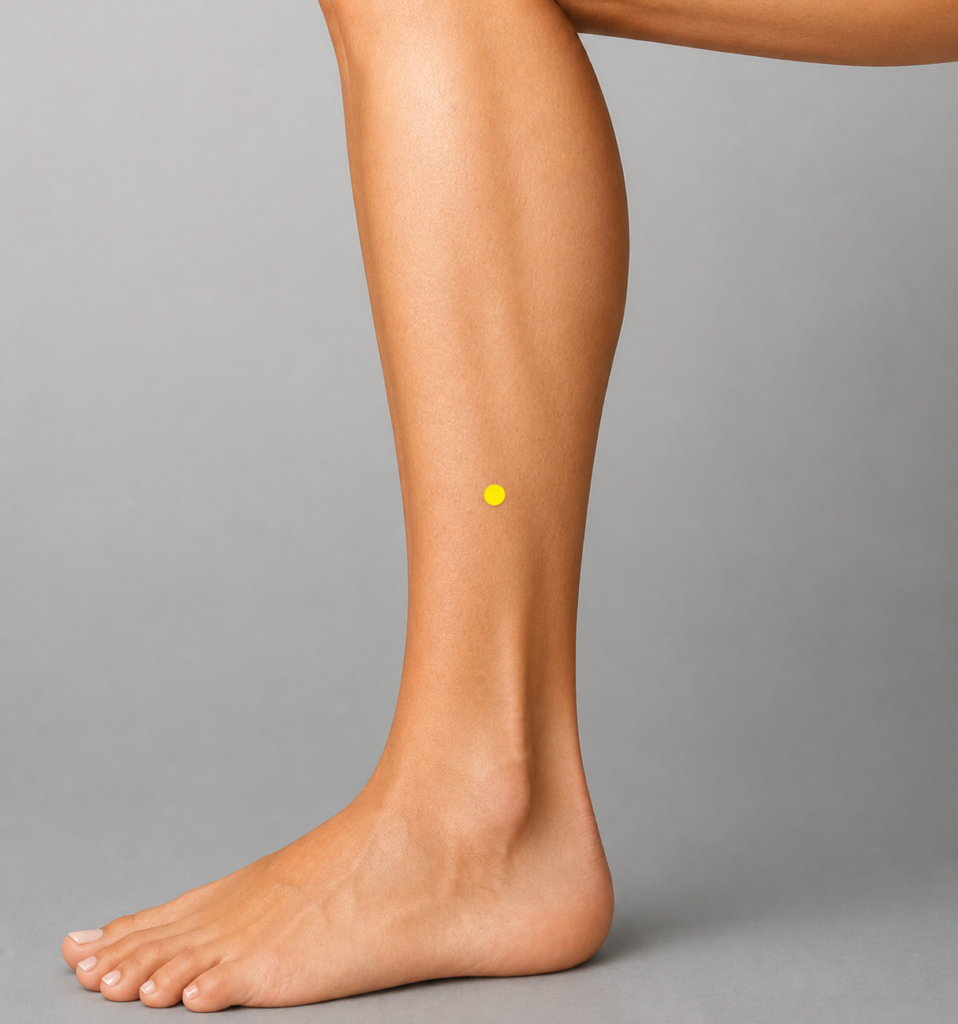
7. Press on GB37 on the lower leg to brighten the eyes. GB37 sits on the outer lower leg, about seven finger-widths above the tip of the outer ankle bone, just in front of the outer leg bone. Press firmly with your thumb for one to two minutes on each leg. GB37 is called “Guangming,” the “Bright Light.”
As a key eye acupressure point in Traditional Chinese Medicine, GB37 connects the Gallbladder and Liver meridians. It is used to treat eye pain, blurred vision, night blindness, and other visual issues. For ocular migraines, it helps strengthen and clear the eyes from afar and guides rising energy downward, away from the head. Daily treatment of this point is recommended between attacks.
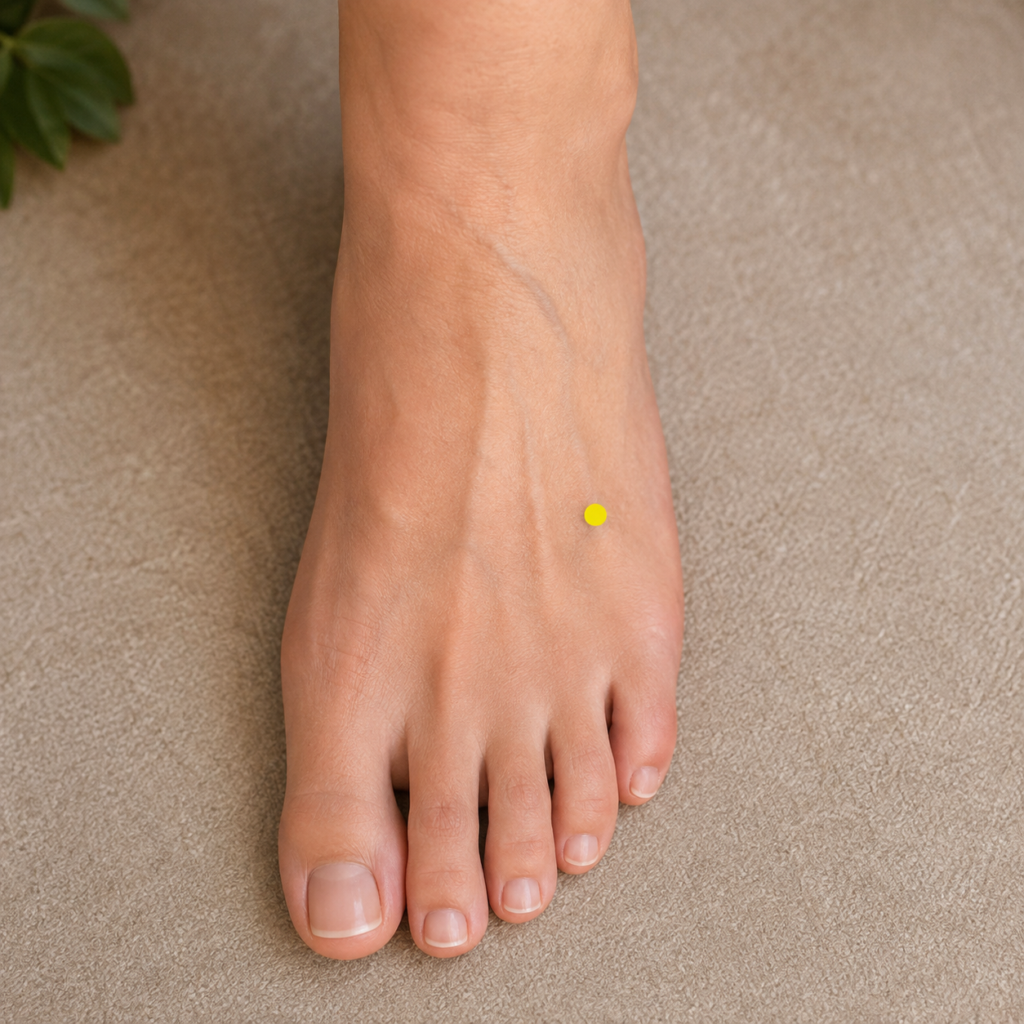
8. Press on GB41 on the top of the foot to clear the side of the head. GB41 sits on the top of the foot. Slide a finger back along the groove between the fourth and fifth toes until it stops in a hollow where the two bones meet. GB41 sits in that hollow, just outside the small tendon that runs to the little toe. Press firmly with your thumb for one to two minutes on each foot. GB41 is called “Zulinqi,” the “Foot Governor of Tears.”
GB41 is a key distal point for migraines localized on the side of the head and for eye-related pain; its traditional name highlights its use in treating eye conditions like excessive tearing. When combined with TE5 on the arm, it can relieve pain along the entire side of the head. Typically, GB41 is tender in people with frequent migraines, so start with moderate pressure.
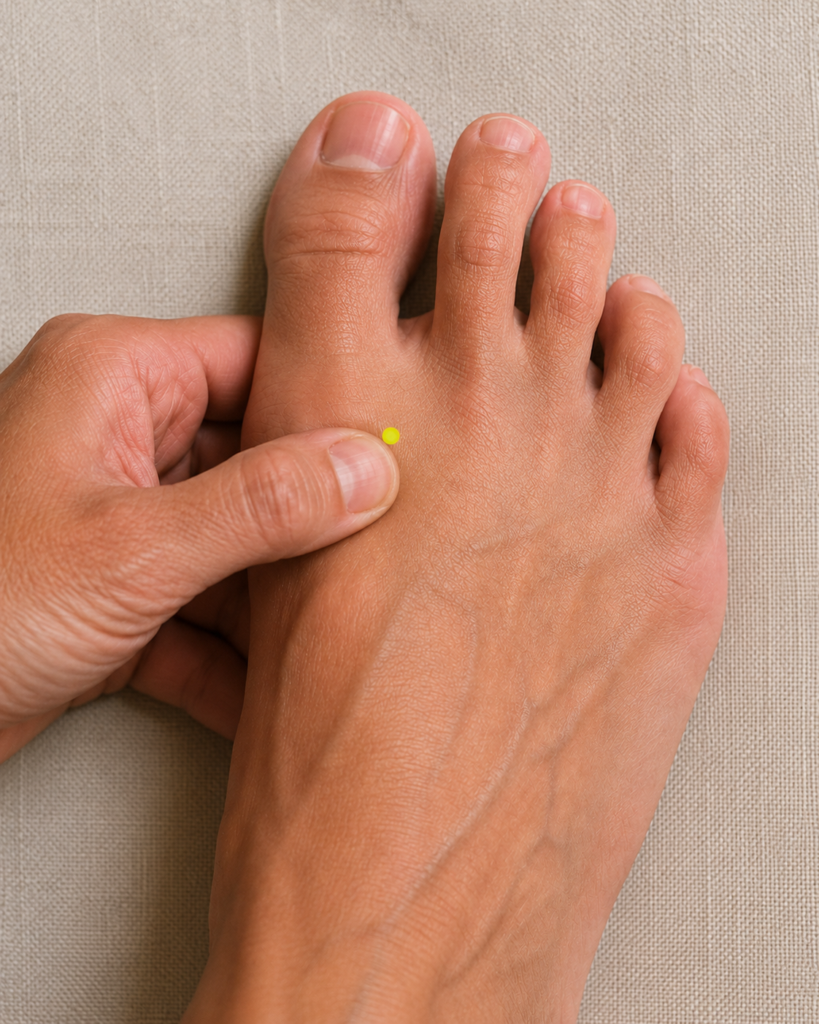
9. Press on LR3 on the top of the foot to calm the Liver and draw energy down. LR3 sits on the top of the foot, in the webbing between the big toe and second toe, about two finger-widths back from the webbing, in the hollow just before the two bones meet. Press firmly with your thumb for one to two minutes on each foot. LR3 is called “Taichong,” the “Great Surge.”
In Traditional Chinese Medicine, the Liver is connected to the eyes. When stressed, the Liver can become tense, causing energy to rise toward the head. LR3 is the main point to calm the Liver, suppress wind, and direct rising energy downward to the feet. When used with LI4 on the hands, it forms the Four Gates, a known pairing for calming the whole body, easing pain, and reducing stress. LR3 is also one of the most effective daily acupressure points for lowering the frequency of episodes.
Why These Acupressure Points Work
In Traditional Chinese Medicine, migraines affecting the eyes are believed to result from Liver Yang and wind ascending to the head and eyes. Additionally, a deficiency of Liver Blood failing to nourish the eyes, or the presence of phlegm and local stagnation around the eye area, are considered contributing factors. The nine points are used within this conceptual framework.
- The head and neck point (GB20) calms wind, releases neck tension, and brightens the eyes.
- The eye and brow points (Taiyang, BL2, Yuyao) move the Qi and Blood around the eyes and ease pressure, aching, and light sensitivity.
- The arm points (LI4, TE5) clear the head and ease one-sided pain along the channels that reach the face and temple.
- The leg and foot points (GB37, GB41, LR3) nourish the eyes, calm the Liver, and draw rising energy back down.
How to Properly Use These Acupressure Points
- At the first sign of an aura, stop what you are doing, sit or lie down somewhere dim and quiet, and do not drive until your vision is completely clear.
- During an aura, press GB20, LI4, and LR3 with slow breathing, then work gently along the brow with BL2, Yuyao, and Taiyang with your eyes closed.
- If a headache follows, add TE5 and GB41, and keep the room dark and quiet.
- Between episodes, work the full routine once a day, holding each point for one to two minutes.
- Use firm pressure on the hands, arms, legs, and feet, and gentle pressure around the eyes and temples.
- Keep your nails short and your hands clean when working near the eyes, and never press on the eyeball itself.
- Track your episodes over several weeks, since the main goal of daily practice is fewer and milder episodes.
Sample routines:
- At the first sign of an aura (five minutes): GB20, LI4, and LR3, followed by BL2, Yuyao, and Taiyang with your eyes closed.
- During a headache (ten minutes): LI4, TE5, GB41, and LR3, then GB20 with your head supported.
- Daily prevention (ten to fifteen minutes): the full routine, with extra time on GB37 and LR3.
- After screen work (three minutes): BL2, Yuyao, and Taiyang, followed by a few minutes of looking into the distance.
Home Care and Lifestyle Support for Ocular Migraines

Maintaining consistent daily habits is among the most effective methods to decrease the frequency of ocular migraines.
- Keep a regular sleep schedule, going to bed and waking at about the same time every day, including weekends.
- Eat regular meals and do not skip breakfast, since low blood sugar is a common trigger.
- Drink water steadily through the day.
- Take regular breaks from screens, lower screen brightness, and use the twenty-twenty-twenty habit: every twenty minutes, look at something twenty feet away for twenty seconds.
- Keep a diary of episodes, sleep, meals, stress, and activities to find your personal triggers.
- Limit alcohol, especially red wine, and pay attention to any foods that seem to set off episodes.
- Keep caffeine steady and moderate, since both too much and sudden withdrawal can trigger migraines.
- Make room for exercise, such as walking, swimming, or yoga, which helps reduce migraine frequency over time.
- Practice daily stress relief, such as slow breathing, meditation, or acupressure, and plan for the letdown after busy periods.
Traditional Chinese Medicine follows specific principles: warm, cooked, regular meals support digestion and help prevent phlegm that impairs clarity. Avoid greasy, fried, and extremely spicy foods, as well as alcohol, because they increase internal heat and cause energy to rise. Leafy greens, goji berries, and black sesame are traditionally used to nourish the Liver Blood and eyes. Chrysanthemum tea is also well-known as a cooling beverage to soothe tired and strained eyes. Going to bed before eleven o’clock benefits the Liver, as Traditional Chinese medicine believes the Liver restores the Blood during the night. Finding healthy ways to release frustration and stress, such as physical activity, spending time outdoors during cooler parts of the day, or discussing concerns with someone, helps keep the Liver from becoming tense.
How Acupuncture Can Help

Acupuncture addresses ocular migraines by calming the rising Liver energy and wind that manifest behind the eyes, reducing tension in the neck, shoulders, and temples, and nourishing the eyes. The goal is to lower both the frequency and severity of episodes, while also tackling triggers like stress, poor sleep, hormonal shifts, and eye strain. Many patients find that regular acupuncture decreases how often they experience migraines and makes episodes shorter and less intense. Herbal formulas can be added for patterns like Liver Blood deficiency or hormonal migraines.
Acupuncture works well alongside the care of your doctor, eye doctor, or neurologist. Learn more about how acupuncture can help with migraines and why some people keep getting migraines.
When to Get Professional Help
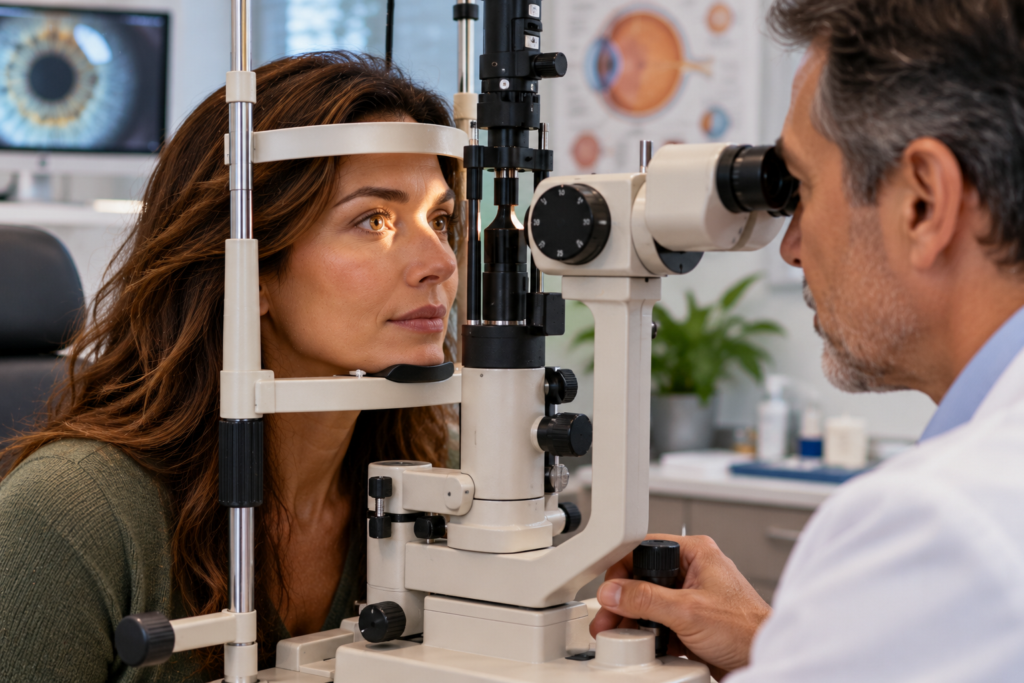
Ocular migraines require diagnosis by a healthcare professional. A first episode of visual aura should be evaluated by a doctor, since some serious conditions can look similar. Seek emergency help if you suddenly lose vision, especially in one eye, or experience vision changes with weakness, numbness, slurred speech, confusion, facial drooping, difficulty walking, or a sudden severe headache peaking within a minute. These could signal stroke or brain hemorrhage. Seek same-day eye care for a sudden shower of new floaters, flashes at the edge of your vision, or a shadow or curtain moving across your vision, which can signal a retinal detachment. Consult your doctor promptly if you experience repeated vision loss, aura lasting over an hour, first aura after age fifty, aura pattern changes, more severe or frequent migraines, or if pain relief is needed more than two or three days weekly. If you have a migraine with aura and also smoke or take estrogen-containing birth control, talk with your doctor, since the combination can raise the risk of stroke.”
Acupressure can be a gentle supportive method to manage ocular migraines, but it should complement, not replace, medical diagnosis and treatment.
For other types of migraine and headache, acupressure for migraines, acupressure for vestibular migraine, acupressure for a tension headache, and acupressure for an occipital headache are companion pieces. If your episodes tend to follow long hours of close work, acupressure for eye strain offers a quick routine for tired eyes, and home remedies for migraines covers more ways to prevent episodes naturally.
Above and Beyond Acupuncture offers acupuncture, cupping, and lifestyle coaching at the North Frank Lloyd Wright Boulevard location in Scottsdale.
Schedule an appointment online to start your healing journey.
The points above are only as effective as the technique used to apply them. Where to press, how firmly, and for how long all affect the result. For a full breakdown of how to perform acupressure properly at home, read Performing Acupressure in 3 Easy Steps.

About the Publisher
Paul Kerzner, L.Ac., is a licensed acupuncturist and board-certified herbalist, as well as the founder of Above and Beyond Acupuncture in Scottsdale. His own journey from chronic patient to practicing acupuncturist shapes his commitment to providing honest, clinically grounded information about acupuncture and Traditional Chinese Medicine. Learn more about Paul and his clinical approach on the About Us page.