
Key Takeaways
- Insomnia is a common sleep disorder that makes it hard to fall asleep, stay asleep, or get good-quality sleep, even when there is enough time and a good sleep environment.
- Short-term insomnia often follows stress or a change in schedule, while chronic insomnia occurs three or more nights a week for more than three months.
- In Traditional Chinese Medicine, sleep depends on a calm mind and on the Yang settling into the Yin each night, and stress, worry, overwork, and depleted Blood or Yin all keep the mind from resting.
- Nine acupressure points on the head, wrists, legs, ankles, and feet help calm the mind, ease stress, nourish the Yin and Blood, and restore the natural rhythm between waking and sleep.
- Acupressure for insomnia works best alongside steady sleep habits, and insomnia that lasts more than three months or comes with loud snoring, low mood, or daytime sleepiness should be checked by a provider.
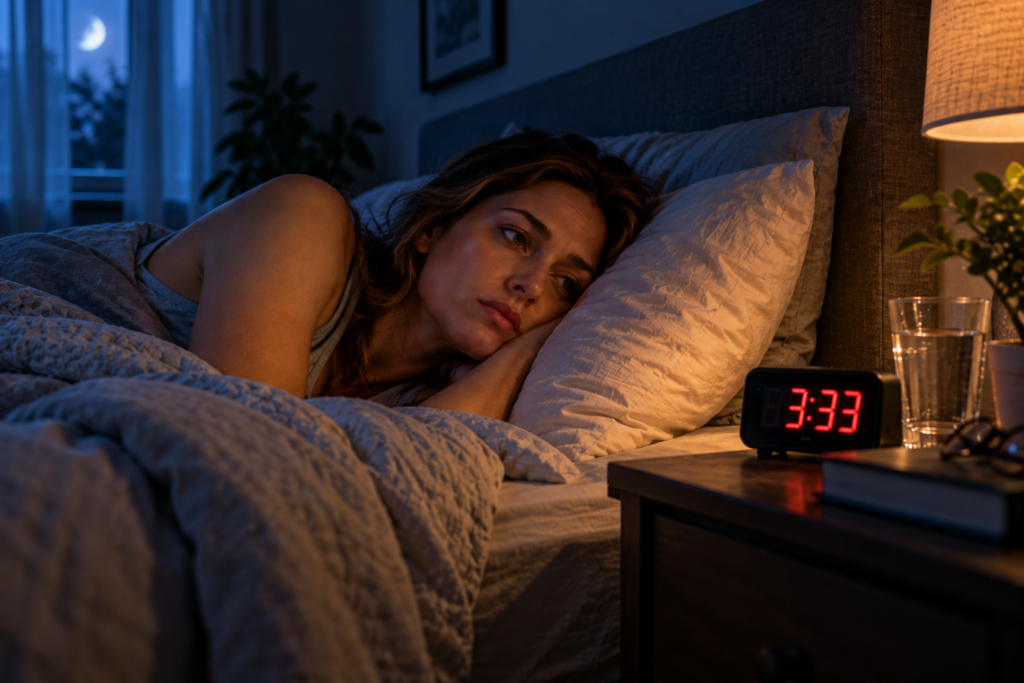
For many people with insomnia, the night is measured in glances at the clock. Your body is exhausted, but your mind won’t switch off. Sleep may come easily, only to fall apart a few hours later. By morning, the day ahead already feels heavier than it should.
From the National Heart, Lung and Blood Institute: Insomnia is a common sleep disorder that makes it difficult to fall asleep, stay asleep or get restful sleep, even when you have plenty of time and a good sleep environment. Occasional (short-term) insomnia is usually linked to stress or a change in routine or environment, and typically resolves within days or weeks. Chronic insomnia is defined as occurring on 3 or more nights per week for 3 months or longer, and cannot be fully explained by another medical condition. Over time, it can negatively affect memory, concentration and mood, and is associated with an increased risk of hypertension, heart disease and diabetes.
Insomnia can happen at any age, but it becomes more common as people get older and is more prevalent in women than men, particularly during pregnancy and menopause. Stress related to work, money, relationships or loss, along with shift work, frequent travel, long daytime naps, screen use in the hours before bed, caffeine, nicotine and alcohol, can all increase the risk. Worrying about your sleep can also perpetuate insomnia, even after the initial trigger has passed.
In Traditional Chinese Medicine, sleep is the time when the day’s Yang returns to Yin, allowing the mind (Shen) to rest in the Heart. If stress constricts the Liver Qi, worry depletes the Heart and Spleen, or overwork and age deplete the Yin and Blood, the mind has nowhere to settle. Some people lie awake with racing thoughts; others wake in the early hours feeling hot and restless, or sleep lightly and dream throughout the night.
The nine points listed below help calm the mind, ease the stress behind a restless night, nourish Yin and Blood, and restore the natural rhythm between wakefulness and sleep.
What Acupressure Points to Press and Why
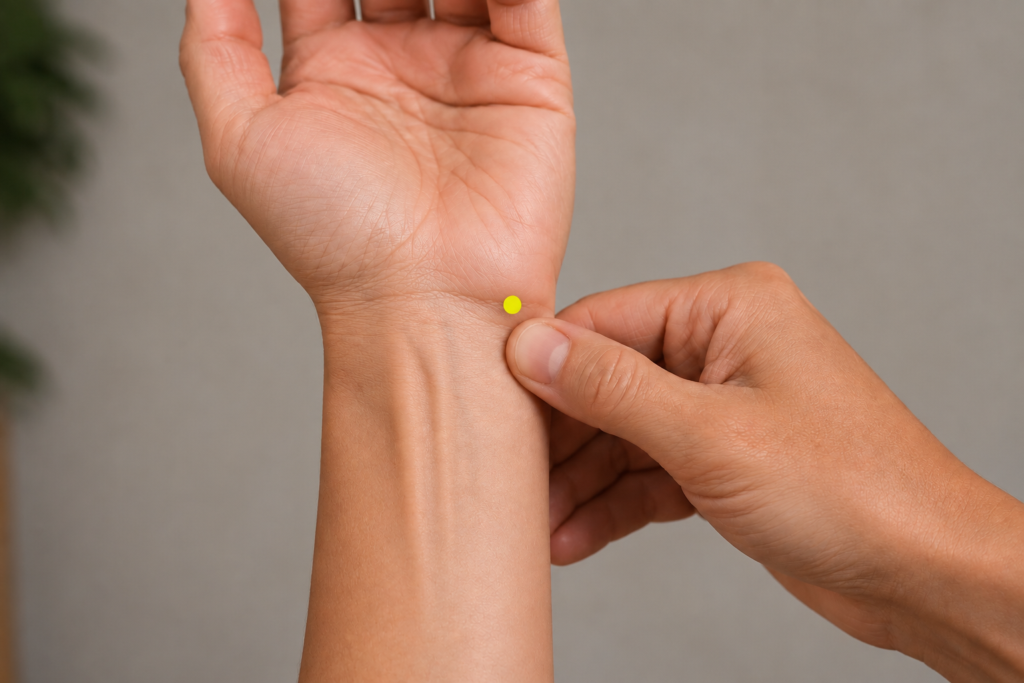
1. Press on HT7 on the wrist crease to calm the mind. HT7 sits on the inner wrist crease, on the pinky side, in the small hollow just to the thumb side of the tendon that runs along the edge of the wrist. Press gently with the thumb of your other hand for one to two minutes on each wrist. HT7 is called “Shenmen,” the “Spirit Gate.”
HT7 is the source point of the Heart (in Traditional Chinese Medicine, the Heart houses the mind). It’s one of the most commonly used points for insomnia, anxiety, and a restless mind, helping to settle the mind so sleep can come and stay.
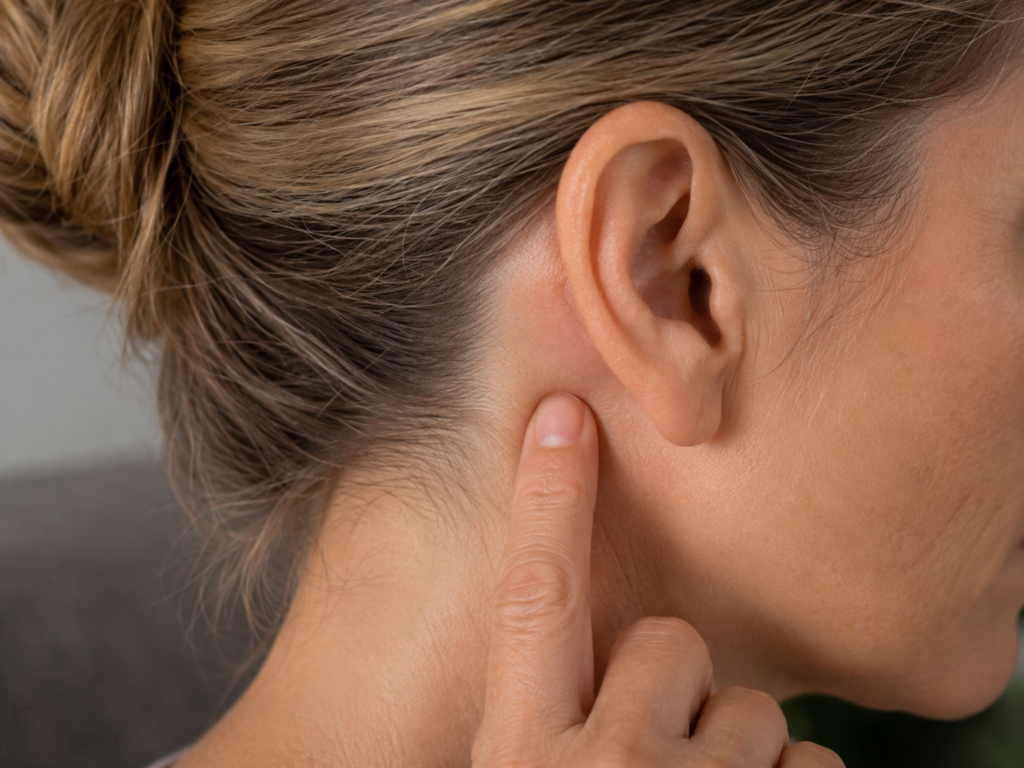
2. Press on Anmian behind the ear to sleep more deeply. Anmian sits behind each ear, in the small hollow halfway between the bony bump just behind the earlobe and the hollow at the base of the skull. Press gently with your fingertips for one to two minutes on both sides at once. Anmian means “Peaceful Sleep.”
Anmian is an extra point named for its use in insomnia. It’s used for difficulty falling asleep, waking during the night, and a restless, overactive mind. It’s particularly useful as part of a short routine just before bed.
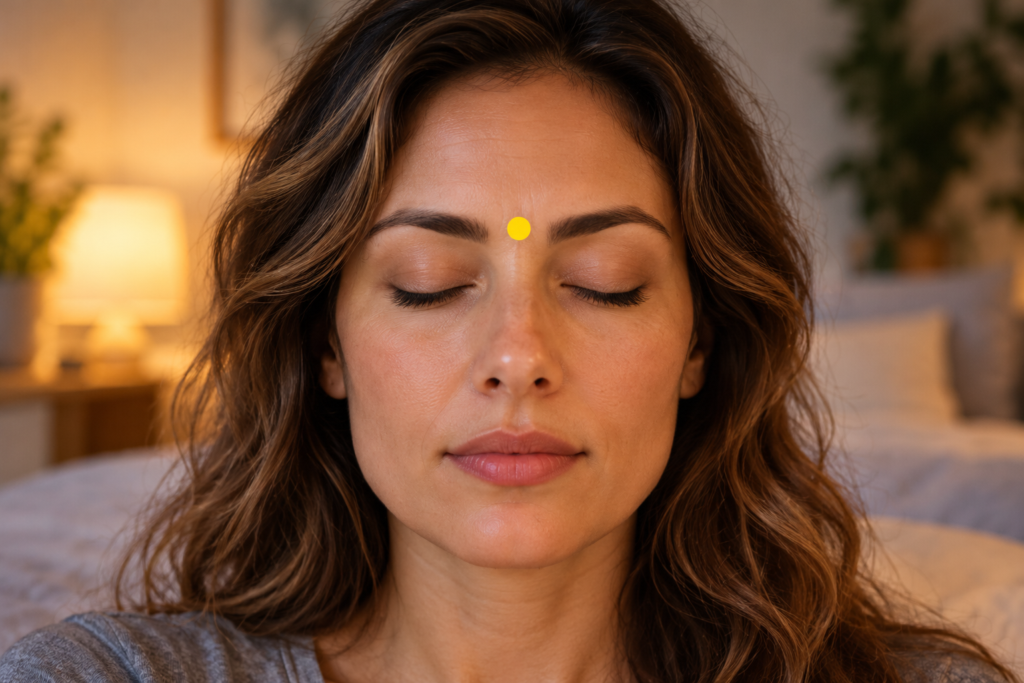
3. Press on Yintang between the eyebrows to quiet a racing mind. Yintang sits on the midline of the forehead, directly between the inner ends of the eyebrows. Press gently with your fingertip, or make slow, small circles for one to two minutes while breathing slowly. Yintang is called the “Hall of Impression.”
Yintang is an extra point traditionally used to calm the mind, ease anxiety, and relieve the mental chatter that keeps so many people awake. It’s one of the most soothing points to press while lying in bed with your eyes closed.
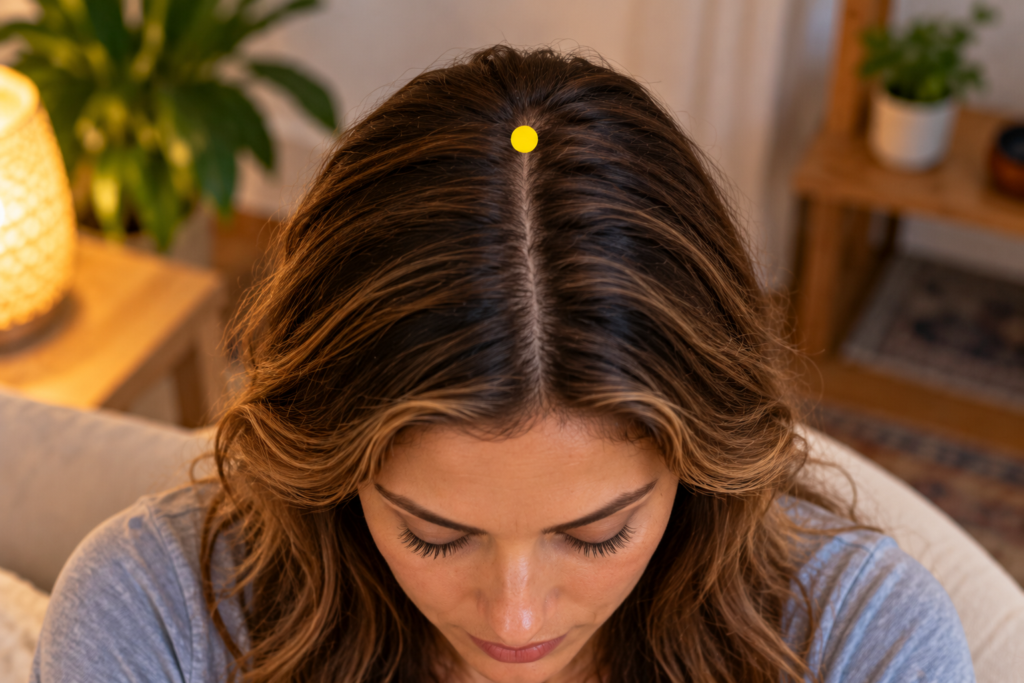
4. Press on GV20 on the top of the head to settle the mind. GV20 sits on the midline of the head, at the midpoint of an imaginary line drawn from the top of one ear, over the head, to the top of the other ear. Press gently with your fingertip, or make small circles, for one to two minutes. GV20 is called “Baihui,” the “Hundred Meetings.”
GV20 is located at the crown of the head, where several channels converge, and is one of the most commonly used points in Traditional Chinese Medicine for insomnia. It calms the mind, helps with a heavy or foggy head, and is often used with Yintang and Anmian to quiet the thoughts keeping you awake.
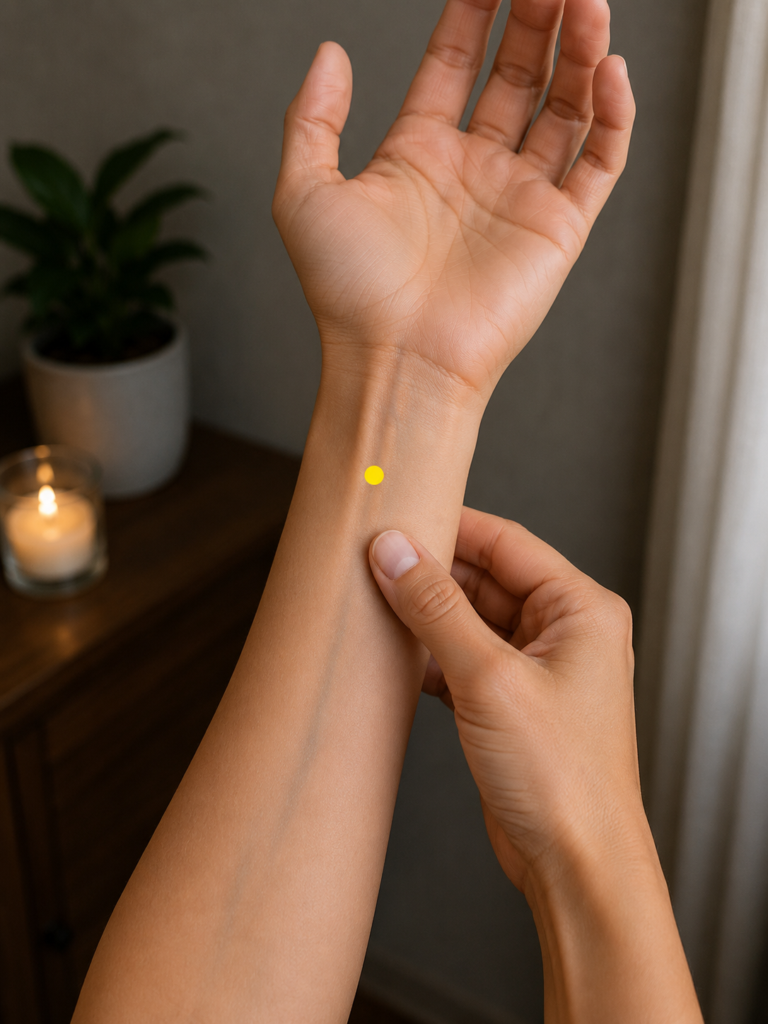
5. Press on PC6 on the inner forearm to ease stress and anxiety. PC6 sits on the inner forearm, three finger-widths above the wrist crease, between the two tendons. Press firmly with the thumb of your other hand for one to two minutes on each arm. PC6 is called “Neiguan,” the “Inner Pass.”
PC6 is one of the most commonly used points for calming the mind and opening the chest. It eases the anxiety, tight chest, and racing heart that often come with a sleepless night, and it pairs naturally with HT7.
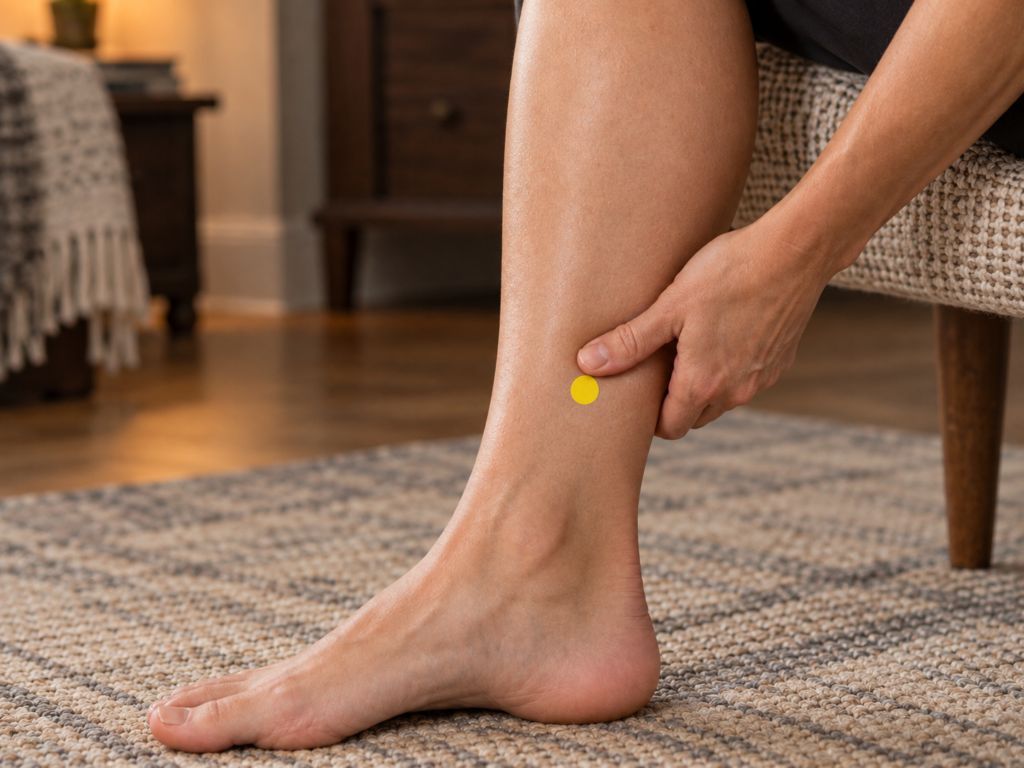
6. Press on SP6 above the inner ankle to nourish the Yin and Blood. SP6 sits on the inner lower leg, four finger-widths above the tip of the inner ankle bone, just behind the edge of the shinbone. Press firmly with your thumb for one to two minutes on each leg. SP6 is called “Sanyinjiao,” the “Three Yin Intersection.” SP6 is avoided during pregnancy.
SP6 is the confluence of the Spleen, Liver, and Kidney channels and is one of the most commonly used points for insomnia in Traditional Chinese Medicine. It nourishes Yin and Blood, which anchor the mind at night, and is particularly useful for insomnia caused by worry, fatigue, or the hormonal shifts of menopause.
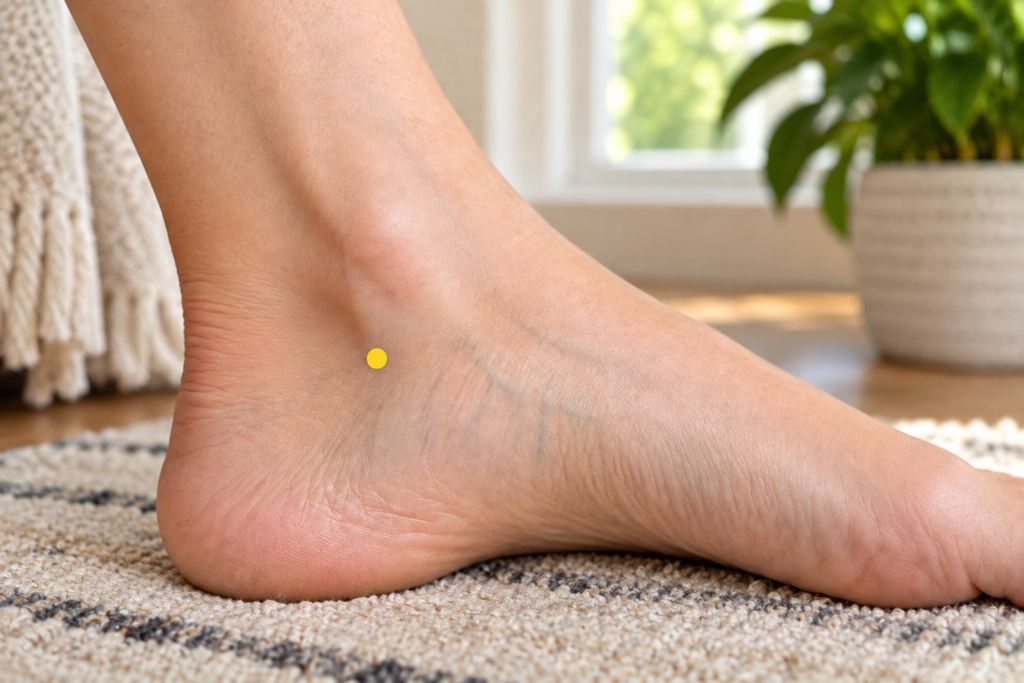
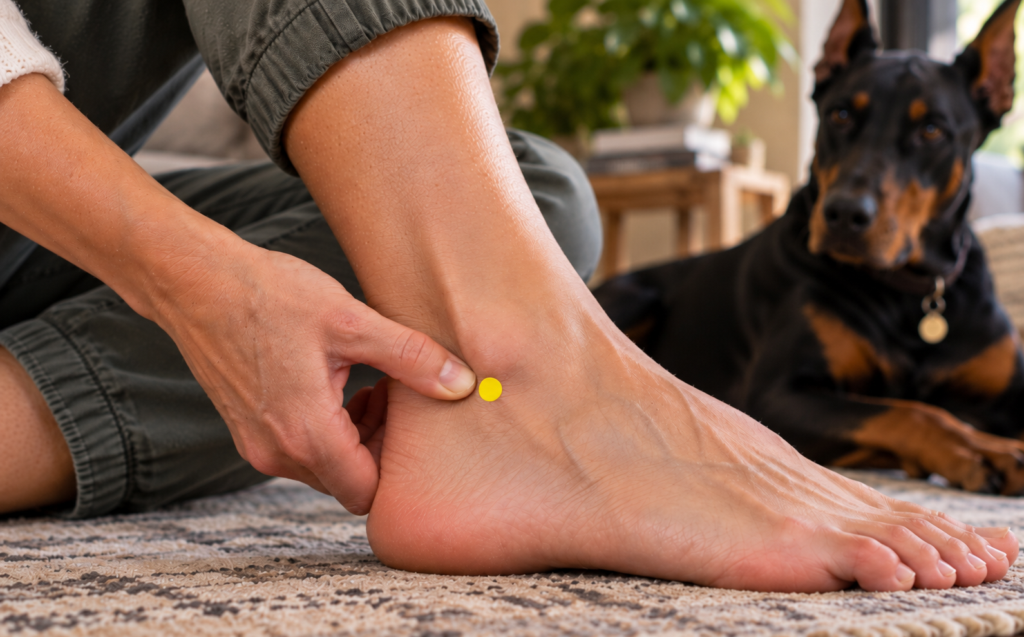
7. Press on KI6 below the inner ankle to help the body settle into sleep. KI6 sits in the small hollow about one thumb-width below the tip of the inner ankle bone. Press gently with your thumb for one to two minutes on each foot. KI6 is called “Zhaohai,” the “Shining Sea.”
KI6 opens the Yin Heel Vessel (which, in Traditional Chinese Medicine, is associated with closing the eyes and the ability to fall asleep) and nourishes the Kidney Yin. It’s therefore useful for insomnia with night sweats, dry mouth, and/or waking up hot and restless.
8. Press on BL62 below the outer ankle to calm an overactive mind. BL62 sits in the small hollow directly below the tip of the outer ankle bone. Press gently with your thumb for one to two minutes on each foot, or hold KI6 and BL62 at the same time with the thumb and index finger on either side of the ankle. BL62 is called “Shenmai,” the “Extending Vessel.”
BL62 opens the Yang Heel Vessel (in Traditional Chinese Medicine, associated with wakefulness and the opening of the eyes). When this vessel is overactive, the eyes remain open and the mind remains alert. KI6 and BL62 are a classic pair for insomnia and are used together to restore balance between the waking and sleeping states.
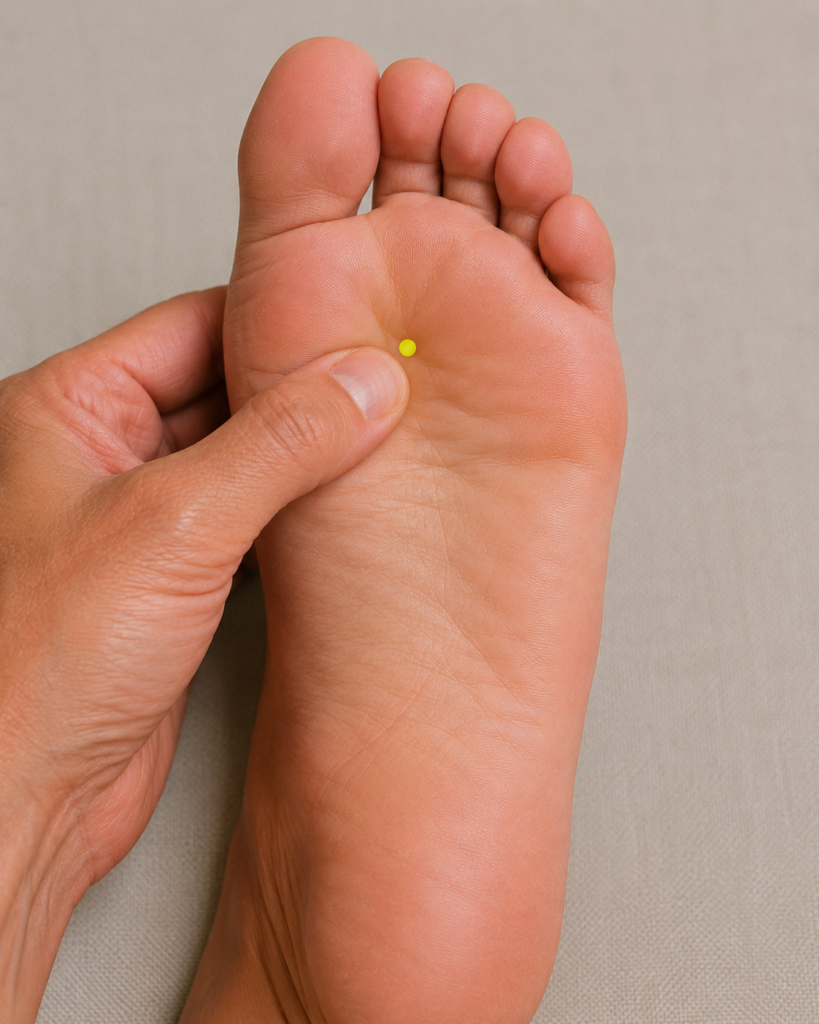
9. Press on KI1 on the sole of the foot to draw energy downward. KI1 sits on the sole of the foot, in the hollow that appears about one-third of the way from the base of the second toe to the back of the heel when the toes are curled. Press firmly with your thumb for one to two minutes on each foot. KI1 is called “Yongquan,” the “Bubbling Spring.”
KI1 is the lowest point on the body and the first point of the Kidney channel. In Traditional Chinese Medicine, it’s traditionally used to draw energy down from a busy head and ground the body, which is especially helpful when the mind is racing and the body feels wired yet tired at night.
Why These Acupressure Points Work

In Traditional Chinese Medicine, sleep is a matter of a calm mind (which is able to settle in the Heart), sufficient Yin and Blood to anchor it, and a healthy ebb and flow between the Yang of the day and the Yin of the night. Stress, worry, overwork, and aging all disturb all three of these, which is why insomnia so frequently follows a period of intense activity and why it can be so persistent once it’s started.
The nine points work together to calm the mind and promote restful sleep:
- The calming points (HT7, PC6, Yintang) settle the Heart, ease anxiety, and quiet a racing mind.
- The head points (GV20, Anmian) relax the head and help the body fall into deeper sleep.
- The balancing points (KI6, BL62) restore the natural rhythm between waking and sleep.
- The nourishing and grounding points (SP6, KI1) nourish the Yin and Blood and draw energy downward.
How to Properly Use These Acupressure Points

Acupressure for insomnia is most effective when practiced as a calm, consistent routine during the latter part of the evening.
- Work through all nine points 30 to 60 minutes before bed in a quiet, dim room. Hold each point for one to two minutes while breathing slowly.
- If you wake up during the night, press HT7, Yintang, and KI1 while still lying in bed. Avoid turning on the lights or checking your phone.
- Apply gentle pressure to the head, face, and ankles, and firmer pressure to the forearms, legs, and soles of the feet.
- Practice nightly for at least two to four weeks, as sleep patterns take time to change.
Daily habits can make a big difference to insomnia. Wake up at the same time every day, including weekends, and get some morning light. Keep your bedroom cool, dark, and quiet, and use your bed only for sleep. Avoid caffeine after midday, avoid alcohol and nicotine in the evening, skip long daytime naps, and put away all screens at least an hour before bed. If you’re still awake after about 20 minutes, get up and do something quiet in dim light; return to bed when you feel sleepy. Traditional Chinese Medicine also recommends finishing dinner fairly early and soaking your feet in warm water before bed to draw the energy down and relax the body.
Learn more about home remedies for insomnia.
When to Get Professional Help

If you have insomnia three or more nights a week for over three months, if it began after you started a new medication, or if excessive daytime sleepiness is affecting your work, mood, or ability to drive, see a provider. CBT-I (cognitive behavioral therapy for insomnia) is the recommended first-line treatment for chronic insomnia. Get assessed if you snore loudly, gasp, or pause in breathing during sleep (which could be a sign of sleep apnea), or if you feel an urge to move your legs at night (which could be a sign of restless legs syndrome). If insomnia occurs alongside persistent low mood, anxiety, or thoughts of self-harm, see a mental health professional, or call or text 988 to access the Suicide and Crisis Lifeline. Don’t stop any prescribed sleep medication without first discussing it with your provider.
Acupressure is a natural and supportive practice for insomnia and can be used in addition to, rather than as a replacement for, diagnosis and medical care.
For related health concerns, acupressure for trouble falling asleep, acupressure for trouble staying asleep, and acupressure for nightmares are companion posts. If you tend to wake in the early hours, learn how to fall back asleep when you wake up at 3 a.m.
Above and Beyond Acupuncture offers acupuncture, cupping, and lifestyle coaching at the North Frank Lloyd Wright Boulevard location in Scottsdale.
Schedule an appointment online to start your healing journey.
The points above are only as effective as the technique used to apply them. Where to press, how firmly, and for how long all affect the result. For a full breakdown of how to perform acupressure properly at home, read Performing Acupressure in 3 Easy Steps.

About the Publisher
Paul Kerzner, L.Ac., is a licensed acupuncturist and board-certified herbalist, as well as the founder of Above and Beyond Acupuncture in Scottsdale. His own journey from chronic patient to practicing acupuncturist shapes his commitment to providing honest, clinically grounded information about acupuncture and Traditional Chinese Medicine. Learn more about Paul and his clinical approach on the About Us page.