Key Takeaways
- Emotional dysregulation is difficulty controlling emotional responses: feelings can rise quickly, feel intense, and take a long time to settle.
- It is linked to ADHD, autism, PTSD, borderline personality disorder, depression, anxiety, and early trauma or chronic invalidation. Therapies such as DBT and CBT teach skills that help.
- In Traditional Chinese Medicine, emotional dysregulation reflects a mind unanchored in the Heart, Liver Qi that surges rather than flows smoothly, and insufficient cooling Yin to keep emotional heat in check.
- Nine acupressure points on the head, chest, wrists, hands, legs, and feet help reduce emotional intensity, anchor the mind, smooth the flow of Liver Qi, and ground the body.
- Acupressure for emotional dysregulation works best alongside therapy and healthy routines, and thoughts of self-harm require immediate help by calling or texting 988.

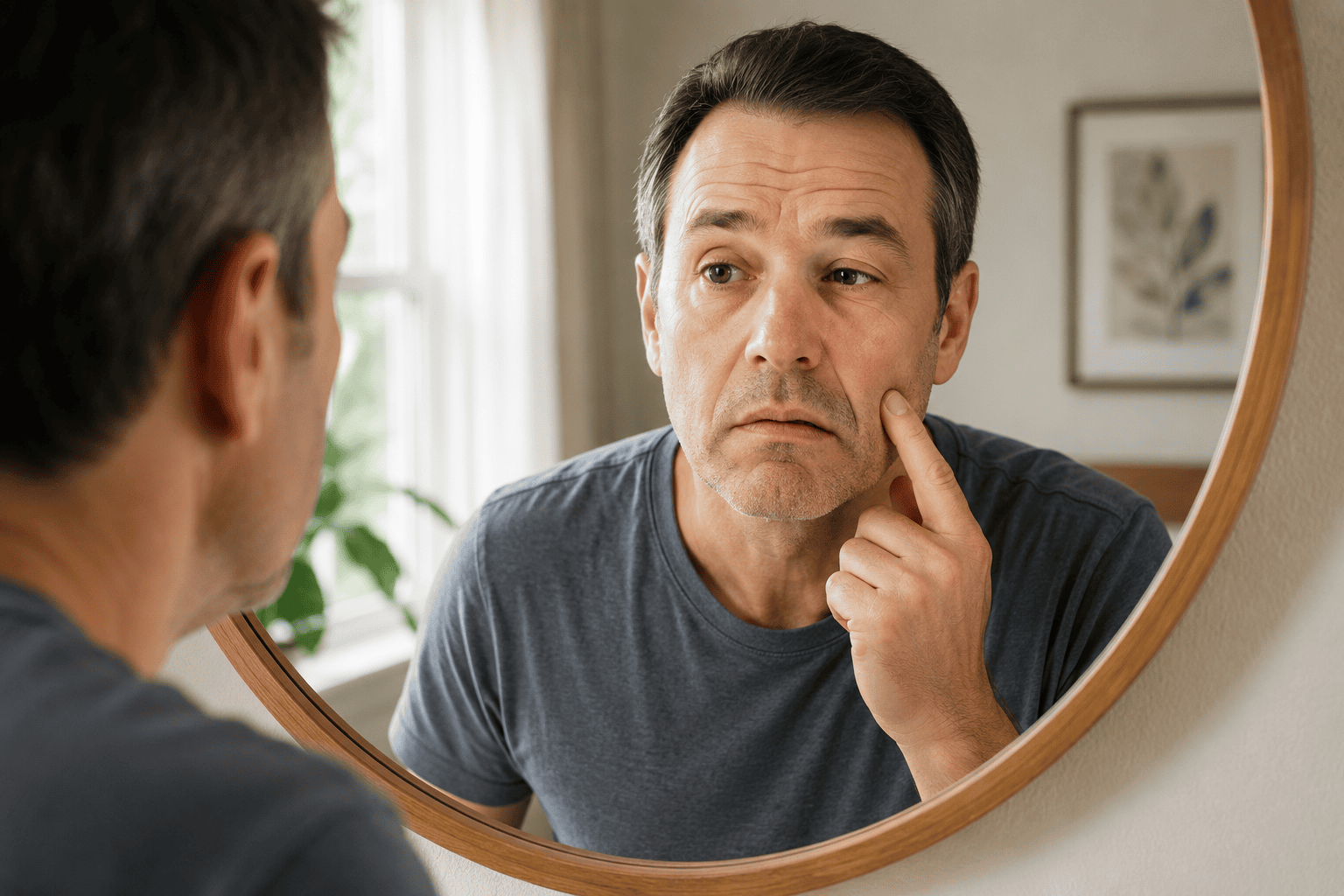
Most people’s emotions build and then settle, like a dimmer switch. Frustration may build and level off, while intense feelings of hurt may gradually fade. For people with emotional dysregulation, however, emotions can feel more like an on/off switch. A small thing, such as a comment, a change of plan, or a slightly tense tone, can trigger a full-on wave of anger, panic, or sadness. It can feel absolutely overwhelming. Once it’s over, you may be left feeling exhausted and deeply embarrassed, with relationships potentially damaged and significant anxiety about it happening again.
According to WebMD, emotional dysregulation makes it difficult to control emotional responses, and feelings can overwhelm both the mind and body. It is linked to conditions such as ADHD, autism, PTSD, borderline personality disorder, depression, anxiety, and OCD. Early childhood trauma, neglect, brain injury, and chronic invalidation, when feelings are often dismissed or judged, can also play a role. Therapies such as dialectical behavior therapy (DBT) and cognitive behavioral therapy (CBT) teach skills like mindfulness and distress tolerance. Some people also benefit from medication. Eating nutritious meals and exercising regularly can help, too. Coping strategies include accepting feelings, labeling them accurately, practicing self-compassion, and seeking support.
When emotions run high, the body often reacts first. Your heart pounds, your face may flush, your chest can feel tight, and it can feel like your thinking shuts down. Calming your body first by breathing slowly, pausing, or using a physical anchor, such as pressing on an acupressure point, can help you pause before you react.
Traditional Chinese Medicine explains this pattern through the Heart, the Liver, and the balance of Yin and Yang. The Heart is said to house the mind; when unsettled, emotions can shift quickly and the mind may feel restless. The Liver helps Qi and emotions flow smoothly, but when stress or old hurts block its Qi, pressure can build and rise as anger or tears. Yin is the body’s cooling, steadying side. When stress, poor sleep, or overwork depletes Yin, emotional heat can flare more easily and take longer to settle.
The nine points below reduce emotional intensity, anchor the mind in the Heart, smooth the flow of Liver Qi, and ground the body so feelings can rise and pass without taking over.
What Acupressure Points to Press and Why
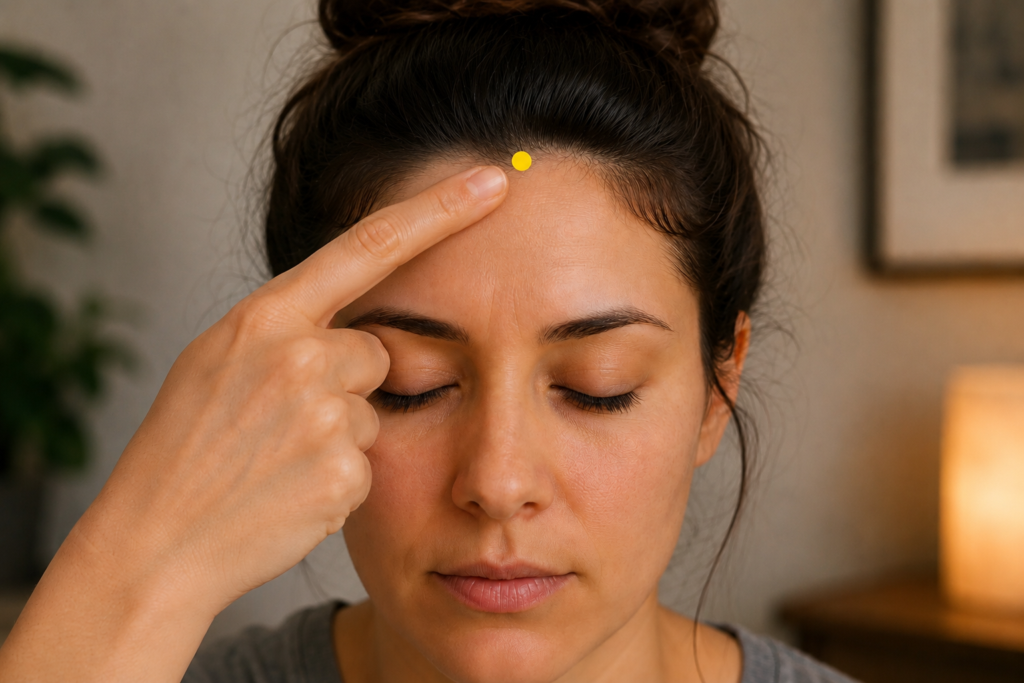
1. Press on GV24 at the front hairline to anchor the mind. GV24 sits on the midline of the head, about half a thumb-width behind the front hairline. Press gently with your fingertip, or make slow, small circles, for one to two minutes while breathing slowly. GV24 is called “Shenting,” the “Spirit Court.”
GV24 is traditionally used to calm the mind when emotions run high or thoughts feel scattered. Its name, the Spirit Court, refers to where the mind resides, and it’s also a classic point for emotional instability, anxiety, and a mind that won’t settle.
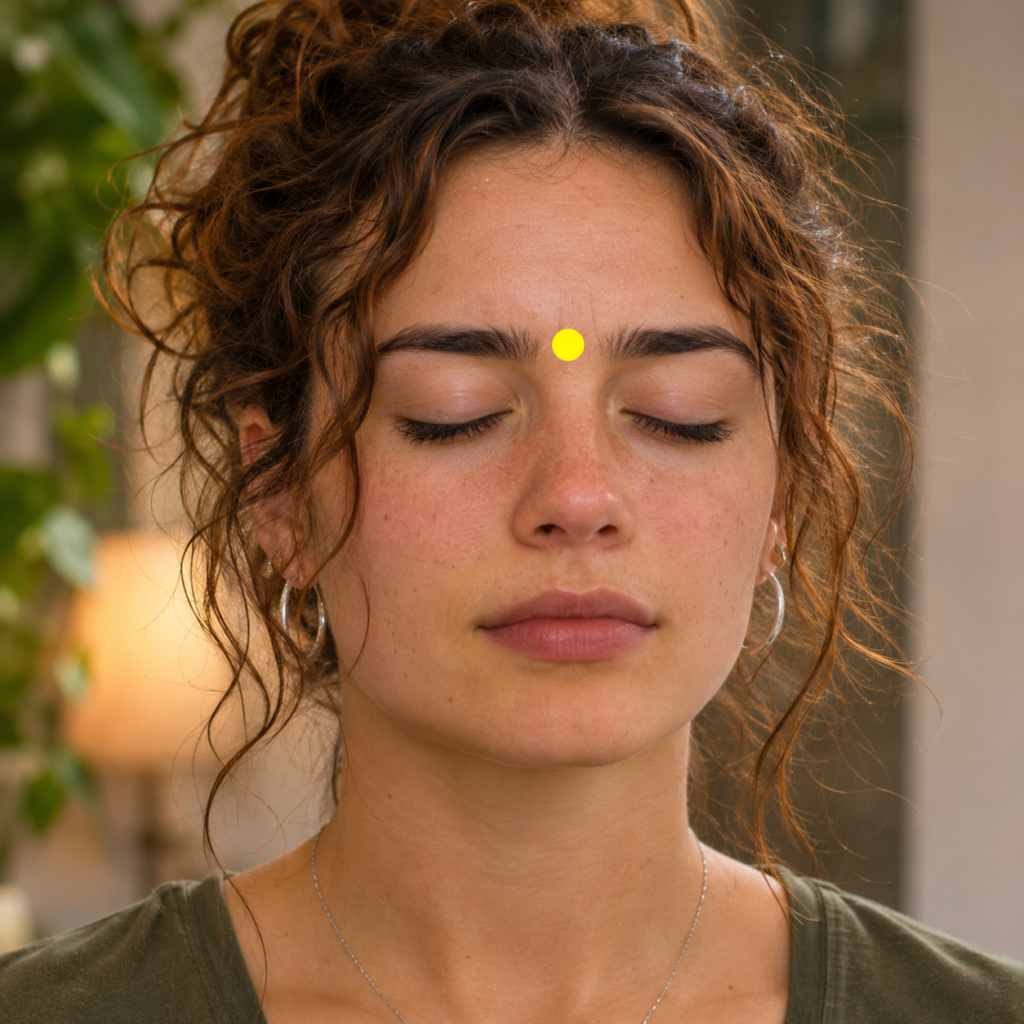
2. Press on Yintang between the eyebrows to pause before reacting. Yintang sits on the midline of the forehead, directly between the inner ends of the eyebrows. Press gently with your fingertip, or make slow, small circles, for one to two minutes with the eyes closed. Yintang is called the “Hall of Impression.”
Yintang is an extra point traditionally used to calm the mind and ease anxiety. It’s a point you press with your eyes closed to create a natural pause, a moment of stillness for the body to settle before you respond to a surge of emotion that may have just come through.
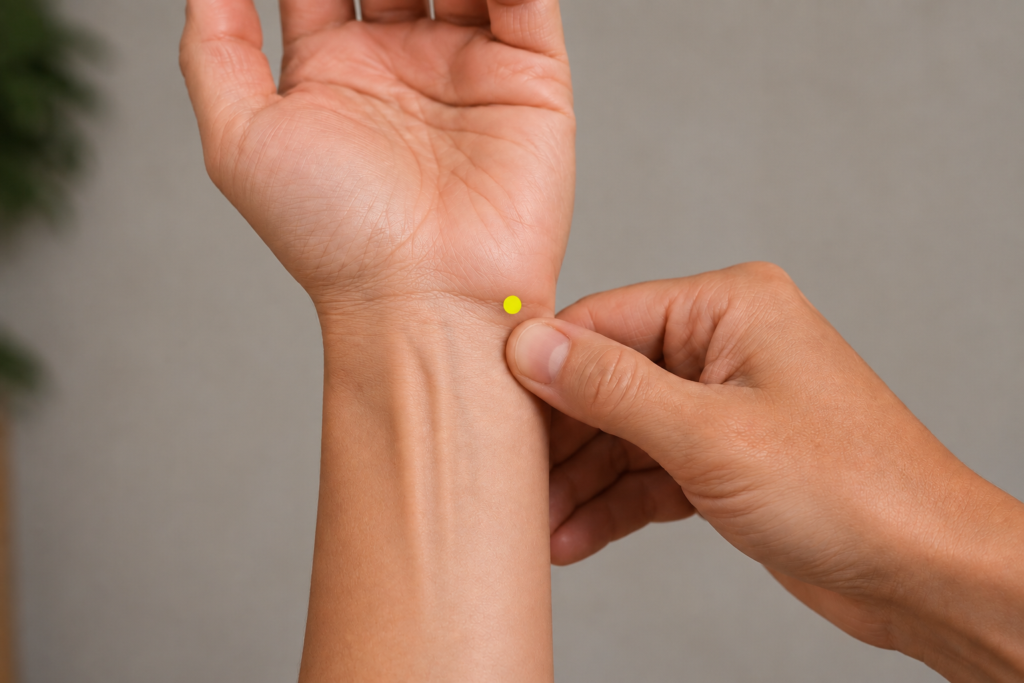
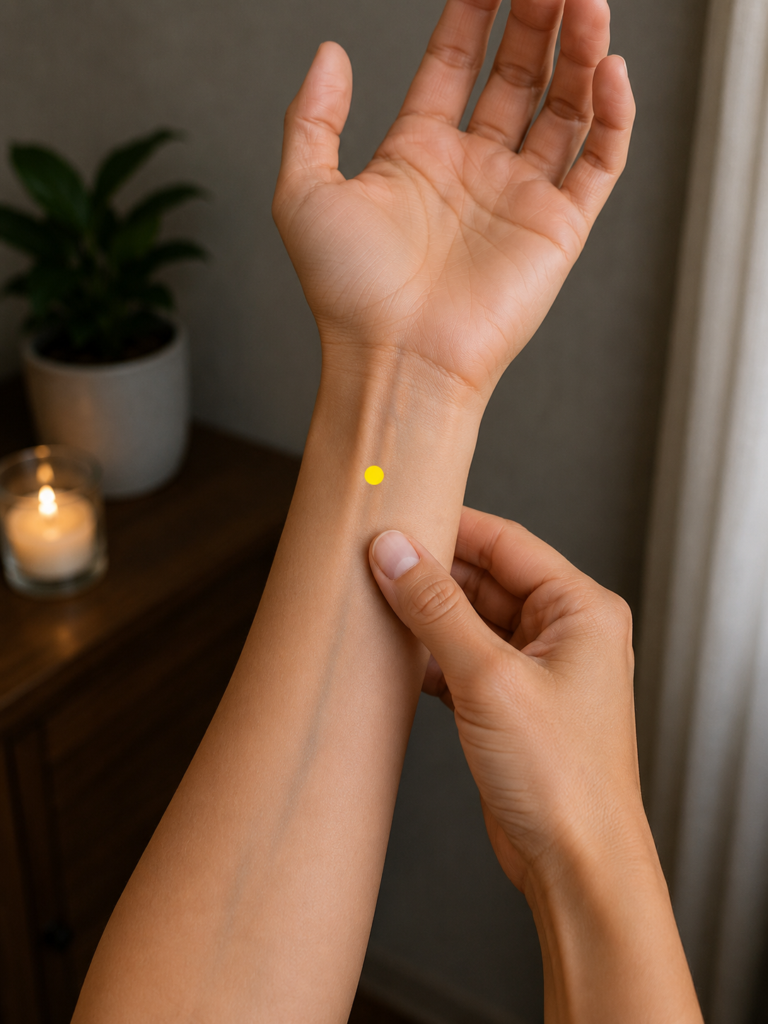
3. Press on HT7 on the wrist crease to steady the Heart. HT7 sits on the inner wrist crease, on the pinky side, in the small hollow just to the thumb side of the tendon that runs along the edge of the wrist. Press gently with the thumb of your other hand for one to two minutes on each wrist. HT7 is called “Shenmen,” the “Spirit Gate.”
HT7 is the source point of the Heart, which houses the mind in Traditional Chinese Medicine. It’s one of the most important points for emotional upset, anxiety, and a racing heart, helping the mind return to a steadier baseline after a strong reaction.
4. Press on PC6 on the inner forearm to settle a surge of emotion. PC6 sits on the inner forearm, three finger-widths above the wrist crease, between the two tendons. Press firmly with the thumb of your other hand for one to two minutes on each arm while breathing out slowly. PC6 is called “Neiguan,” the “Inner Pass.”
PC6 is one of the most commonly used points in Traditional Chinese Medicine for calming the mind and opening the chest. The Pericardium protects the Heart, and PC6 can help ease the pounding heart, tight chest, and churning stomach that may come with a wave of intense feeling.
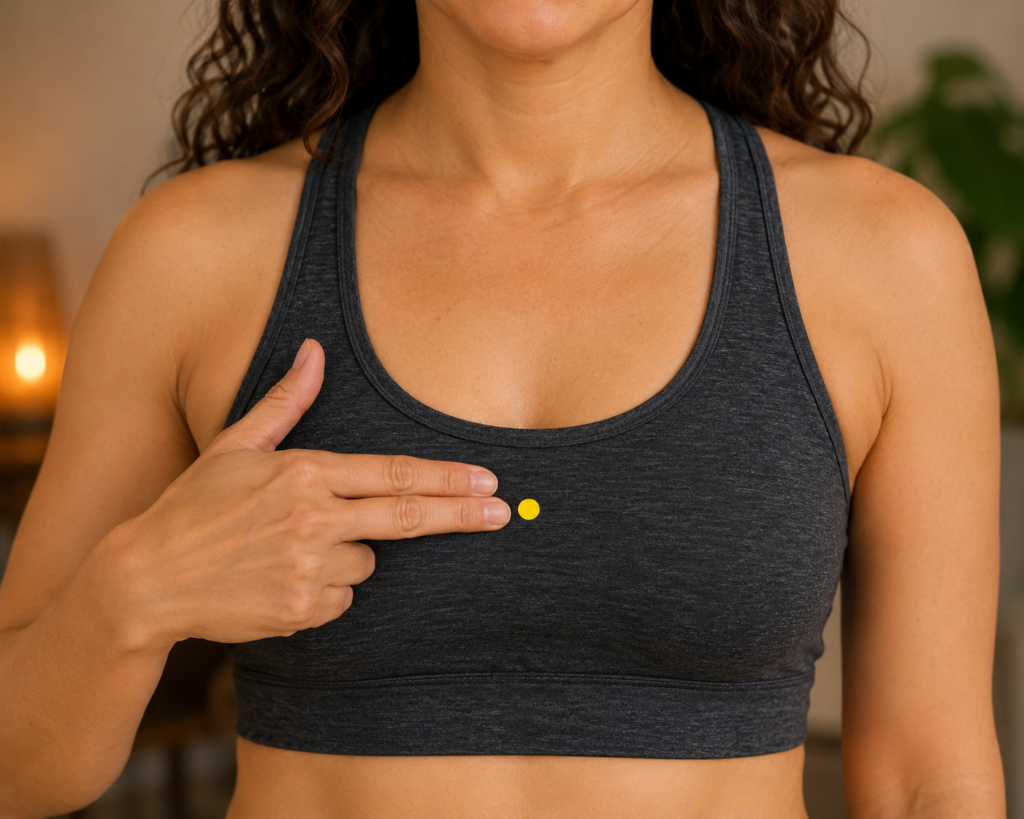
5. Press on CV17 on the center of the chest to release a tight chest. CV17 sits on the breastbone, on the midline of the chest, about midway between the nipples. Press gently with your fingertips, or rest the palm flat over the area, for one to two minutes while breathing slowly into the belly. CV17 is called “Danzhong,” the “Chest Center.”
CV17 is where the Qi of the chest gathers. Strong emotions often settle in the chest as tightness, heaviness, or a lump that won’t shift. CV17 helps release that pressure, allowing the breath to deepen again.
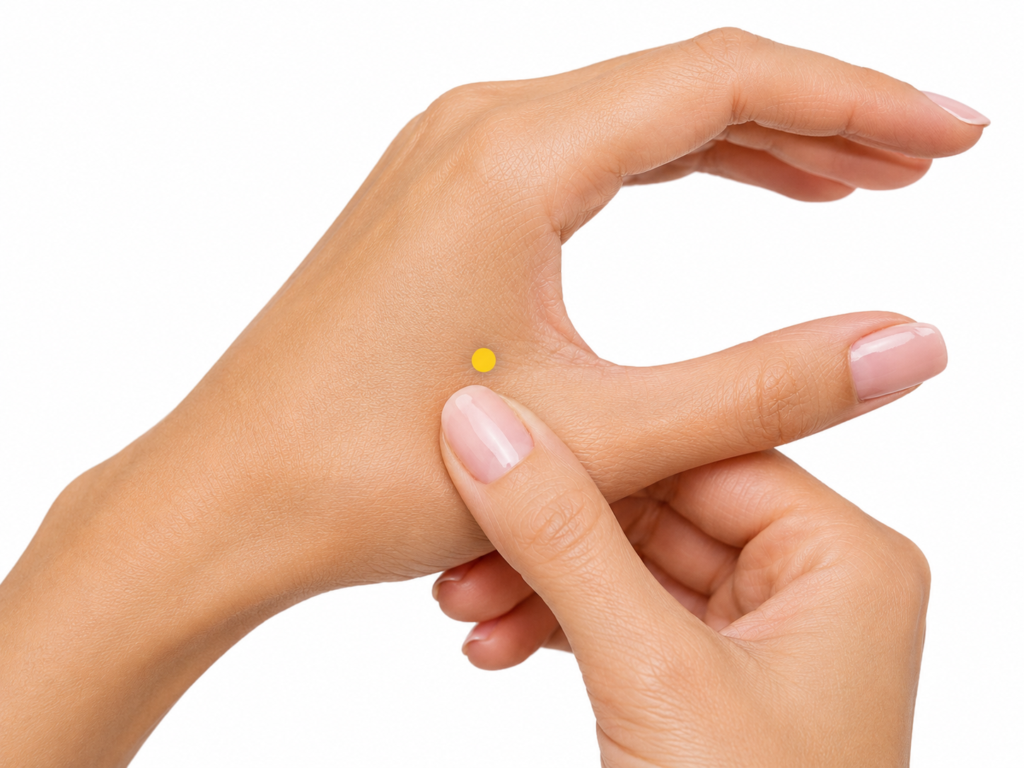
6. Press on LI4 on the back of the hand to release tension. LI4 sits in the webbing between the thumb and index finger, at the highest point of the muscle when the two are pressed together. Press firmly with the thumb of your other hand for one to two minutes on each hand. LI4 is called “Hegu,” the “Joining Valley.” LI4 is avoided during pregnancy.
LI4 is one of the most important points in Traditional Chinese Medicine for releasing tension throughout the body. Together with LR3, it forms the Four Gates, a classic pairing used to move stagnant Qi and calm the whole system. It also gives clenched hands a constructive place to direct pressure.
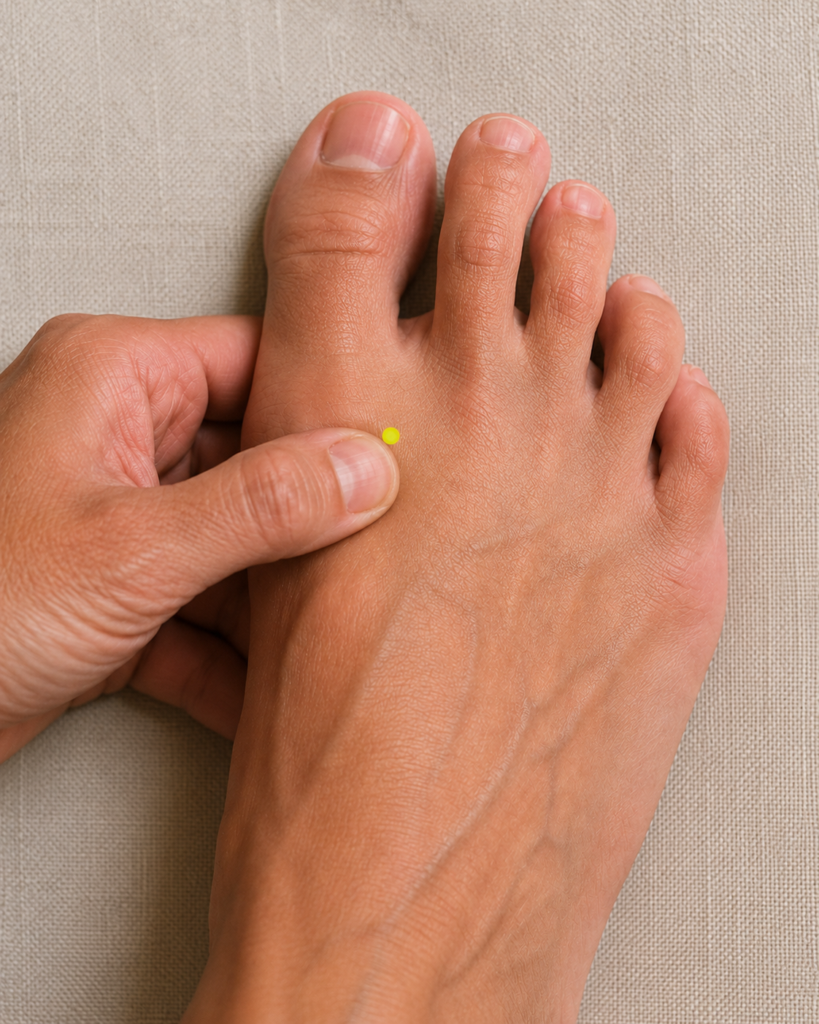
7. Press on LR3 on the top of the foot to smooth surging emotions. LR3 sits on the top of the foot, in the hollow where the bones of the big toe and second toe meet, about two finger-widths above the web between the toes. Press firmly with your thumb for one to two minutes on each foot. LR3 is called “Taichong,” the “Great Surge.”
LR3 is the source point of the Liver, which is responsible for the smooth flow of Qi and emotions. When pressure builds and bursts out as anger, frustration, or tears, LR3 helps release the constraint and guide the rising energy back down.
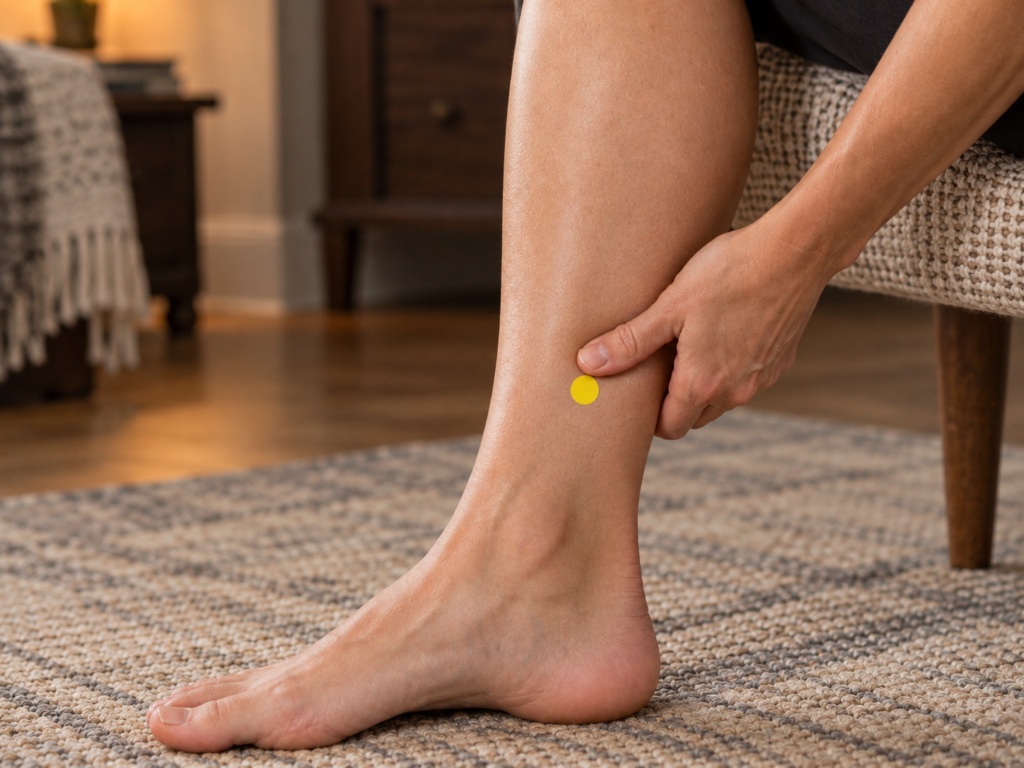
8. Press on SP6 on the inner lower leg to cool and steady. SP6 sits on the inner lower leg, four finger-widths above the tip of the inner ankle bone, just behind the edge of the shinbone. Press firmly with your thumb for one to two minutes on each leg. SP6 is called “Sanyinjiao,” the “Three Yin Intersection.” SP6 is avoided during pregnancy.
SP6 is where the Spleen, Liver, and Kidney channels meet. It nourishes Yin and Blood, the body’s cooling and calming aspects, helping prevent emotional heat from flaring up so quickly and allowing feelings to settle sooner.
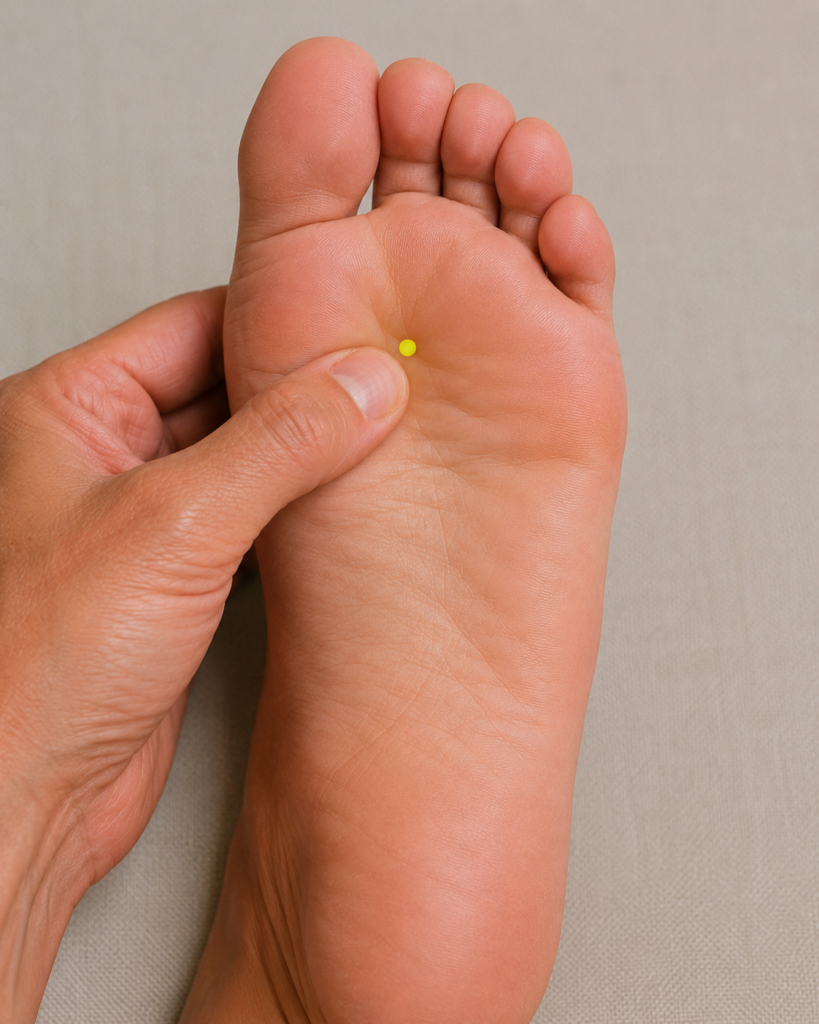
9. Press on KI1 on the sole of the foot to ground the body. KI1 sits on the sole of the foot, in the depression about one-third of the way from the base of the second toe to the back of the heel, where a small hollow forms when the toes curl. Press firmly with your thumb for one to two minutes on each foot, or press the soles firmly into the floor while seated. KI1 is called “Yongquan,” the “Bubbling Spring.”
KI1 is the body’s lowest point and the first point on the Kidney channel. It’s traditionally used to draw energy down from the head and chest, helping when emotions feel heightened and the body needs grounding.
Why These Acupressure Points Work
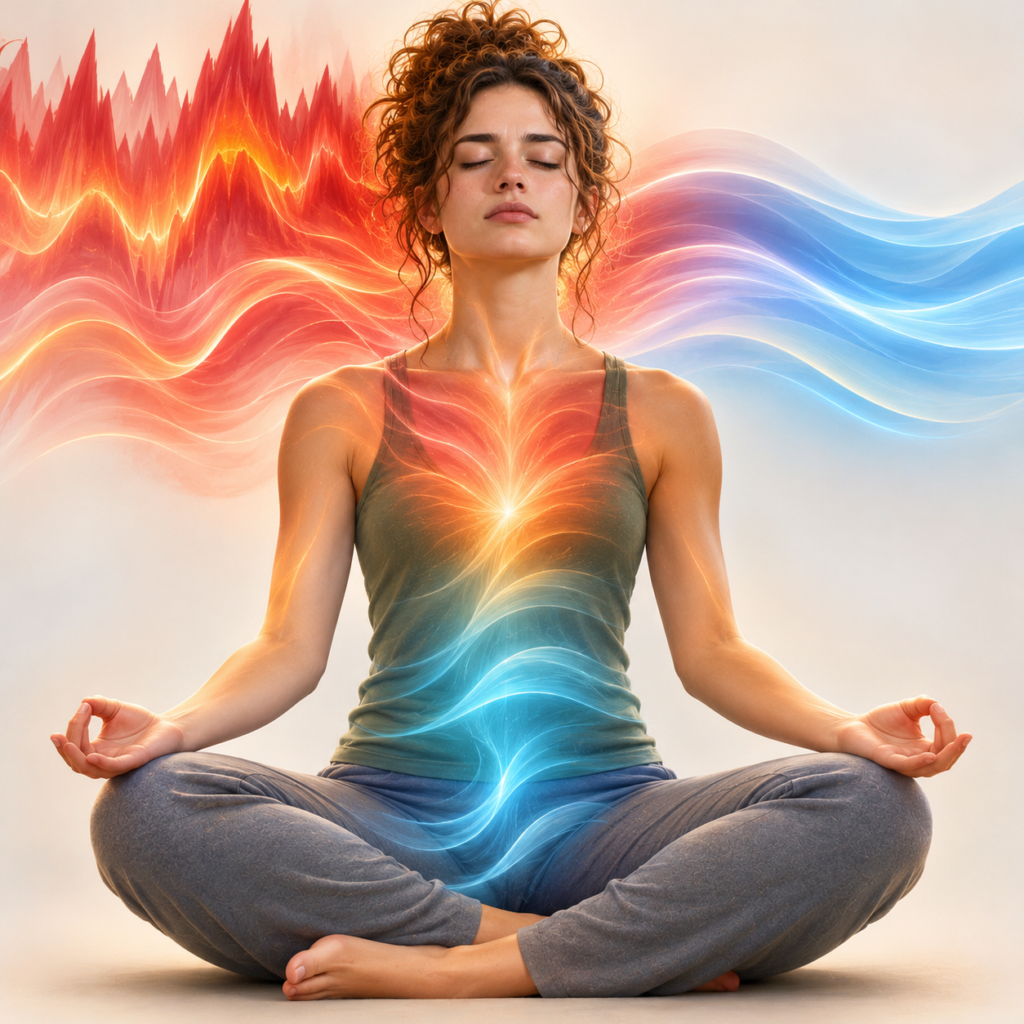
In Traditional Chinese Medicine, emotional dysregulation reflects a mind that is not settled in the Heart, Liver Qi that surges rather than flows, and insufficient cooling Yin to temper emotional heat. The approach is to calm the mind, release the chest, smooth Liver Qi, nourish Yin, and draw energy downward so the body can hold strong feelings without being overwhelmed by them.
The nine points work together to reduce emotional intensity and restore balance:
- The mind points (GV24, Yintang, HT7) anchor the mind and create a pause before reacting.
- The chest points (PC6, CV17) ease the pounding heart and tight chest of a surge of emotion.
- The Four Gates (LI4, LR3) release tension and smooth the flow of Liver Qi.
- The grounding points (SP6, KI1) nourish Yin and steady the body.
How to Properly Use These Acupressure Points

Acupressure for emotional dysregulation is most effective both as an in-the-moment tool and as a daily practice to reduce the baseline intensity of emotions.
- When emotions begin to intensify, apply pressure to the PC6 point on one arm while inhaling for a count of four and exhaling for a count of six. Then, with your eyes closed, apply pressure to Yintang before responding.
- Work through all nine points once daily, holding each for one to two minutes. Ideally, complete the routine during a calm period rather than when upset, so that it becomes familiar.
- Apply gentle pressure to the head, forehead, chest, and wrist crease, and firmer pressure to the forearms, hands, legs, and feet.
- Continue this practice daily for at least four to six weeks, as a more stable emotional baseline develops gradually.
Daily habits can help make managing your emotions easier. Try to keep regular sleep and meal times, since hunger or being tired can make you more likely to overreact. Try to move every day, even if it’s only a short walk, to release stress and tension before it builds up. When emotions arise, try naming them, and give yourself permission to step away from a heated situation until you feel calmer. Cutting back on alcohol, caffeine, and late-night screen time may also help, as these can make emotions harder to manage. Practicing mindfulness, presence or slow breathing for a few minutes each day can prepare you to use these skills when needed. Traditional Chinese Medicine suggests eating warm, regular meals and avoiding too much spicy, fried, or greasy food, which may make your system more reactive.
You can also learn more about why a mindfulness practice matters.
When to Get Professional Help

Consider reaching out to a mental health professional if intense emotions are affecting your relationships, work, or school life. It’s also important to seek help if these feelings lead to substance use/abuse, risky behavior, eating disorders, or occur with depression, panic attacks, flashbacks, or feeling constantly on edge. Therapies such as dialectical behavior therapy can be helpful. A doctor can check for conditions like ADHD, depression, or thyroid problems that may make emotions harder to manage. Always talk with your provider before stopping or changing any prescribed medication.
If you ever have thoughts of self-harm or hurting someone else, call or text 988 to reach the Suicide and Crisis Lifeline right away.
Acupressure can be a gentle, supportive tool for emotional ups and downs, but it should be used alongside, not instead of, medical care and diagnosis.
For related emotional concerns, acupressure for anger, acupressure for irritability, and acupressure to calm down are companion posts.
Above and Beyond Acupuncture offers acupuncture, cupping, and lifestyle coaching at the North Frank Lloyd Wright Boulevard location in Scottsdale.
Schedule an appointment online to start your healing journey.
The points above are only as effective as the technique used to apply them. Where to press, how firmly, and for how long all affect the result. For a full breakdown of how to perform acupressure properly at home, read Performing Acupressure in 3 Easy Steps.

About the Publisher
Paul Kerzner, L.Ac., is a licensed acupuncturist and board-certified herbalist, as well as the founder of Above and Beyond Acupuncture in Scottsdale. His own journey from chronic patient to practicing acupuncturist shapes his commitment to providing honest, clinically grounded information about acupuncture and Traditional Chinese Medicine. Learn more about Paul and his clinical approach on the About Us page.