Key Takeaways
- Any baby under three months old with a temperature of 100.4°F or higher should go to the emergency department immediately. Acupressure is never a substitute for medical care.
- Babies between three and six months old with a fever over 101°F should be checked by a doctor. Any child with a fever of 102°F or higher, or one lasting more than two to three days, should be seen the same day.
- A baby who continues to feed, play, and sleep well is less likely to be seriously ill. However, difficulty breathing, a seizure, unresponsiveness, a rash that does not fade when pressed, or signs of dehydration require emergency care.
- In Traditional Chinese Medicine, babies are considered full of Yang energy. When Wind or an external illness enters the body, Heat rises quickly, and fever can climb rapidly.
- After consulting a doctor, nine gentle acupressure points on the face, upper back, arms, hands, and feet may help clear Heat and soothe a baby with a mild fever.

When your baby feels warm against your cheek and the thermometer confirms a fever, even the simplest decisions can feel overwhelming. Should you call the doctor? What should you do? Fever is one of the most common reasons babies are seen by a doctor. Knowing which fevers are emergencies and which are simply uncomfortable but can be managed at home can make a stressful night a little easier.
According to Connecticut Children’s, any baby under three months old with a fever of 100.4°F or higher should go to the emergency department immediately. For babies three to six months old, a fever above 101°F should be evaluated by a doctor to rule out a bacterial infection. A child with a fever of 102°F or higher, a fever lasting more than two to three days, or worsening symptoms should see a pediatrician or go to urgent care that day. Emergency warning signs include trouble breathing, a seizure, extreme sleepiness or unresponsiveness, severe dehydration, a rash that does not fade when pressed, a bulging or sunken soft spot, a stiff neck, and high-pitched crying that cannot be soothed. Connecticut Children’s notes that a child who is drinking, playing, and sleeping well is less likely to have a serious fever.
In general, a fever indicates that the body is responding to an infection, most commonly a viral illness. However, in young infants, the immune system is still developing, and a fever may be the only early indication of a serious bacterial infection. For this reason, guidelines for infants under three months of age are particularly stringent. In many cases, an infant’s appearance and behavior are more significant than the precise temperature.
Traditional Chinese Medicine holds that infants have abundant Yang energy, which supports rapid growth and may cause their body temperature to rise quickly. When Wind, Cold, or Heat enters the body, the protective Qi attempts to repel it, and in infants, this often results in Heat. A fever accompanied by chills, clear mucus, and an absence of sweating is referred to as Wind-Cold. A fever accompanied by a flushed face, sore throat, thirst, and restlessness is referred to as Wind-Heat. Gentle acupressure at points intended to dispel Wind, clear Heat, and calm the mind may help ease an infant’s discomfort during a fever while the body recovers.
The following points are intended solely to comfort your baby after you have consulted a doctor. Do not use them for a baby under three months of age who has a fever. The points begin on the face and upper back, continue to the arms and hands, and conclude on the feet. Always measure distances using your baby’s own finger-widths, not an adult’s.
What Acupressure Points to Press and Why
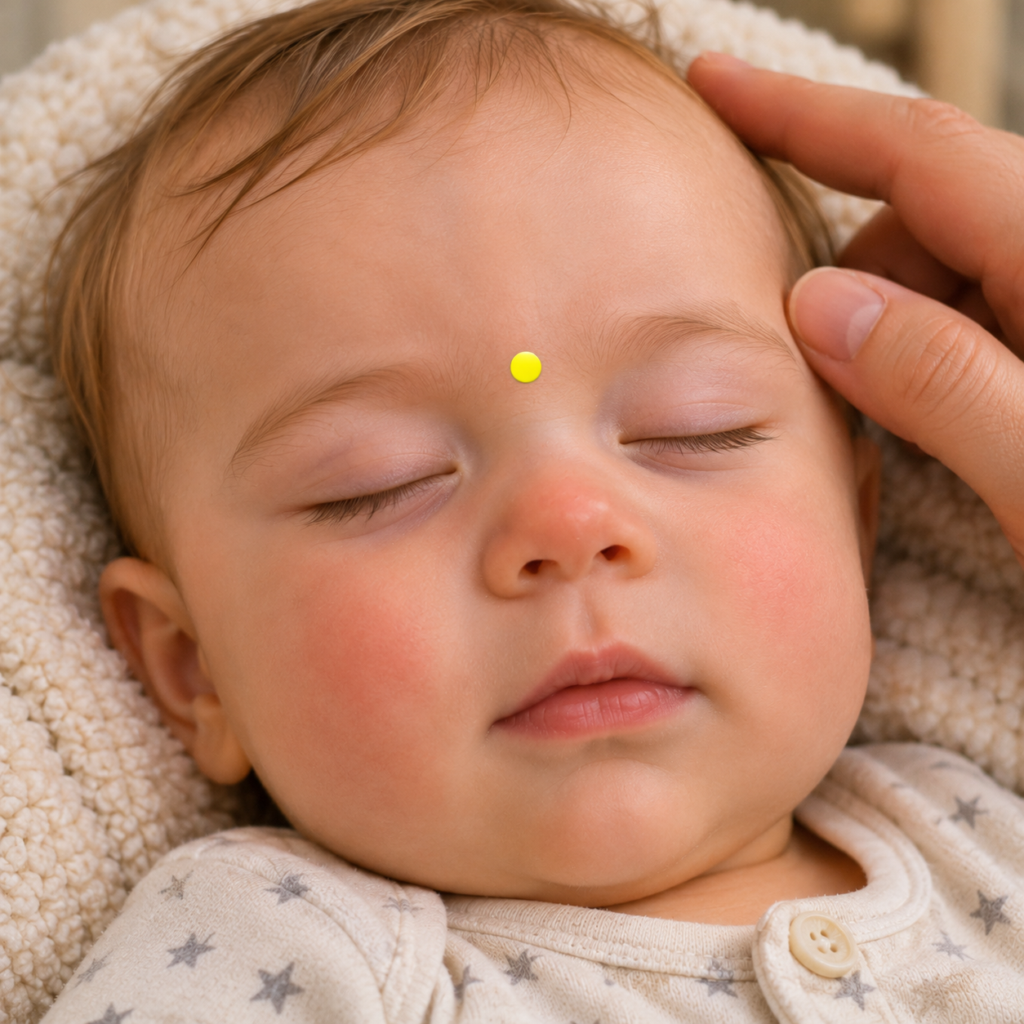
1. Stroke Yintang between the eyebrows to calm a feverish baby. Yintang sits at the midpoint between the baby’s eyebrows. With the pad of your thumb, stroke gently upward from Yintang toward the hairline, alternating thumbs, for 30 seconds to one minute. Yintang means the “Hall of Impression.”
Yintang is an extra point traditionally used to calm the mind and ease restlessness. Gentle, slow strokes upward may help a hot, fussy baby feel more settled.
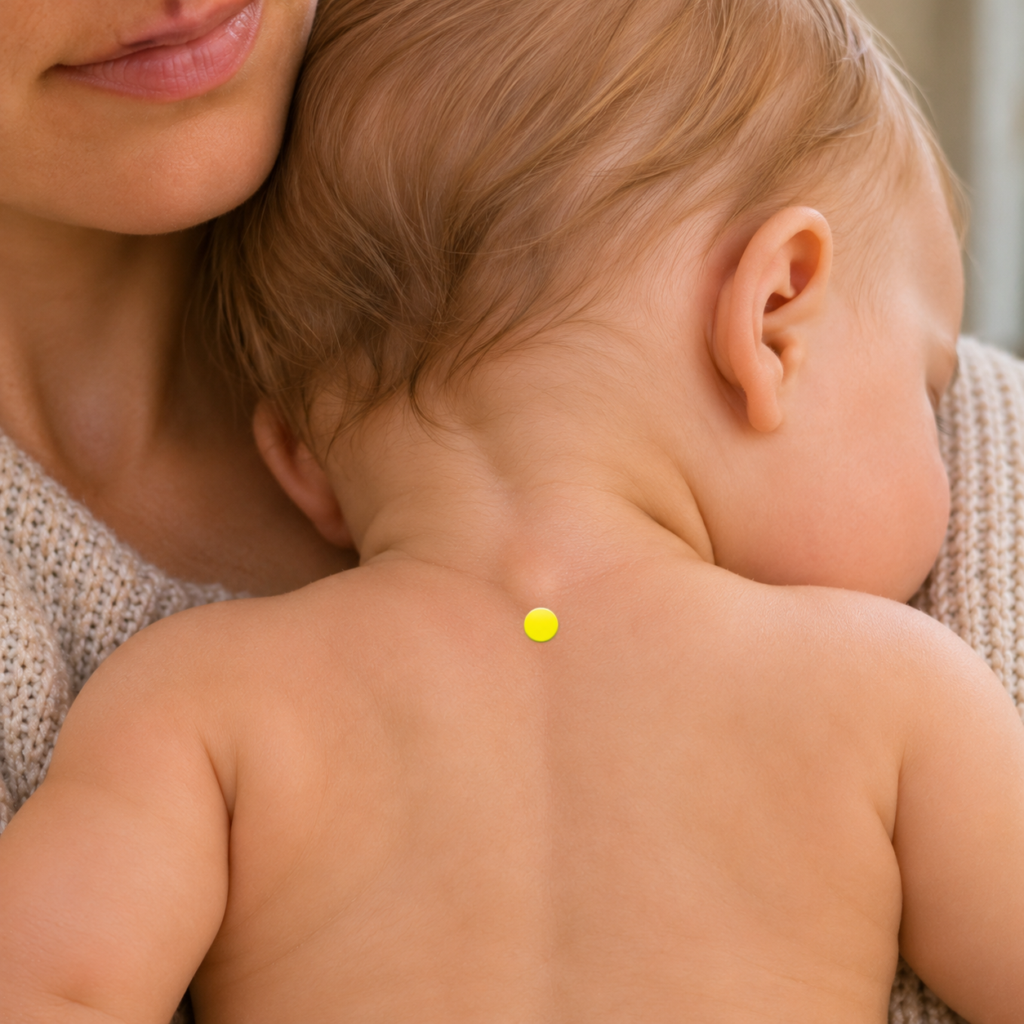
2. Rub GV14 at the base of the neck to clear Heat. GV14 sits on the midline of the upper back, just below the large bump at the base of the neck that stands out when the head bends forward. With the baby held upright against your shoulder, make slow, light circles with one fingertip for 30 seconds. GV14 is called “Dazhui,” the “Great Vertebra.”
GV14 is the meeting point of the Governing Vessel and all the Yang channels, and it is one of the most important points in Traditional Chinese Medicine for clearing Heat and fever.
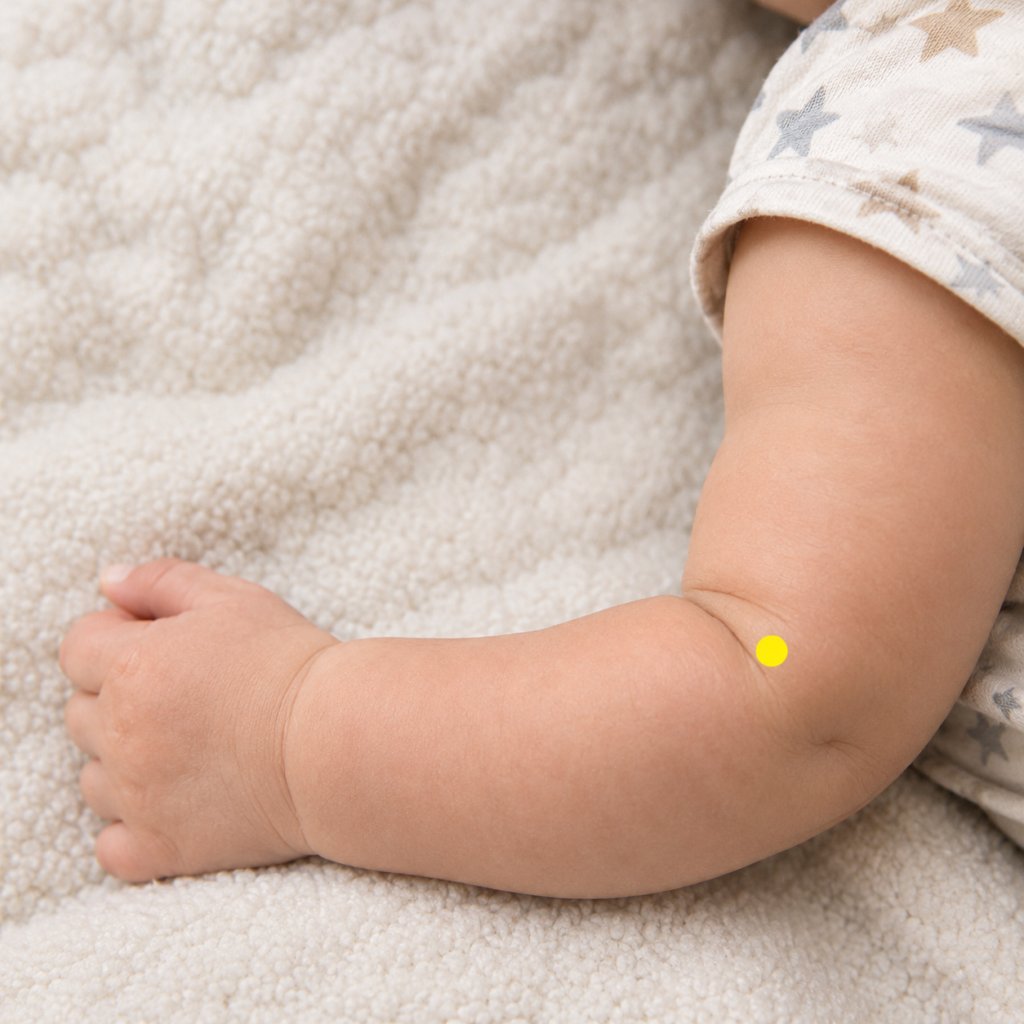
3. Press LI11 at the elbow crease to cool the body. LI11 sits at the outer end of the elbow crease when the baby’s elbow is gently bent, on the thumb side of the arm. Make tiny, light circles with your fingertip for 30 seconds on each arm. LI11 is called “Quchi,” the “Pool at the Bend.”
LI11 is the sea point of the Large Intestine. It is traditionally used to clear Heat from the whole body and pairs well with GV14 for fever.
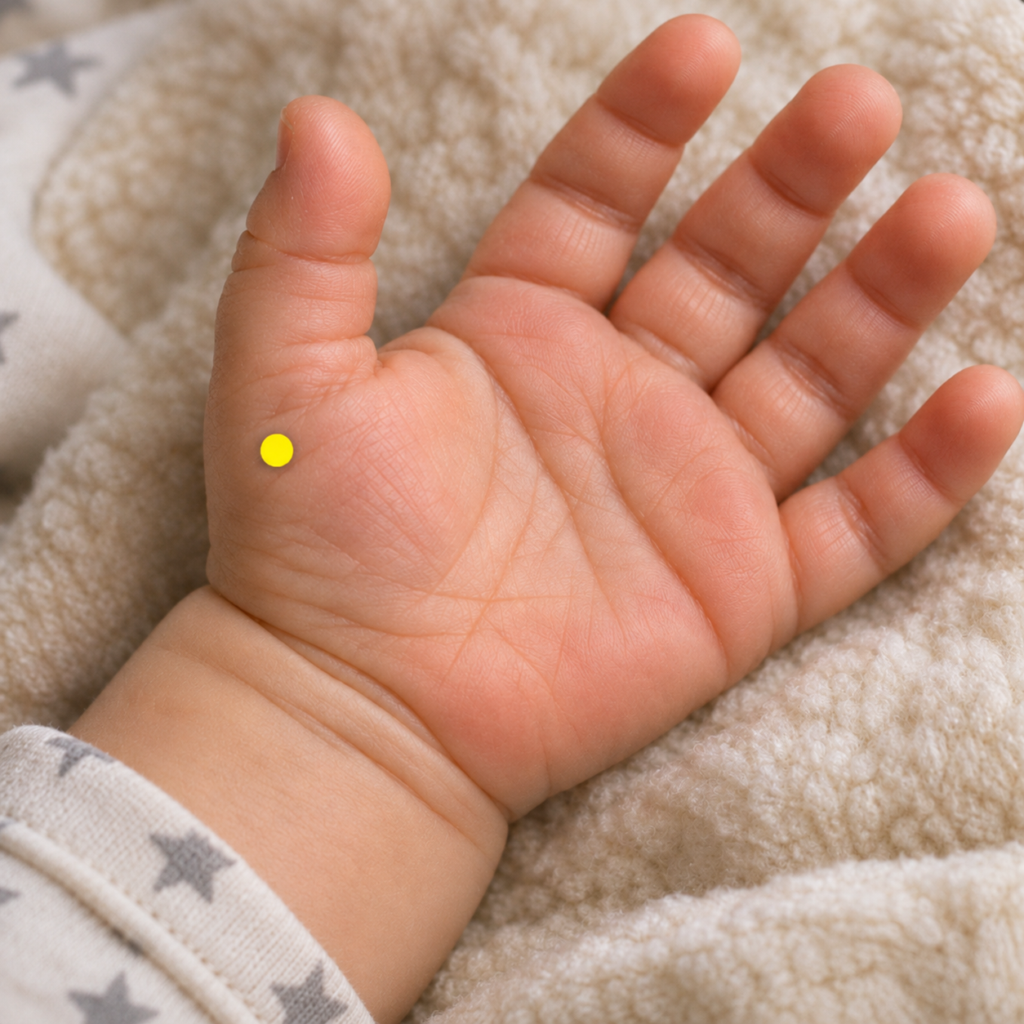
4. Press LU10 on the palm to clear Heat from the Lung. LU10 sits on the palm side of the hand, at the middle of the thumb bone, where the fleshy pad at the base of the thumb meets the smooth skin of the palm. Make tiny, light circles with your fingertip for 30 seconds on each hand. LU10 is called “Yuji,” the “Fish Border.”
LU10 is the spring point of the Lung. It clears Heat from the Lung and is traditionally used for fever with a sore throat and cough.
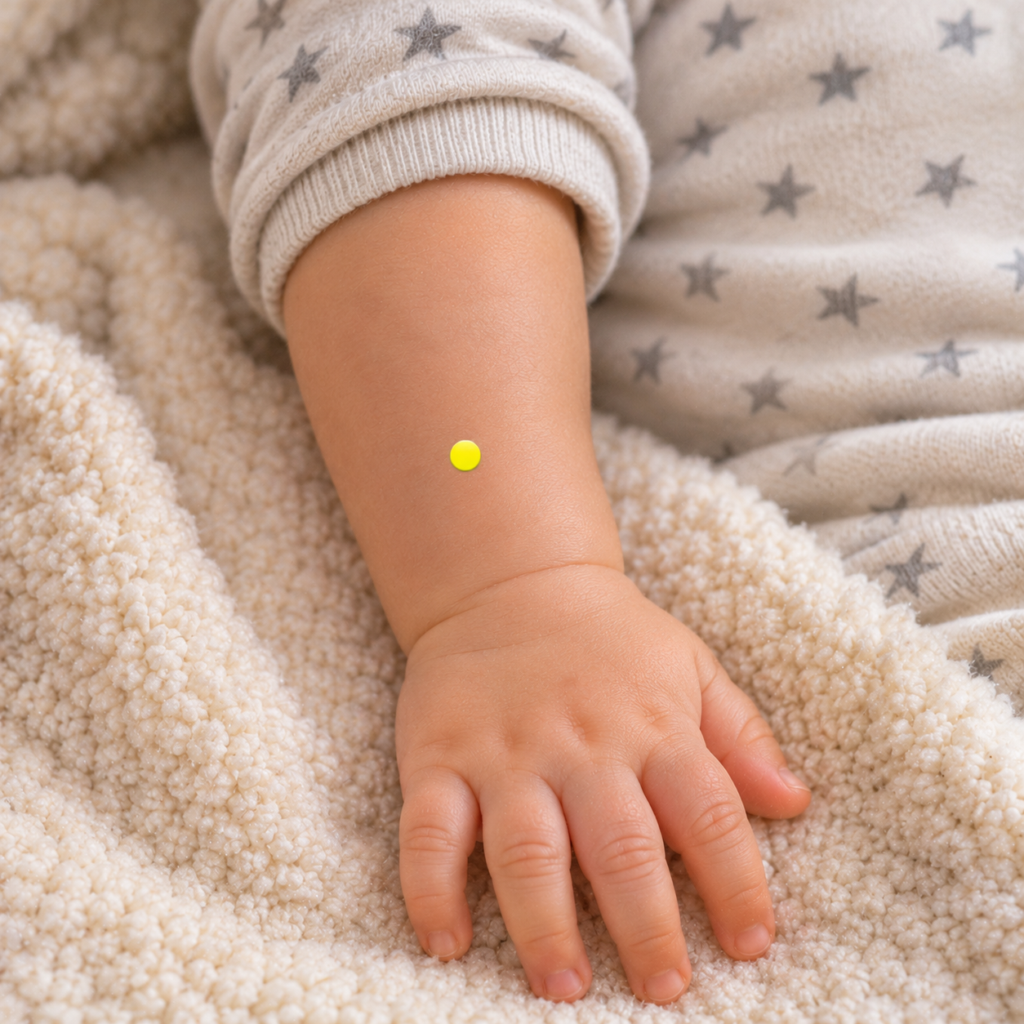
5. Press TE5 on the back of the forearm to release Wind. TE5 sits on the back of the forearm, about two of the baby’s finger-widths above the wrist crease, in the middle between the two bones of the forearm. Make tiny, light circles with your fingertip for 30 seconds on each arm. TE5 is called “Waiguan,” the “Outer Gate.”
TE5 is the connecting point of the Triple Burner. It releases Wind and Heat from the surface and is traditionally used for fever at the start of a cold.
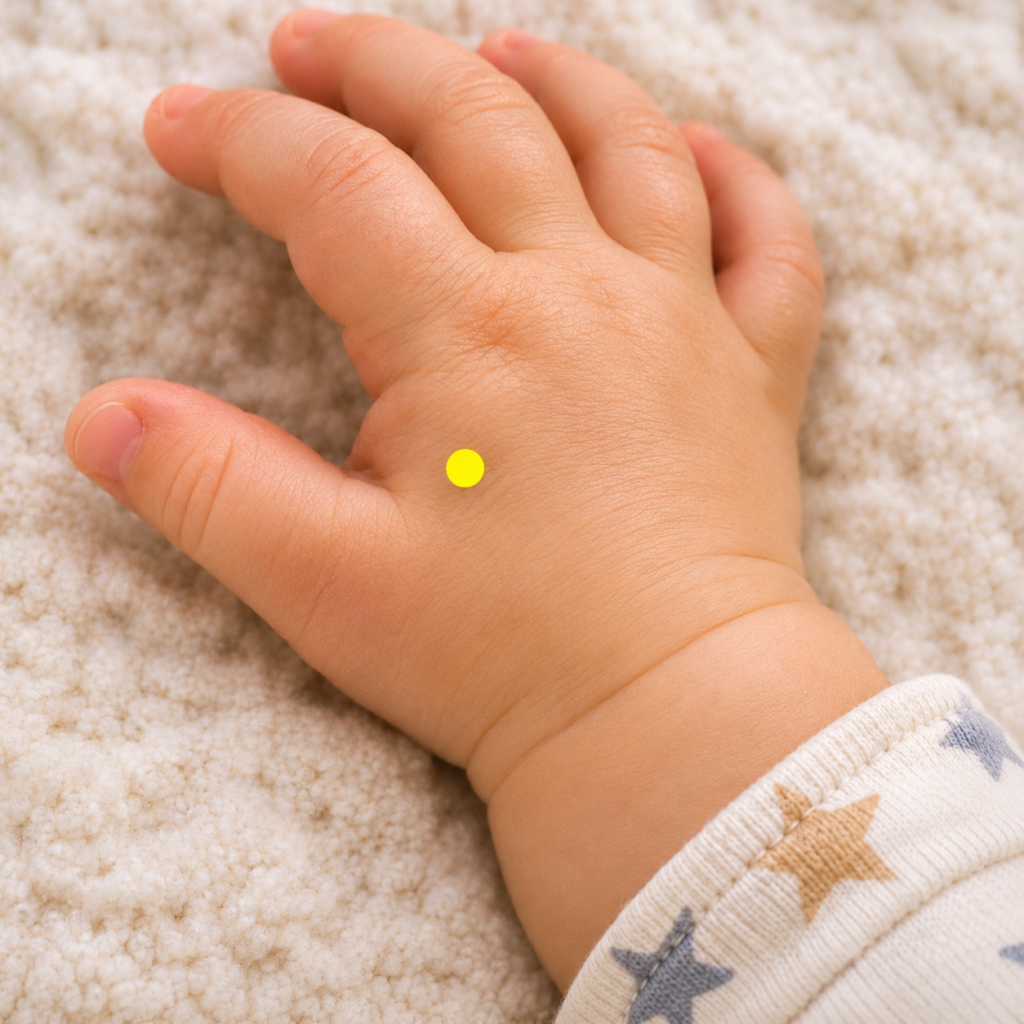
6. Press LI4 on the back of the hand to release the surface. LI4 sits on the back of the hand, in the fleshy web between the thumb and index finger. Hold the baby’s hand and make tiny, light circles on the point for 30 seconds on each hand. LI4 is called “Hegu,” the “Joining Valley.”
LI4 is the source point of the Large Intestine. It releases Wind, clears Heat, and is traditionally used for fever, sore throat, and a stuffy nose.
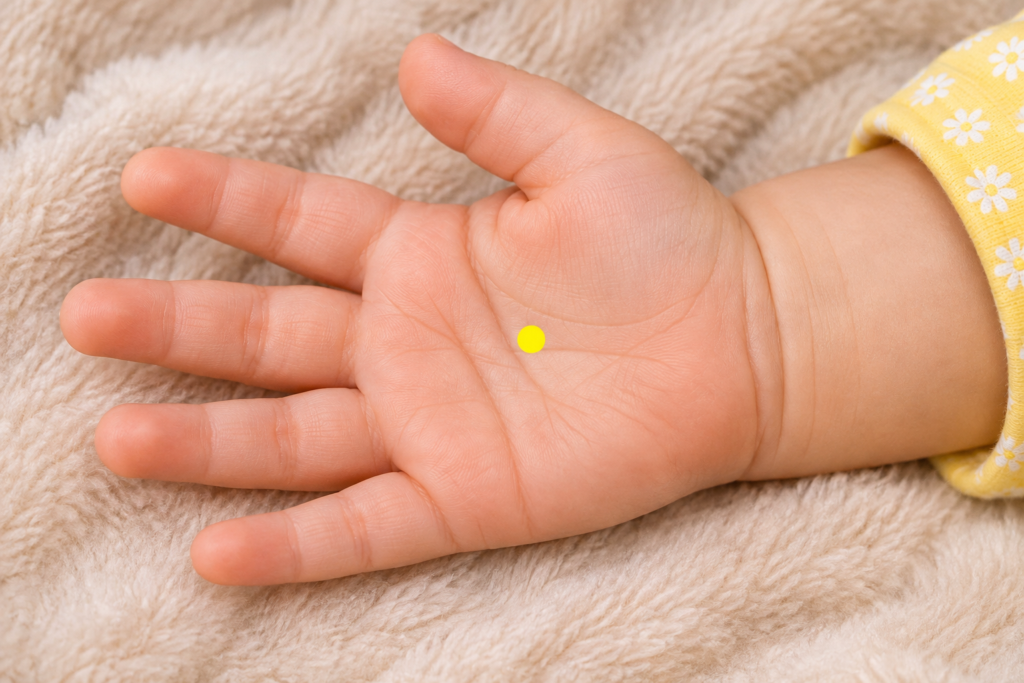
7. Circle PC8 in the center of the palm to cool the Heart. PC8 sits in the center of the palm, where the tip of the middle finger touches when the baby’s hand closes into a loose fist. Make slow, light circles with your fingertip for 30 seconds on each palm. PC8 is called “Laogong,” the “Palace of Toil.”
PC8 is the spring point of the Pericardium. It clears Heat from the Heart and helps when a fever leaves a baby flushed, restless, and unable to settle.
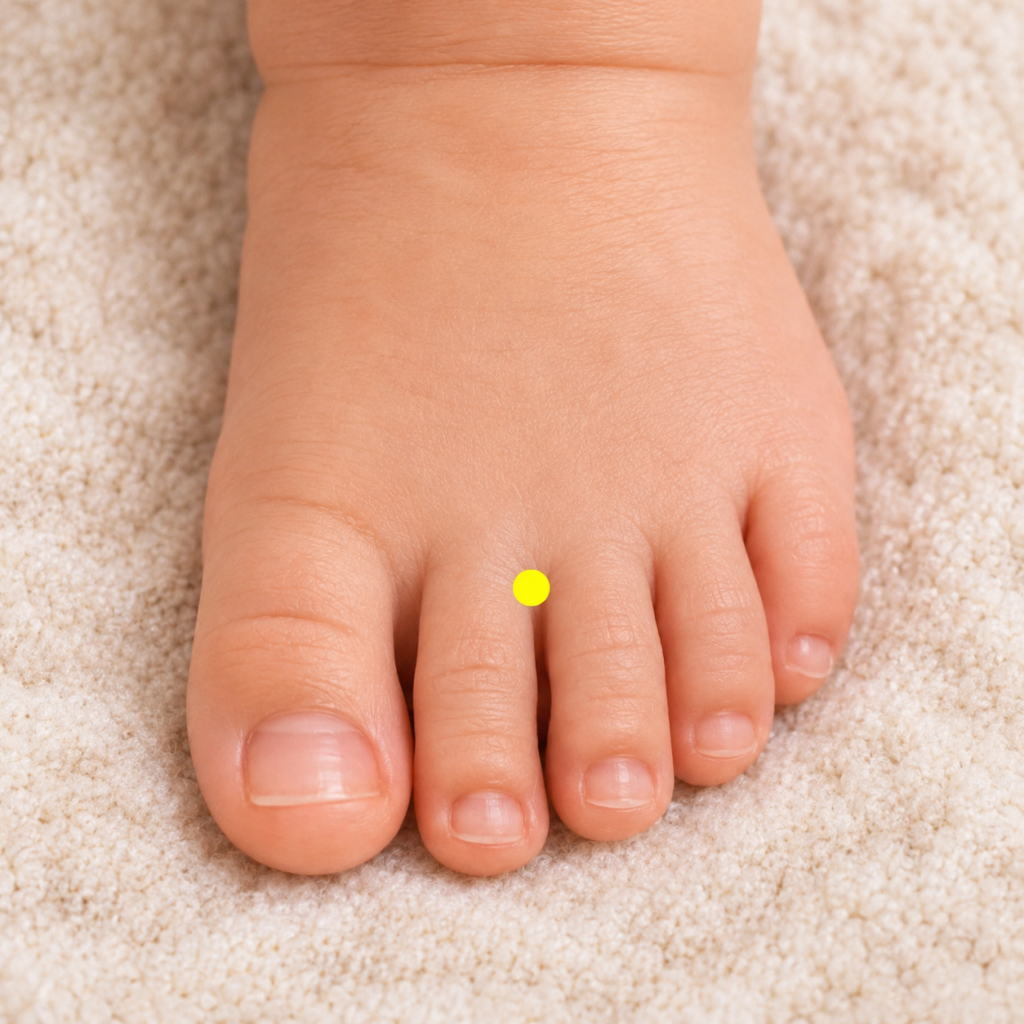
8. Press ST44 on the top of the foot to clear Heat. ST44 sits on the top of the foot, at the edge of the web between the second and third toes. Make tiny, light circles with your fingertip for 30 seconds on each foot. ST44 is called “Neiting,” the “Inner Courtyard.”
ST44 is the spring point of the Stomach. It clears Heat and draws it downward, away from the head and face.
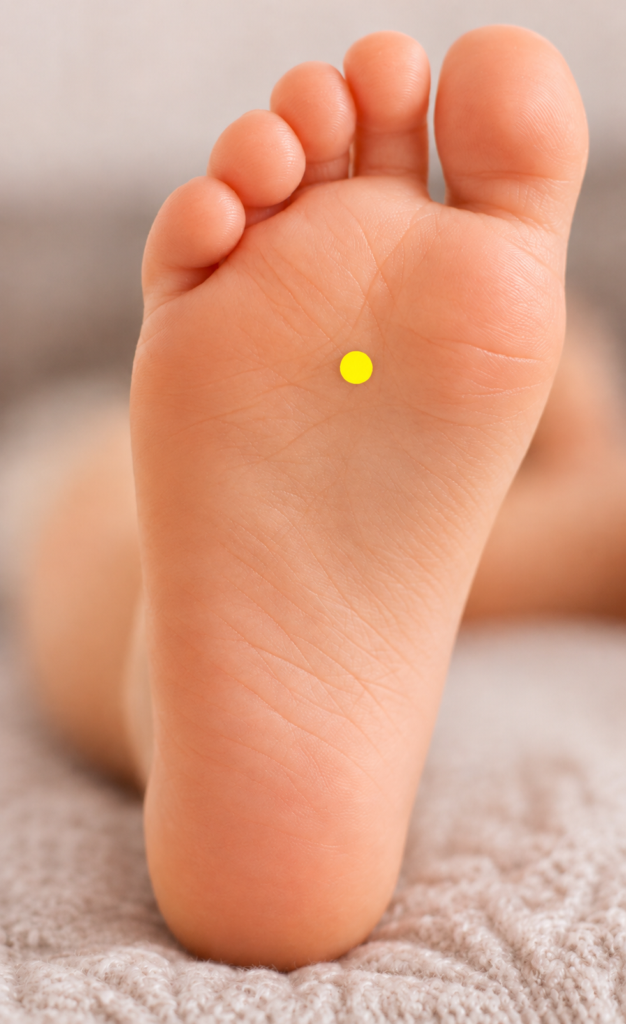
9. Rub KI1 on the sole of the foot to draw Heat down. KI1 sits on the sole of the foot, in the small hollow near the front of the foot, about one-third of the way from the base of the toes to the back of the heel. Rub gently with your thumb in small circles for 30 seconds on each foot. KI1 is called “Yongquan,” the “Bubbling Spring.”
KI1 is the lowest point on the body and the well point of the Kidney. Gently rubbing the soles draws Heat downward and is a soothing way to finish.
Why These Acupressure Points Work
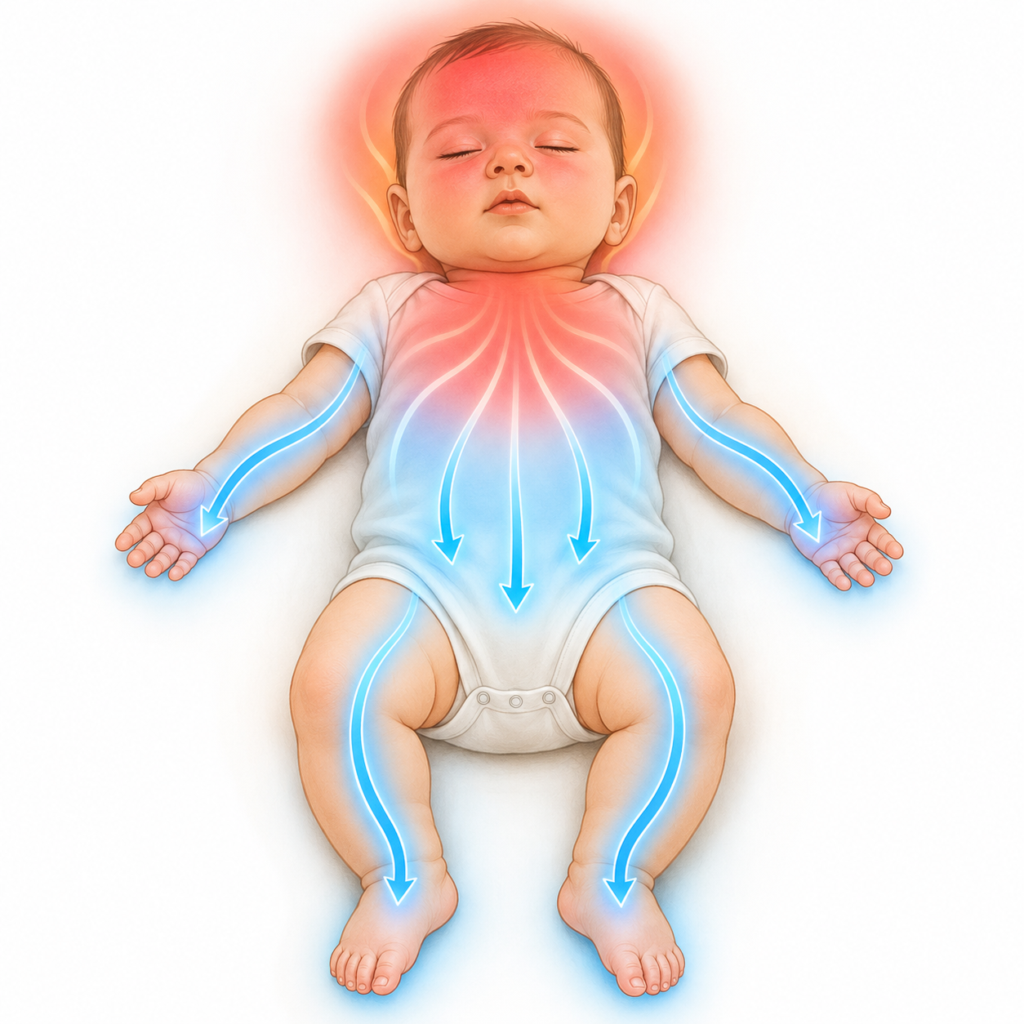
From a Traditional Chinese Medicine perspective, a baby’s fever occurs when Wind, Cold, or Heat enters the body and stirs the baby’s abundant Yang energy. Points on the upper back, arm, and thumb clear Heat; points on the hand and forearm release Wind from the body’s surface; and points on the face, palm, and foot calm the mind and draw Heat downward.
The nine points work together to provide comfort to an infant with a fever:
- GV14, LI11, and LU10 clear Heat from the body.
- TE5 and LI4 release Wind and Heat from the surface.
- PC8 and Yintang cool the Heart and calm the mind.
- ST44 and KI1 draw Heat downward.
How to Properly Use These Acupressure Points

Acupressure may provide comfort for a baby over three months old with a mild fever, but only after you’ve called or seen the pediatrician. It should never replace medical care.
- While holding the baby upright against your shoulder, begin by applying gentle circular motions to GV14 at the base of the neck.
- With the baby lying on their back or reclined in your arms, gently stroke upward from Yintang, then make small circular motions on LI11, TE5, and LI4 on both arms.
- Make small circular motions on LU10 at the base of each thumb, followed by gentle circular motions on PC8 in each palm.
- Conclude by applying small circular motions to ST44, followed by a gentle rub of KI1 on both soles.
- Use only light, slow fingertip pressure, much lighter than you would use on an adult. Stop if the baby fusses or seems uncomfortable. Avoid the soft spots on the top of the head, and do not use these points on broken, irritated, or rashy skin. Stop and seek care right away if the baby seems to be getting sicker.
Comfort measures may be used alongside acupressure. Connecticut Children’s recommends dressing your baby in lightweight clothing, maintaining a comfortable room temperature, and offering plenty of breast milk or formula to help prevent dehydration. Watch for signs of dehydration, including a dry mouth, cracked lips, fewer than six wet diapers in 24 hours, no tears when crying, or a sunken soft spot. Always consult your pediatrician before giving your baby fever-reducing medication, and follow the dosage appropriate for your baby’s weight and age. Avoid wrapping a feverish baby in heavy blankets, as this may trap heat; a light layer is preferable. Always place babies on their backs to sleep. Traditional Chinese Medicine also recommends ensuring that your baby rests, remains calm, and is kept away from drafts.
You can learn more about whether acupressure is safe for kids.
When to Get Professional Help

Call 911 if a baby has difficulty breathing, the ribs pull inward with each breath, the lips or face turn blue, a seizure occurs, or the baby becomes limp or unresponsive. Seek emergency care immediately for any baby younger than three months with a temperature of 100.4°F or higher, or for a baby of any age who has extreme sleepiness, signs of severe dehydration, a rash that does not fade when pressed or purple spots, a bulging or sunken soft spot, a stiff neck, or an inconsolable, high-pitched cry. Contact the pediatrician if a baby between three and six months old has a fever above 101°F. Arrange same-day medical care for a fever of 102°F or higher, a fever lasting more than two to three days, or worsening symptoms. A fever lasting more than five days requires medical attention. If a febrile seizure occurs, place the baby on their side, remain calm, and seek medical help.
Acupressure is a gentle, supportive practice for baby fever. It complements, and does not replace, diagnosis and medical care.
For related concerns, acupressure for baby cough, acupressure for fever, and acupuncture for kids are companion pieces.
Above and Beyond Acupuncture offers acupuncture, cupping, and lifestyle coaching at the North Frank Lloyd Wright Boulevard location in Scottsdale.
Schedule an appointment online to start your healing journey.
The points above are only as effective as the technique used to apply them. Where to press, how firmly, and for how long all affect the result. For a full breakdown of how to perform acupressure properly at home, read Performing Acupressure in 3 Easy Steps.

About the Publisher
Paul Kerzner, L.Ac., is a licensed acupuncturist and board-certified herbalist, as well as the founder of Above and Beyond Acupuncture in Scottsdale. His own journey from chronic patient to practicing acupuncturist shapes his commitment to providing honest, clinically grounded information about acupuncture and Traditional Chinese Medicine. Learn more about Paul and his clinical approach on the About Us page.