
Key Takeaways
- Headaches can result from stress, sleep issues, or dehydration, and acupressure offers a natural way to alleviate pain.
- Understanding headache types, like tension headaches and migraines, helps identify appropriate acupressure points for relief.
- Traditional Chinese Medicine links headache locations to body imbalances, providing a map for effective acupressure treatments.
- Maintaining regular hydration, eating meals consistently, and managing stress can greatly decrease how often and how severe headaches are.
- Acupressure for headaches focuses on specific points to reduce symptoms, using techniques that promote relaxation and energy flow.

Do you get headaches that start as a dull band around your forehead, throb at your temples, feel like a tight ache at the base of your skull, or feel like pressure on top of your head? These headaches often occur after stressful days, a short night’s sleep, missing a meal, or hours spent in front of a screen. Headaches are among the most common reasons people turn to pain relievers, and most individuals have them at least occasionally.
The good news is that many headaches follow identifiable patterns that can be alleviated. Acupressure provides a simple, drug-free method to ease headaches when they begin, release underlying tension, and decrease their frequency. Traditional Chinese Medicine offers a helpful map: the location of your headache on your head reveals much about its cause and which points will be most effective. The points listed in this article can help relieve your symptoms.
What is a Headache?
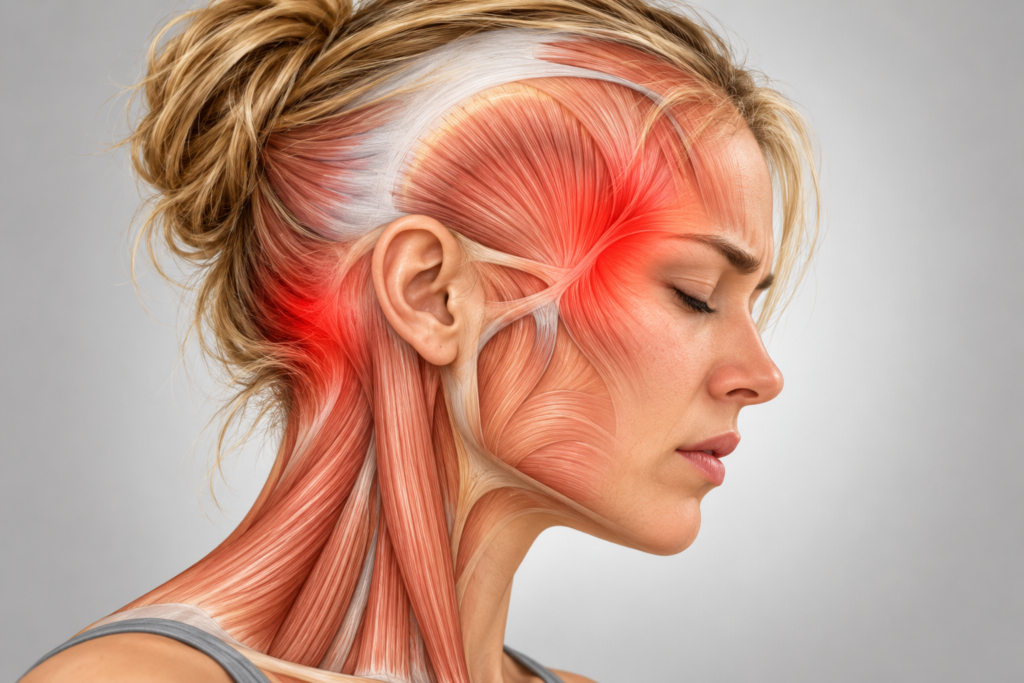
A headache is pain experienced anywhere in the head or upper neck. While the brain itself cannot feel pain, the muscles, blood vessels, nerves, and tissues around the skull, face, and neck can. When these structures become tight, irritated, or sensitized, they cause the typical ache, pressure, or throbbing linked to a headache.
Doctors divide headaches into two main categories.
Primary headaches are conditions in themselves and account for the vast majority of headaches. They comprise:
- Tension-type headaches, which are the most common kind, feel like a dull band or pressure around the forehead, the temples, or the back of the head.
- Migraines cause a moderate or severe throbbing pain, usually on one side of the head, and are often accompanied by nausea, sensitivity to light and sound, and at times by a visual aura.
- Cluster headaches, which cause severe, stabbing pain around one eye, often at the same time each day for weeks
Secondary headaches are caused by something else, such as:
- Sinus congestion or infection
- Neck problems, which cause pain that starts at the base of the skull
- Jaw clenching or TMJ problems
- Eye strain
- Dehydration, hunger, or caffeine withdrawal
- Overuse of pain medication, which can cause rebound headaches
- Less commonly, serious conditions such as high blood pressure crises, infections, or bleeding in the brain
Common headache symptoms include:
- A dull, tight, or pressing ache around the head
- Throbbing or pulsing pain on one or both sides
- Pressure behind the eyes or across the forehead
- Tightness at the base of the skull and in the neck and shoulders
- Sensitivity to light, sound, or smells
- Nausea, in some types
- Difficulty concentrating, irritability, and fatigue
What Causes Headaches and Who Gets Them?

Headaches affect people of all ages, with women being more prone than men to tension headaches and migraines. This increased risk is partly due to hormonal changes during menstruation, pregnancy, and menopause. Additionally, a family history of migraines further raises the likelihood of experiencing them.
Common headache triggers include:
- Stress, worry, and emotional strain
- Poor sleep, short nights, or sleeping in on the weekend
- Skipped meals and low blood sugar
- Dehydration
- Too much caffeine, or skipping your usual caffeine
- Long hours at a computer or phone, and eye strain
- Poor posture and tight neck and shoulder muscles
- Jaw clenching and teeth grinding
- Alcohol, especially red wine
- Bright or flickering light, loud noise, and strong smells
- Hormonal changes
- Changes in weather and air pressure
- Taking pain medication for headaches more than two or three days a week
Almost everyone has multiple triggers, and their effects tend to add up. For instance, a stressful morning, missing lunch, and working on screens in the afternoon might all contribute to a headache, even if each factor alone wouldn’t cause one. A simple way to identify your personal triggers is to keep a basic headache diary.
How to Tell Common Headache Types Apart
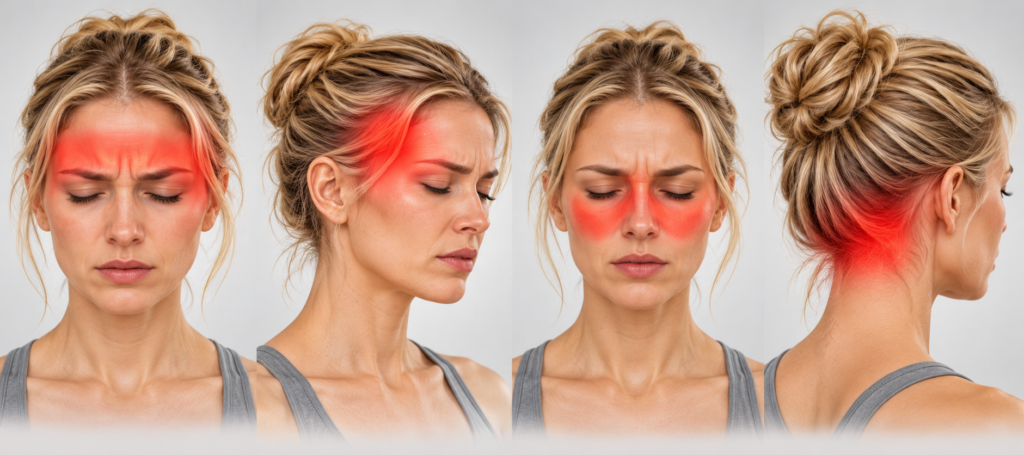
Knowing your headache type guides you in selecting the appropriate treatment.
- A tension headache feels like a tight band or steady pressure on both sides of the head, often with tight neck and shoulders, and usually does not cause nausea. Acupressure for a tension headache covers this type in detail.
- A migraine causes throbbing pain, often on one side, that worsens with activity and comes with nausea or sensitivity to light and sound. Acupressure for migraines covers migraine headaches, and acupressure for ocular migraines covers migraines with visual aura.
- A sinus headache causes pressure across the cheeks, forehead, and around the eyes, usually with congestion and worse when bending forward. Acupressure for a sinus headache addresses this type.
- An occipital headache starts at the base of the skull and may shoot up the back of the head. Acupressure for an occipital headache covers that pattern.
- A cluster headache causes severe, one-sided pain around the eye, with a watery eye or runny nostril on the same side. Acupressure for cluster headaches covers that condition.
This article discusses headaches overall, detailing points for different regions of the head so you can identify which points correspond to your specific pain location.
How Traditional Chinese Medicine Views Headaches

Traditional Chinese Medicine initially assesses a headache based on its location, as different channels pass through various parts of the head.
- Forehead headaches are associated with the Yangming channels of the Stomach and Large Intestine and are often connected to digestion, diet, and heat. Treatment can use the points Yintang, LI4, and ST44.
- Temple and side headaches relate to the Shaoyang channels of the Gallbladder and Triple Burner and are often linked to stress and tension. Taiyang and GB8 target this area.
- Headaches at the back of the head and neck are associated with the Taiyang channels of the Bladder and Small Intestine. These headaches often stem from neck tension, poor posture, and exposure to wind and cold. Points GB20 and SI3 target this region.
- Headaches at the top of the head connect to the Liver channel, which ascends to the crown, and are often linked to stress, frustration, and low Blood levels. Points GV20 and LR3 target this area.
Traditional Chinese Medicine then examines the pattern behind the headache. Most people show more than one of the following, and the points in this routine are chosen to address each pattern.
- Liver Yang rising: throbbing headaches at the temples or top of the head, triggered by stress, anger, or frustration, often with a flushed face, irritability, and tight shoulders. LR3, GB20, and Taiyang calm the rising energy and draw it back down.
- External wind and cold: headaches that come on after exposure to wind, cold, or air conditioning, often at the back of the head and neck, with stiffness. GB20, SI3, and LI4 release the neck and expel the wind.
- Stomach heat and food stagnation: forehead headaches after rich, spicy, or greasy food, alcohol, or overeating, sometimes with a bad taste in the mouth or acid reflux. ST44, LI4, and Yintang clear the heat and ease the forehead.
- Phlegm and dampness: a dull, heavy, foggy headache, as if the head is wrapped, often with fatigue and poor digestion. LI4, ST44, and GV20 clear the head.
- Qi and Blood deficiency: a dull, empty ache that worsens with fatigue, after menstruation, or late in the day, and improves with rest. GV20 lifts and nourishes the head, while LR3 supports the Liver Blood.
- Blood stagnation: a sharp, fixed, stabbing headache in the same spot, often after an injury or in long-standing cases. Taiyang, GB20, and LI4 move the Qi and Blood.
The goal is to circulate Qi and Blood in the head, soothe rising energy, relax tension in the neck and shoulders, and tackle the underlying pattern causing recurring headaches.
What the Research Shows
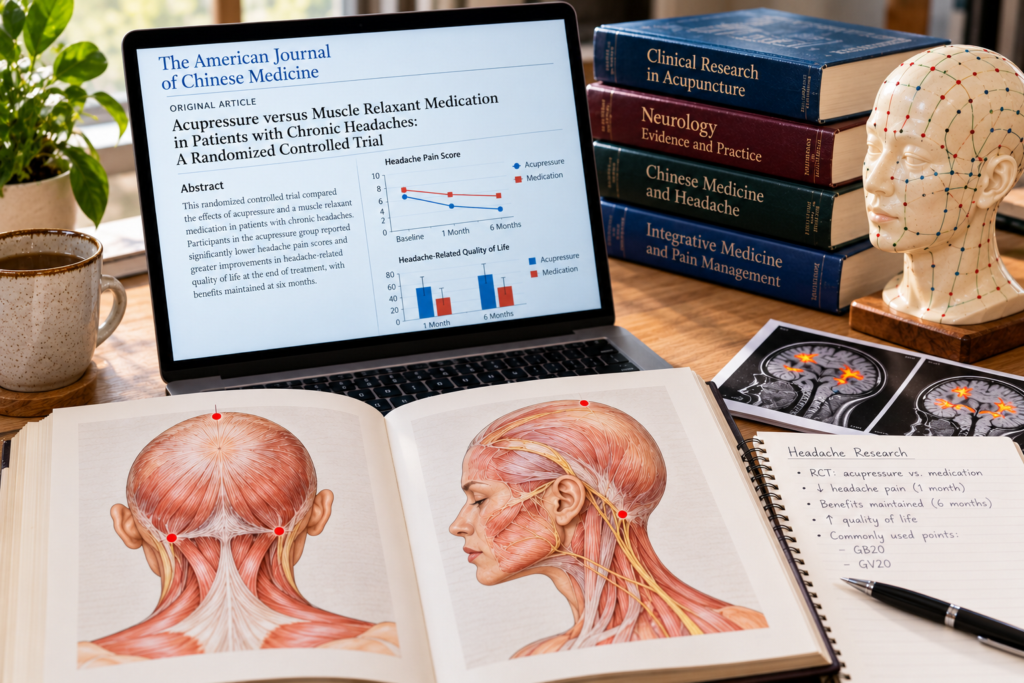
Acupressure has shown encouraging results for headaches in clinical research. In a randomized controlled trial published in The American Journal of Chinese Medicine, people with chronic headaches received either one month of acupressure or one month of a muscle relaxant medication. Those who received acupressure reported significantly less headache pain at the end of treatment, and the advantage was still present six months later. Their headache-related quality of life also improved more than in the medication group. The most commonly used points in this routine included GB20 and GV20.
Acupuncture has solid research backing for headaches, particularly in decreasing the frequency of tension headaches and migraines. Since acupressure targets the same points and channels, it offers a convenient method to relieve headaches at their onset and to enhance acupuncture’s effects between sessions.
Here are nine acupressure points that can help:
What Acupressure Points to Press and Why
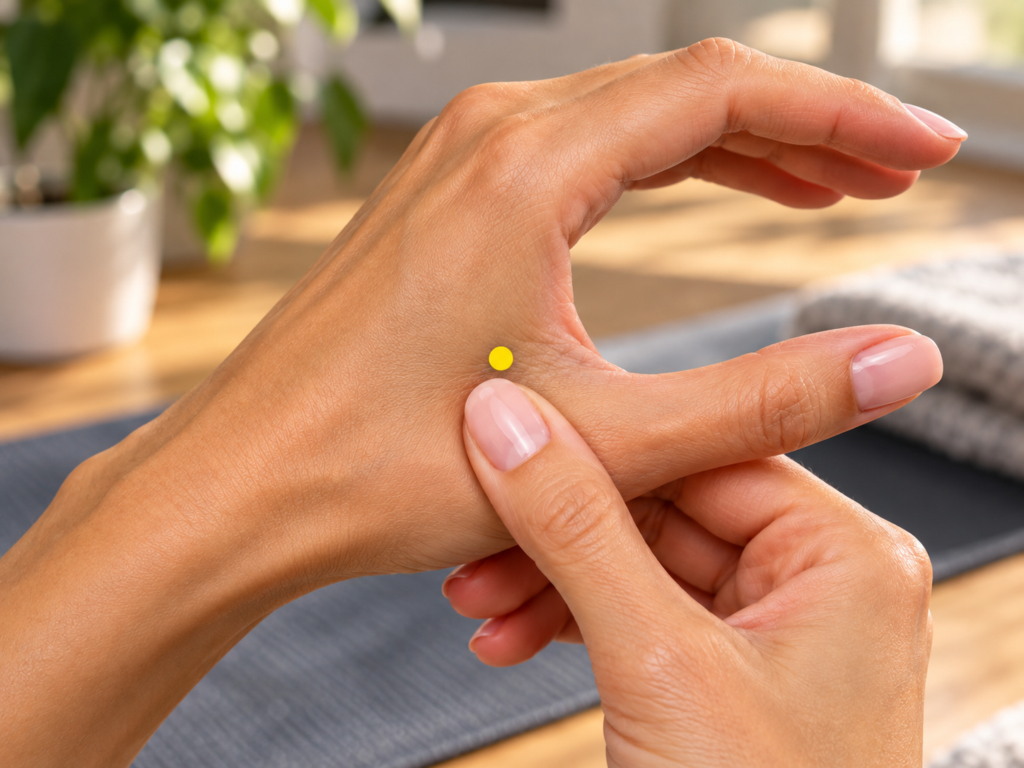
1. Press on LI4 in the hand to relieve head pain anywhere. LI4 sits in the webbing between the thumb and index finger, at the highest point of the muscle when you bring the thumb and index finger together. Press firmly with the thumb of your other hand for one to two minutes on each hand. LI4 is called “Hegu,” the “Joining Valley.” LI4 is contraindicated during pregnancy.
LI4 is a key acupressure point for the face and head, widely used to relieve pain throughout the body. It is especially effective for headaches in various locations, notably across the forehead and face. Its accessibility makes LI4 an ideal starting point for immediate relief, whether at work, in the car, or in public. This point serves as the foundation of this routine.
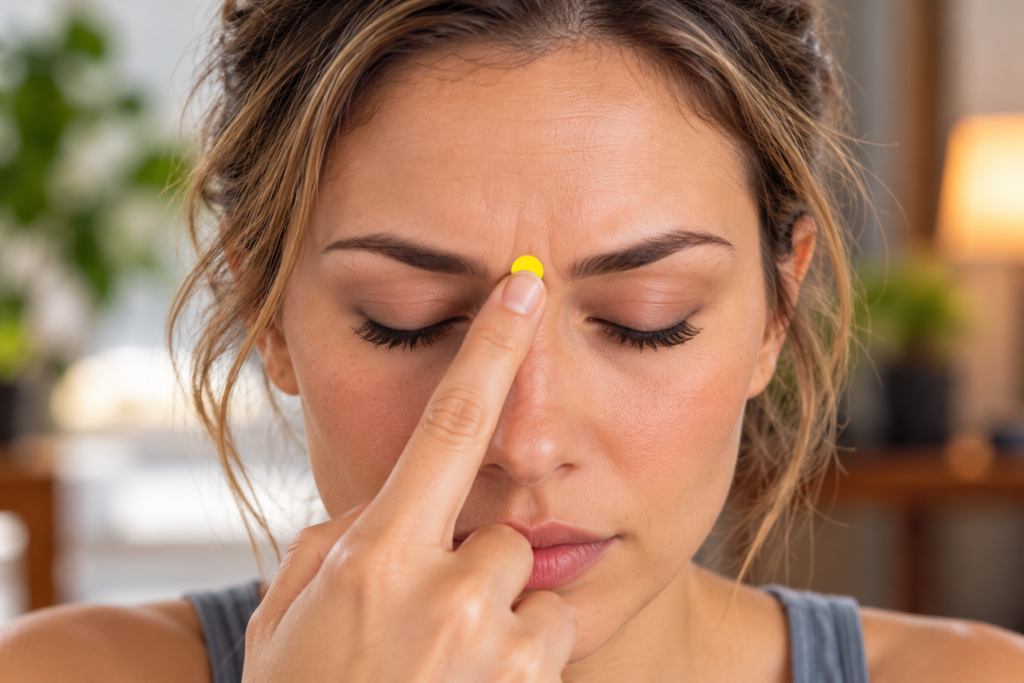
2. Press on Yintang between the eyebrows to ease forehead pressure. Yintang sits in the small hollow directly between the two eyebrows. Press steadily, or make slow circles with your fingertip for one to two minutes while breathing slowly. Yintang is an extra point whose name means “Hall of Impression.”
Pressing on Yintang helps relieve forehead and eye pressure, making it one of the most calming points. It is especially effective for forehead headaches, eye strain from screen work, and stress-related headaches with racing thoughts. Closing your eyes while pressing on Yintang gives your eyes and mind a quick break.
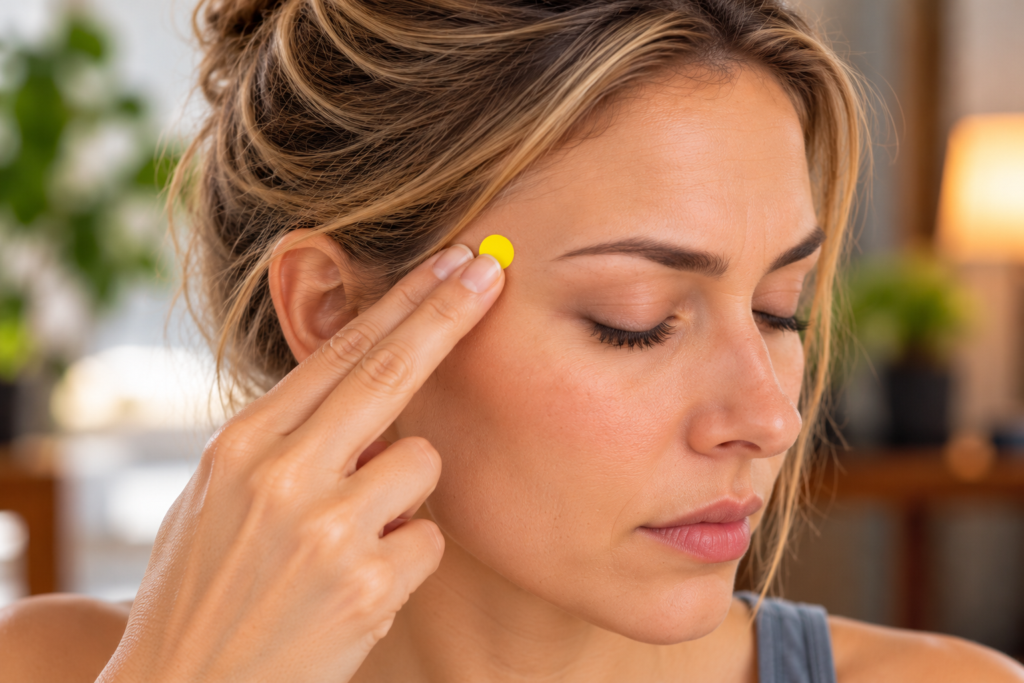
3. Press on Taiyang at the temples to relieve throbbing pain. Taiyang sits in the soft hollow at the temple, about one finger-width behind the midpoint between the outer end of the eyebrow and the outer corner of the eye. Press gently, or make slow circles, with your fingertips on both sides for one to two minutes. Taiyang is an extra point whose name means “Supreme Yang.”
Taiyang is a frequently used acupressure point for headaches that affect the temples, especially those with throbbing pain and pressure behind the eyes. It influences the Qi and Blood on the side of the head, helping to relieve the tight, pulsing pain often caused by stress and prolonged focus. If the area is sensitive, apply gentle pressure.
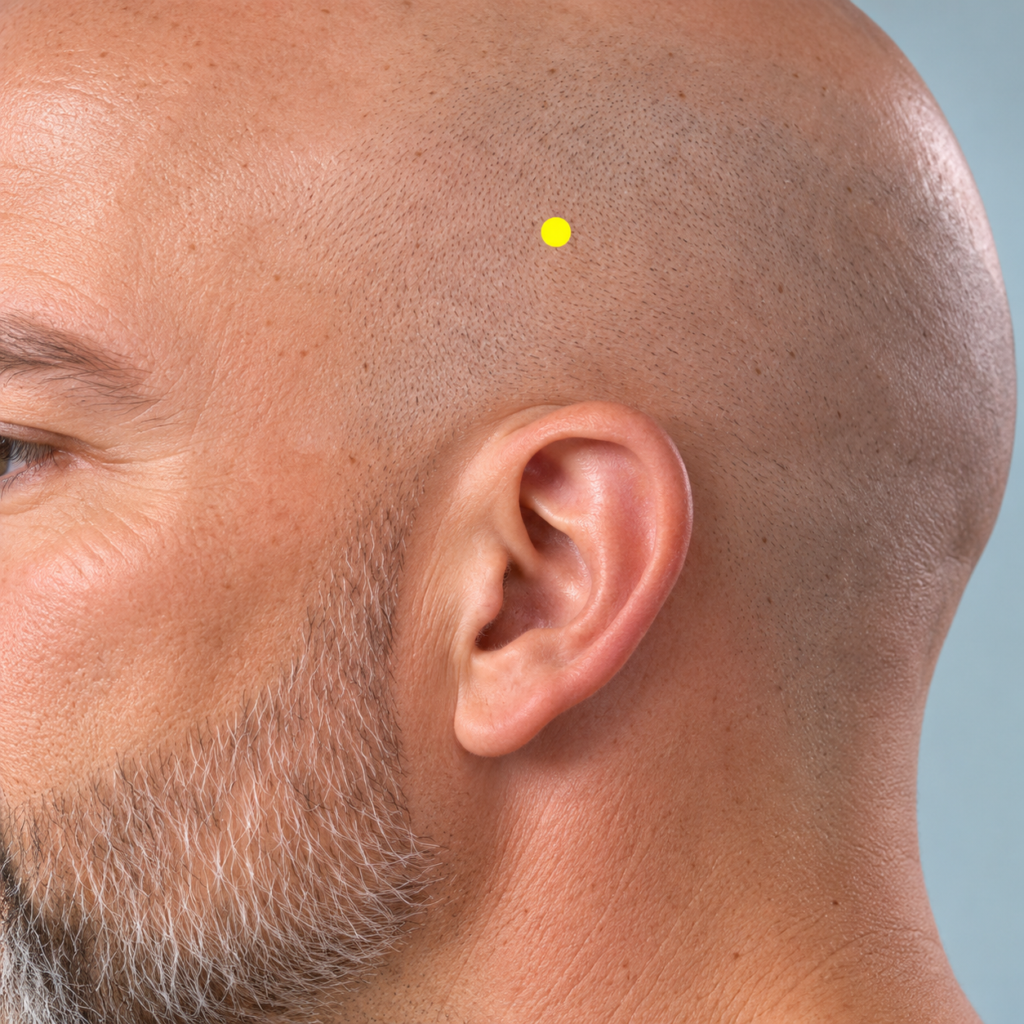
4. Press on GB8 above the ear to ease headaches on the side of the head. GB8 sits on the side of the head, about two finger-widths directly above the tip of the ear. Clench your teeth gently, and you will feel the muscle move beneath your fingers at this spot. Press firmly with your fingertips for one to two minutes on both sides. GB8 is called “Shuaigu,” the “Leading Valley.”
GB8 is located in the large muscle on the side of the head that contracts when you clench your jaw. It is commonly targeted for one-sided headaches, headaches on the side of the head, and those linked to jaw clenching, teeth grinding, and stress. Additionally, it is traditionally used for headaches that happen after alcohol consumption.
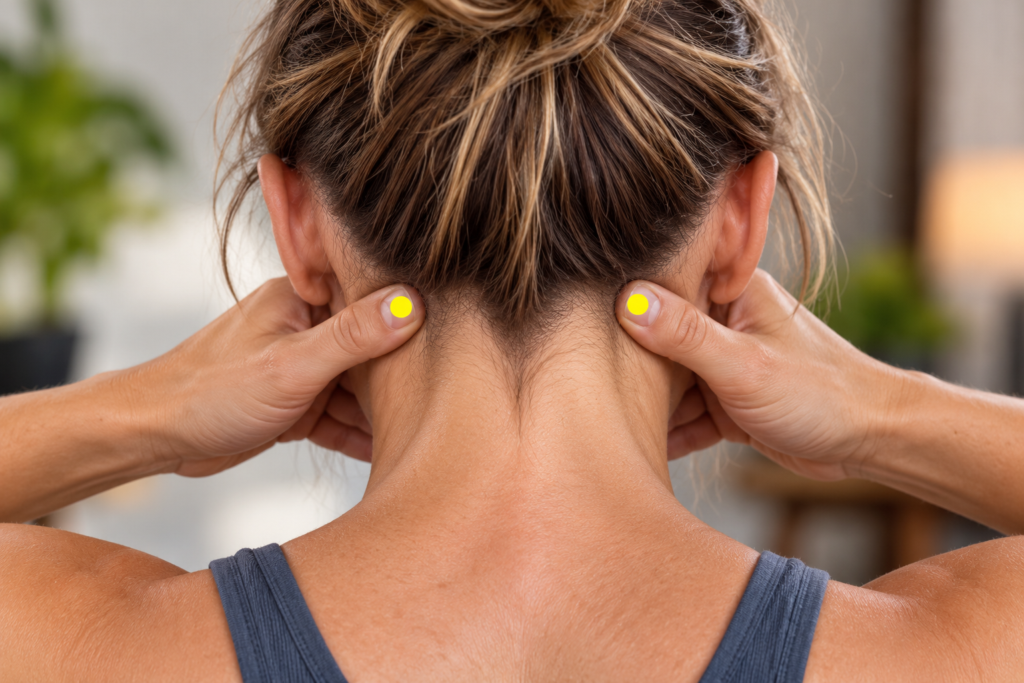
5. Press on GB20 at the base of the skull to release the back of the head. GB20 sits in the two hollows at the base of the skull, between the two large vertical neck muscles and the muscles along the side of the neck, roughly level with the earlobes. Press firmly up and inward with your thumbs for one to two minutes while breathing slowly. GB20 is called “Fengchi,” the “Wind Pool.”
GB20 is an important acupressure point for alleviating different types of headaches. It helps relax tense neck muscles, which are frequently associated with pain at the back of the head, and eliminates wind and cold trapped in the neck. Moreover, it calms the ascending energy that moves upward into the head. To ease a headache, press this point while your head rests against a chair or wall with your eyes closed.
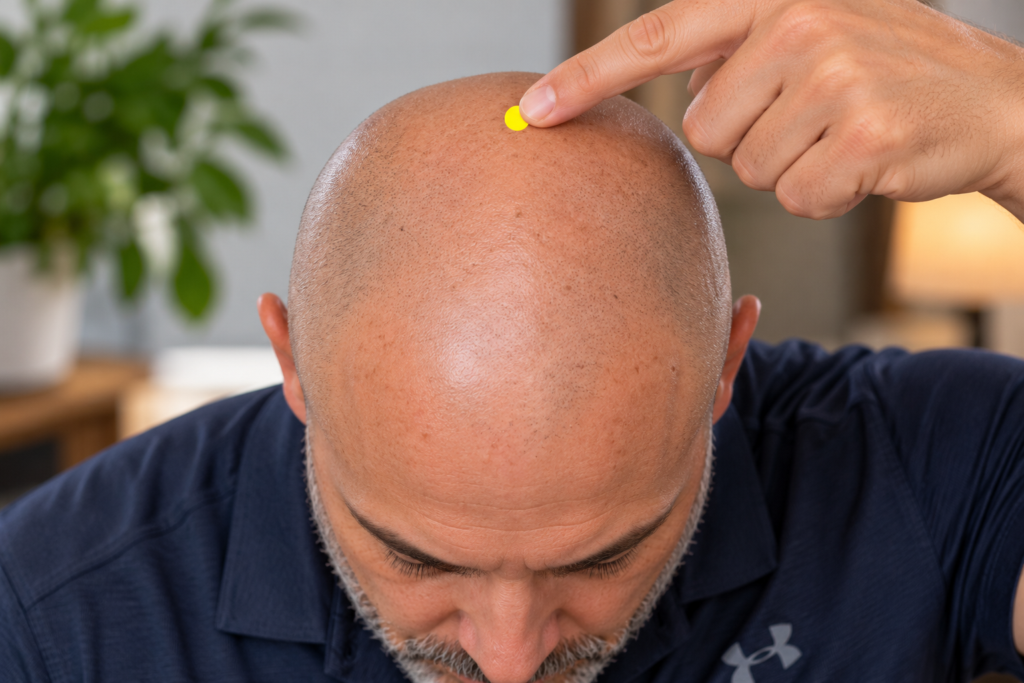
6. Press gently on GV20 at the top of the head to ease pressure at the crown. GV20 sits at the very top of the head, on the midline, on a line drawn up from the tops of both ears. Rest your fingertip there and press gently for one to two minutes. GV20 is called “Baihui,” the “Hundred Meetings.”
GV20 is where many channels converge at the top of the head; it relieves headaches in that area, clears a heavy or foggy sensation, and calms the mind. It also has the effect of raising and nourishing the head when the headaches are due to fatigue and depletion. It is important to apply only a light, steady pressure rather than rubbing vigorously.
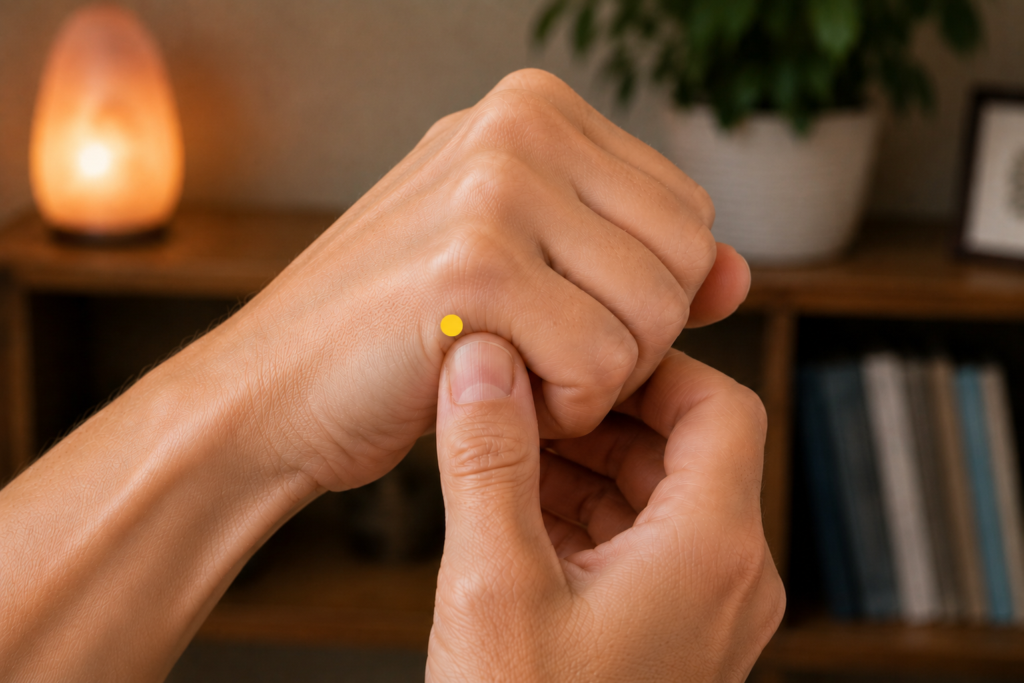
7. Press on SI3 on the side of the hand to release the neck and back of the head. SI3 sits on the outer edge of the hand, on the little finger side, at the end of the crease that forms just below the knuckle of the little finger when you make a loose fist. Press firmly with your thumb for one to two minutes on each hand. SI3 is called “Houxi,” the “Back Stream.”
SI3 is often used to treat the back of the head, neck, and upper back. It helps relax tight neck muscles and alleviates headaches that start at the base of the skull, especially after long periods at a desk or uncomfortable sleeping positions. To enhance its effectiveness, try gently turning your head side to side while applying pressure to SI3 to help loosen the neck.
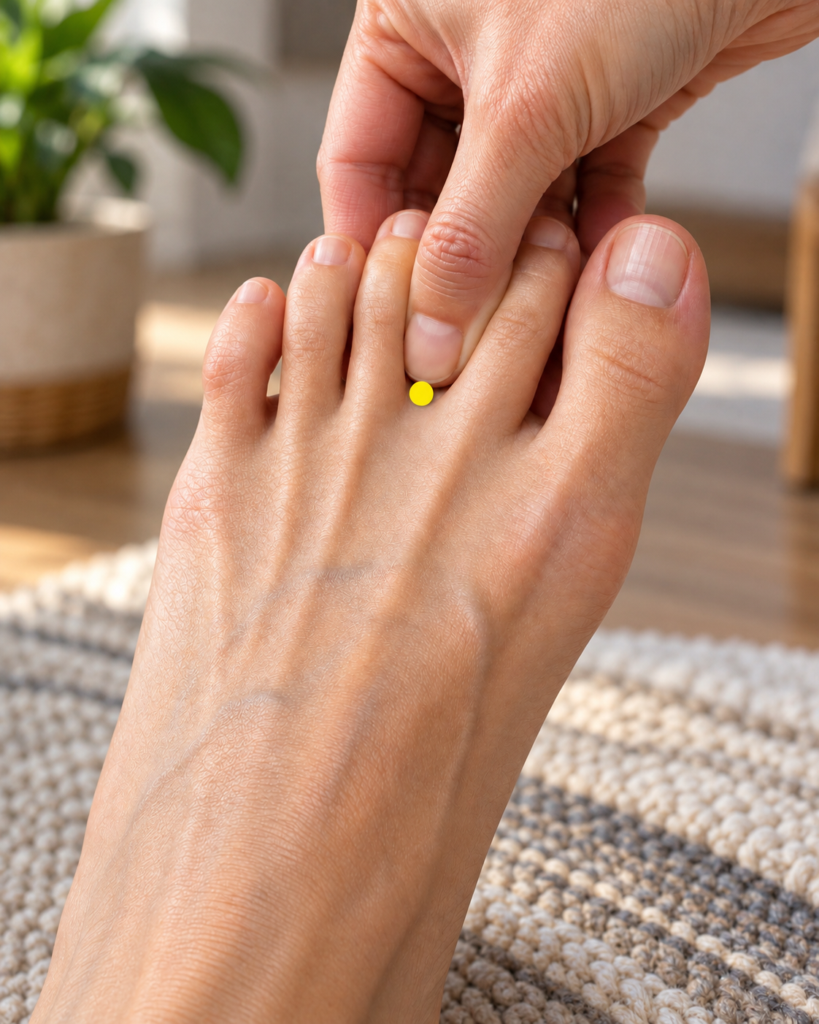
8. Press on ST44 on the top of the foot to clear forehead headaches. ST44 sits on the top of the foot, at the end of the webbing between the second and third toes. Press firmly with your thumb or fingertip for one to two minutes on each foot. ST44 is called “Neiting,” the “Inner Court.”
ST44 is the primary distal point on the Stomach meridian, extending to the forehead. It aids in removing heat from the Stomach and is especially beneficial for forehead headaches caused by rich, spicy, or oily foods, alcohol, overeating, or symptoms like acid reflux, dry mouth, or bad breath. Combining LI4 with ST44 allows treatment of the entire forehead meridian, connecting points from the hands and feet for a comprehensive approach.
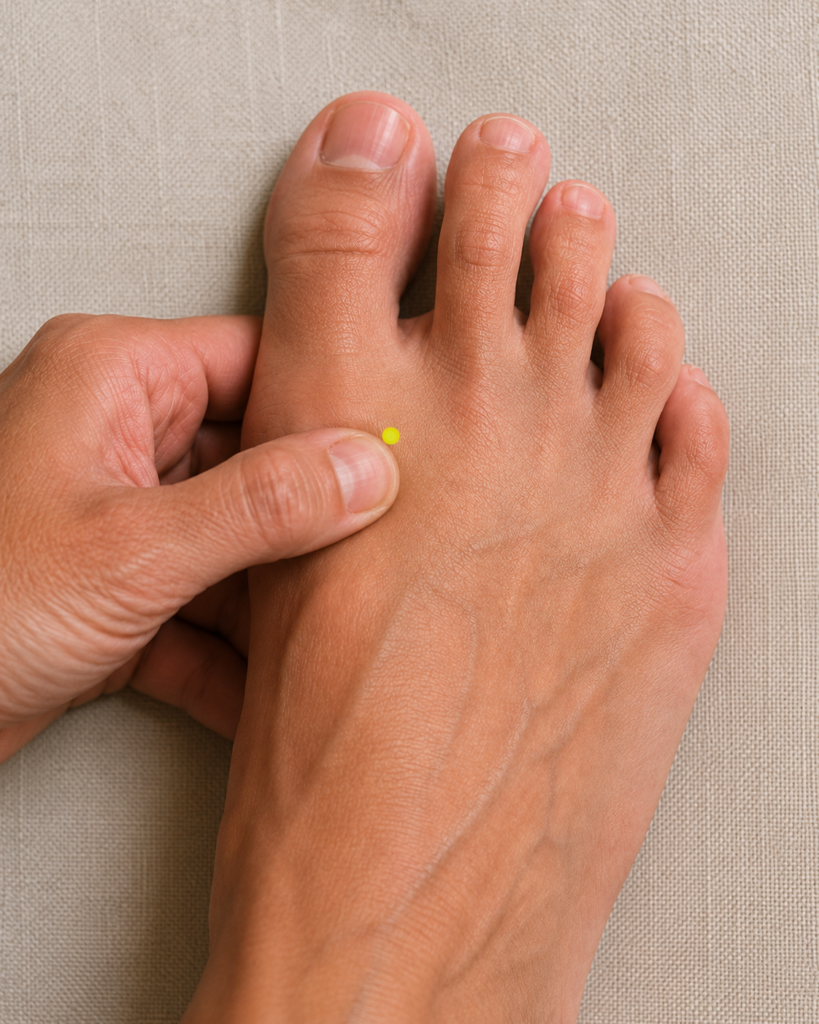
9. Press on LR3 on the top of the foot to calm the Liver and draw energy down. LR3 sits on the top of the foot, in the webbing between the big toe and second toe, about two finger-widths back from the webbing, in the hollow just before the two bones meet. Press firmly with your thumb for one to two minutes on each foot. LR3 is called “Taichong,” the “Great Surge.”
The Liver channel extends to the top of the head. When someone is stressed, the Liver becomes tense, causing energy to rise. LR3 is the key point for calming the Liver and redirecting that energy downward to the feet. Along with LI4 on the hands, it forms the Four Gates, a famous pair used to relax the entire body, reduce pain, and relieve stress headaches. This is also one of the most effective acupressure points to use daily to lower headache frequency.
Why These Acupressure Points Work
In Traditional Chinese Medicine, headaches are believed to stem from a blockage or upward movement of Qi and Blood within the head’s channels. This can be caused by factors like Liver Yang rising, wind and cold, Stomach heat, dampness, depletion, or stagnation. The nine points cover all regions of the head.
- The forehead points (Yintang, LI4, ST44) ease forehead pressure and clear heat from the Stomach channel.
- The temple and side points (Taiyang, GB8) release throbbing and tension on the side of the head.
- The back of the head points (GB20, SI3) release the neck and the base of the skull.
- The top of the head points (GV20, LR3) ease crown headaches and calm the rising Liver energy.
How to Properly Use These Acupressure Points
- At the first sign of a headache, press LI4 and LR3, then add the points that correspond to the location of your headache.
- For a forehead headache: Yintang, LI4, and ST44.
- For a temple or side headache: Taiyang, GB8, and LR3.
- For a headache at the back of the head: GB20, SI3, and LI4.
- For a headache at the top of the head: GV20 and LR3.
- Hold each point for one to two minutes, breathing slowly, with your eyes closed if possible.
- Use firm pressure on the hands and feet and at GB20 and GB8, and gentle pressure at Yintang, Taiyang, and GV20.
- Drink a large glass of water and, if you can, rest in a dim, quiet room while you work through the points.
- To reduce how often headaches occur, work the full routine once a day for several weeks.
Sample routines:
- At the first sign of a headache (five minutes): LI4 and LR3, then the points for the area where your headache sits.
- At your desk (three minutes): GB20, SI3, and Yintang, followed by rolling your shoulders and looking into the distance.
- After a heavy meal or a night of drinking (five minutes): ST44, LI4, and GB8.
- Evening (ten to fifteen minutes): the full routine, finishing with GV20 and LR3 to settle the mind before sleep.
Home Care and Lifestyle Support for Headaches

Consistent daily habits are among the most effective ways to decrease the frequency of headaches.
- Drink water steadily through the day, since even mild dehydration can bring on a headache.
- Eat regular meals and avoid skipping breakfast or lunch.
- Keep a regular sleep schedule, going to bed and waking at about the same time every day.
- Keep caffeine steady and moderate, since both too much and sudden withdrawal can trigger headaches.
- Take regular breaks from screens, and use the twenty-twenty-twenty habit: every twenty minutes, look at something twenty feet away for twenty seconds.
- Set up your workstation so the screen is at eye level and your shoulders stay relaxed.
- Notice jaw clenching and teeth grinding, and ask your dentist about a night guard if needed.
- Limit alcohol, especially red wine.
- Exercise regularly, which reduces both tension headaches and migraines over time.
- Practice daily stress relief, such as slow breathing, meditation, stretching, or acupressure.
- Limit pain medication for headaches to no more than two or three days a week to avoid rebound headaches.
- Keep a headache diary to track your triggers and patterns.
Traditional Chinese Medicine has its own guiding principles: eat warm, cooked food at regular times, and avoid greasy, fried, and very spicy foods, as well as sugar and alcohol, because they cause heat and dampness to rise to the head. To protect the neck from wind and cold, including air from air conditioning blowing onto the back of the neck, wear a scarf or collar if necessary. Chrysanthemum tea is a well-known drink for relieving headaches accompanied by red, tired eyes, and peppermint tea has traditionally been used to clear the head. Finding healthy ways to relieve stress and frustration, such as physical activity, spending time outdoors, or talking through problems, helps keep the Liver from becoming tense. It’s best to rest before you reach exhaustion, as headaches caused by depletion often improve when your body has a chance to recover.
How Acupuncture Can Help
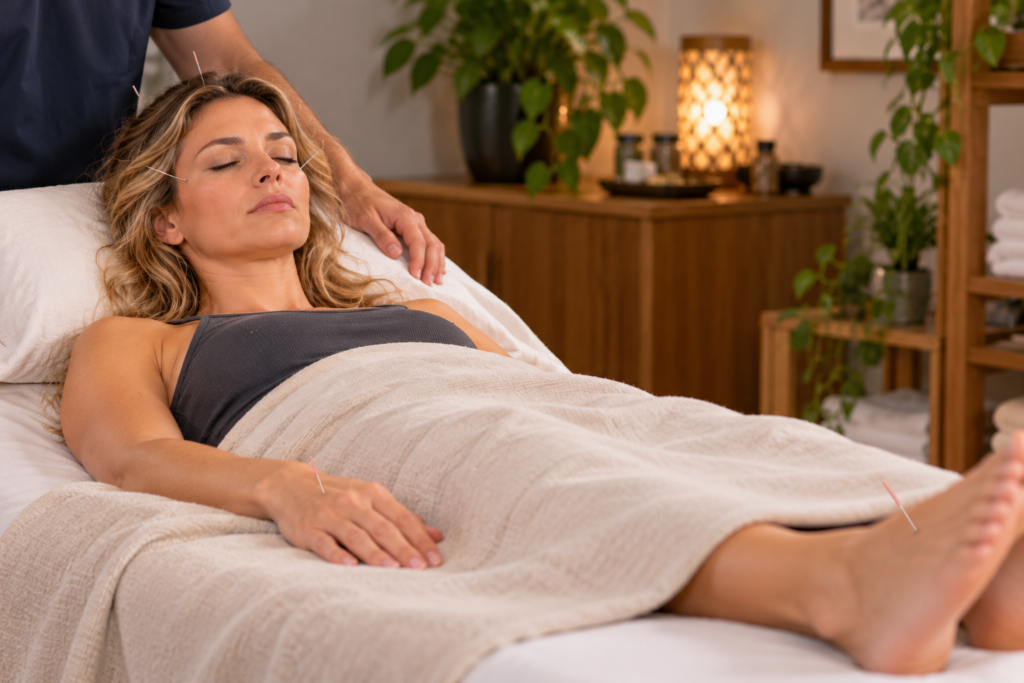
Acupuncture can help relieve headaches by releasing tension in the neck, shoulders, and scalp, soothing the nervous system, and addressing the underlying pattern that causes recurring headaches. This pattern may include stress, hormonal fluctuations, poor digestion, or depletion. The treatment involves stimulating acupuncture points located on the head and neck as well as on the hands and feet, with the specific points chosen based on the headache’s location and cause. Many patients find that regular acupuncture sessions reduce the frequency, duration, and severity of their headaches, and decrease their dependence on pain medication. For chronic or difficult headaches, additional therapies such as cupping on the neck and shoulders and herbal formulas may be used.
Learn more about treating headaches with Traditional Chinese Medicine and how acupuncture can help with migraines by reading these companion posts.
When to Get Professional Help

Most headaches are not serious, but certain symptoms require urgent medical attention.
Seek emergency help if you experience a sudden, intense headache that peaks within a minute, especially if it’s the worst you’ve ever felt, or if it comes with weakness, numbness on one side, slurred speech, confusion, facial drooping, vision loss, or difficulty walking. These could indicate a stroke or brain bleeding. Seek immediate care if your headache comes with fever and a stiff neck, follows a head injury, or occurs with a seizure or fainting. After age fifty, see your doctor promptly if you develop a new headache, if your headache worsens over days or weeks, becomes worse when lying down or coughing, or if you have jaw pain or temple tenderness. During pregnancy or postpartum, severe headaches or changes in your normal pattern also warrant medical attention. If you need pain relief more than two or three days weekly, consult your doctor.
Acupressure is a gentle, supportive approach for headache relief, but it does not replace professional diagnosis and treatment.
For specific headache types, acupressure for a tension headache, acupressure for migraines, acupressure for a sinus headache, acupressure for an occipital headache, and acupressure for cluster headaches are companion pieces. If your headaches come with neck stiffness, acupressure for neck pain can help, and if jaw clenching plays a part, acupressure for TMJ pain offers relief. For simpler steps you can take at home, read how to get rid of a headache without medication.
Above and Beyond Acupuncture offers acupuncture, cupping, and lifestyle coaching at the North Frank Lloyd Wright Boulevard location in Scottsdale.
Schedule an appointment online to start your healing journey.
The points above are only as effective as the technique used to apply them. Where to press, how firmly, and for how long all affect the result. For a full breakdown of how to perform acupressure properly at home, read Performing Acupressure in 3 Easy Steps.

About the Publisher
Paul Kerzner, L.Ac., is a licensed acupuncturist and board-certified herbalist, as well as the founder of Above and Beyond Acupuncture in Scottsdale. His own journey from chronic patient to practicing acupuncturist shapes his commitment to providing honest, clinically grounded information about acupuncture and Traditional Chinese Medicine. Learn more about Paul and his clinical approach on the About Us page.