Key Takeaways
- Fear of flying is one of the most common phobias, and it can trigger panic, a racing heart, shortness of breath, trembling, and a strong urge to get off the plane.
- Treatment is effective for most people with phobias. Available options include therapy, medication, or a combination of both.
- In Traditional Chinese Medicine, fear is the emotion of the Kidney, causing Qi to drop and scatter, while the Heart, which houses the mind, loses its anchor and the chest tightens.
- Nine acupressure points on the head, chest, wrists, hands, and feet can be discreetly pressed while seated to calm the mind, open the chest, steady the breath, and ground the body during a flight.
- Acupressure for fear of flying works best alongside slow breathing and professional help when fear keeps you from traveling. Chest pain or trouble breathing during a flight needs immediate attention from the crew.
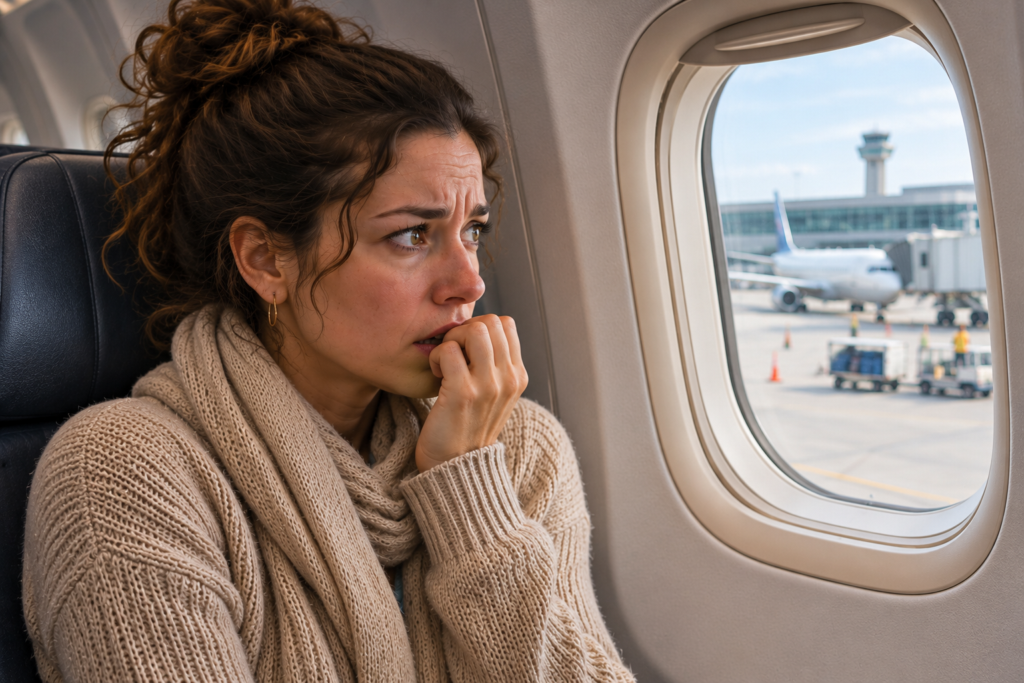
For many people, the fear begins long before the plane leaves the ground. It starts as soon as they book their ticket and builds in the days before the trip, bringing sleepless nights and a constant knot in the stomach. At the airport, just seeing the plane at the gate is enough to make the heart race. Then the cabin doors close, the engines roar at takeoff, turbulence brings every bump, and each change in engine sound becomes “proof” that something is wrong.
According to MedlinePlus, from the National Library of Medicine, a phobia is a type of anxiety disorder: a strong, irrational fear of something that poses little or no real danger, and flying is one of the most common. People with phobias try to avoid what they fear, and when they cannot, they may feel panic and fear, a rapid heartbeat, shortness of breath, trembling, and a strong desire to get away. The causes of specific phobias are not known, although they sometimes run in families. Treatment helps most people and can include medication, therapy, or both.
Fear of flying often has several layers. For some, it’s the turbulence or fear of a crash. For others, it’s being in a confined space, feeling completely out of control, the height, or worrying about having a panic attack in front of a stranger with no way to get out. Identifying which of these is at the root of the fear is key to working through it.
Traditional Chinese Medicine links fear to the Kidney. Fear makes Qi descend and disperse, which explains the weak knees, hollow feeling in the belly, and sudden urge to go to the bathroom that many nervous flyers know all too well. When fear is present, the Heart (which houses the mind) loses its anchor, thoughts run wild, and sleep before a trip is often restless. Qi in the chest becomes stuck, and breathing turns short and shallow.
The nine points below calm the mind, open the chest, steady the breath, and ground the body. Nearly all of them can be practiced quietly from an airplane seat.
What Acupressure Points to Press and Why
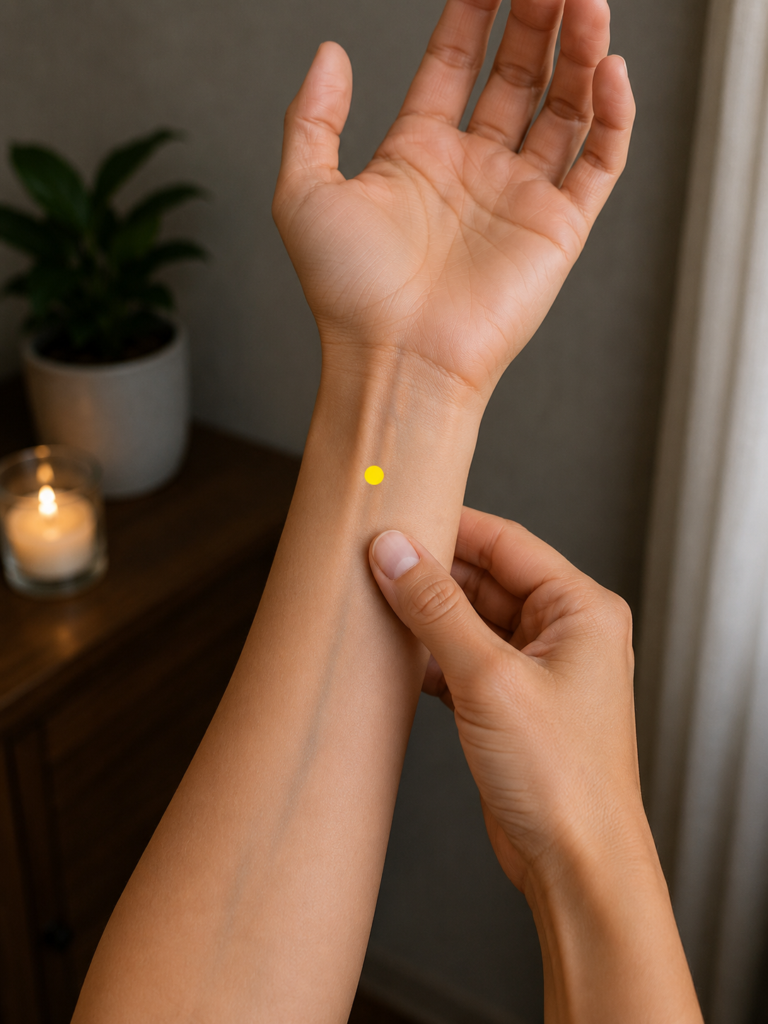
1. Press on PC6 on the inner forearm to calm panic and an unsettled stomach. PC6 sits on the inner forearm, three finger-widths above the wrist crease, between the two tendons. Press firmly with the thumb of your other hand for one to two minutes on each arm while breathing slowly. PC6 is called “Neiguan,” the “Inner Pass.”
PC6 is one of the most commonly used points in Traditional Chinese Medicine for calming the mind, opening the chest, and settling the stomach. It is often chosen for a racing heart and nervous stomach during a fearful flight, and it is also the best-known point for motion sickness, which can make turbulence even worse.
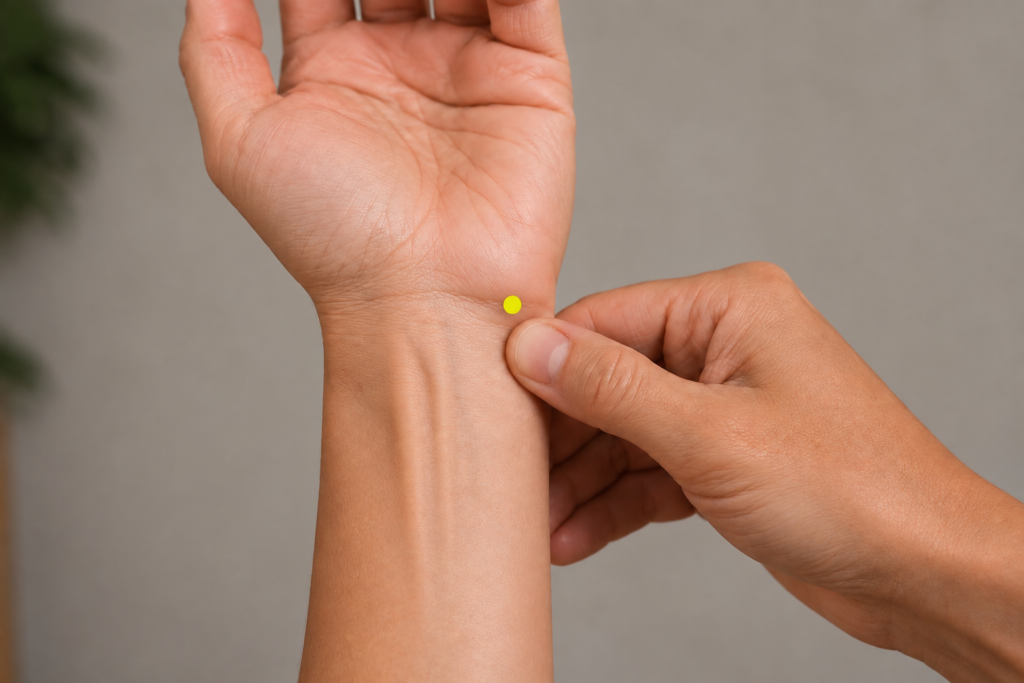
2. Press on HT7 on the wrist crease to settle the mind. HT7 sits on the inner wrist crease, on the pinky side, in the small hollow just to the thumb side of the tendon that runs along the edge of the wrist. Press gently with the thumb of your other hand for one to two minutes on each wrist. HT7 is called “Shenmen,” the “Spirit Gate.”
HT7 is the source point of the Heart, which houses the mind in Traditional Chinese Medicine. It is one of the most important points for anxiety, fear, and a racing heart. It is also very useful for the restless night that so often precedes a flight.
3. Press on CV17 on the center of the chest to ease tightness and steady the breath. CV17 sits on the breastbone, on the midline of the chest, about midway between the nipples. Press gently with your fingertips, or rest the palm flat over the area, for one to two minutes while breathing slowly into the belly. CV17 is called “Danzhong,” the “Chest Center.”
In Traditional Chinese Medicine, CV17 is where the Qi of the chest gathers. It eases the tight, constricted feeling that fear can bring and helps slow and deepen short, shallow breathing.
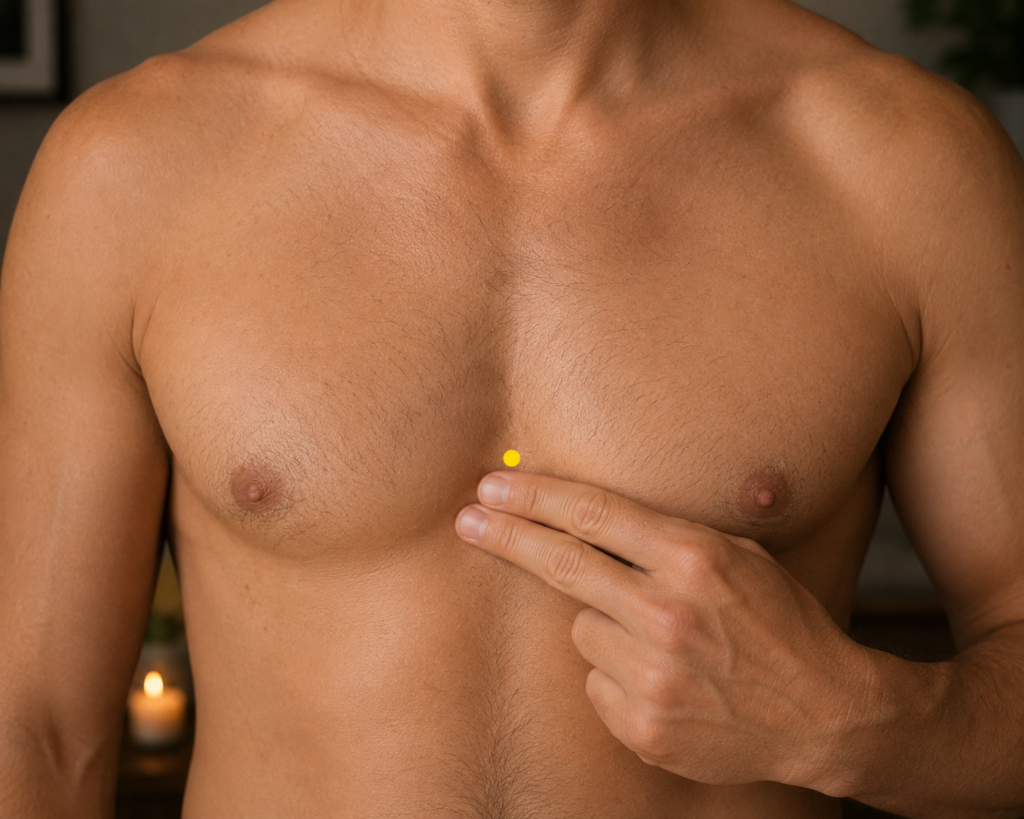
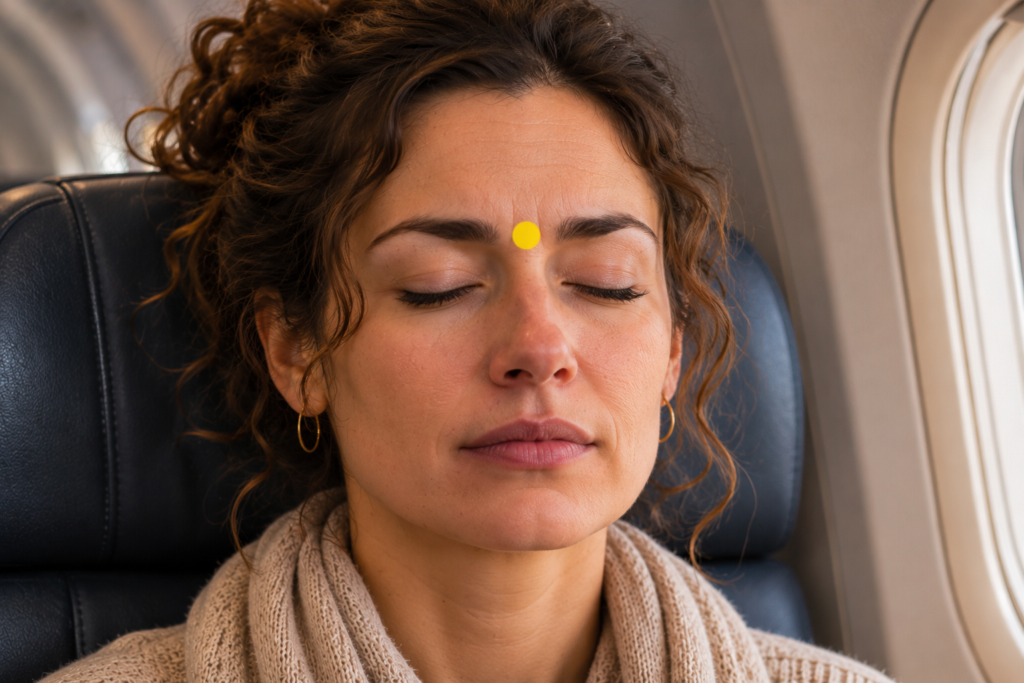
4. Press on Yintang between the eyebrows to quiet racing thoughts. Yintang sits on the midline of the forehead, directly between the inner ends of the eyebrows. Press gently with your fingertip, or make slow, small circles for one to two minutes with your eyes closed. Yintang is called the “Hall of Impression.”
Yintang is an extra point used to calm the mind and ease anxiety. With your eyes closed, press it during takeoff or turbulence to shift your attention away from the aircraft’s sounds and movement and back to your breath.
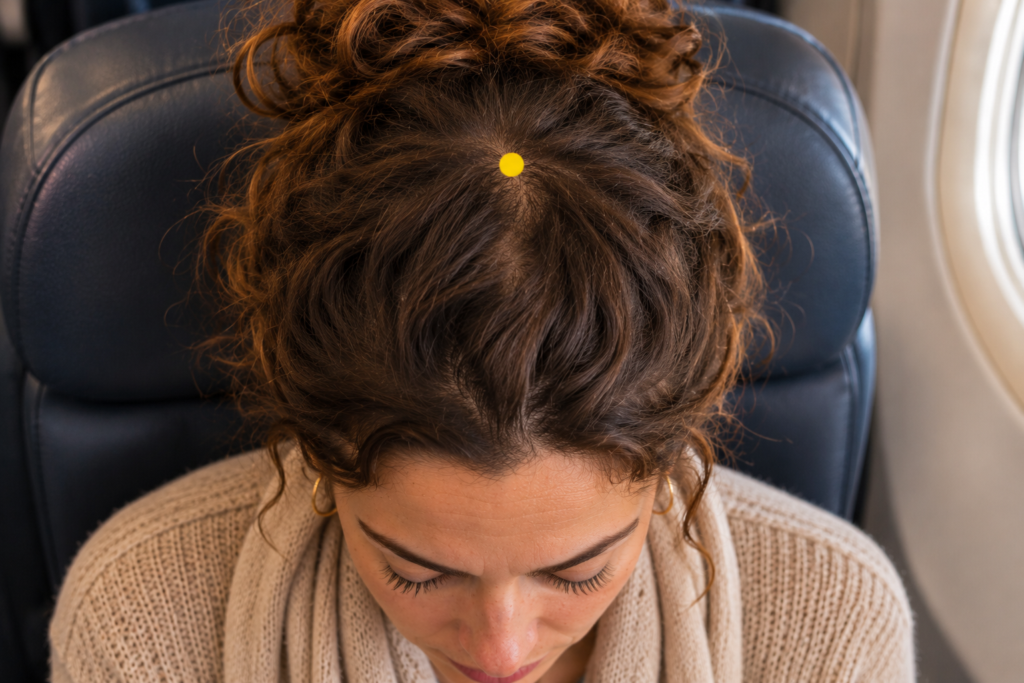
5. Press on GV20 on the top of the head to calm and lift the spirit. GV20 sits on the midline at the very top of the head, where a line drawn from the tops of the ears meets the center of the skull. Press gently with your fingertip, or make slow, small circles, for one to two minutes. GV20 is called “Baihui,” the “Hundred Meetings.”
GV20 is where several channels meet at the top of the head. It is traditionally used to calm the mind, lift the spirit, and ease anxiety and dizziness. It can help counter the sinking, scattered feeling that fear brings.
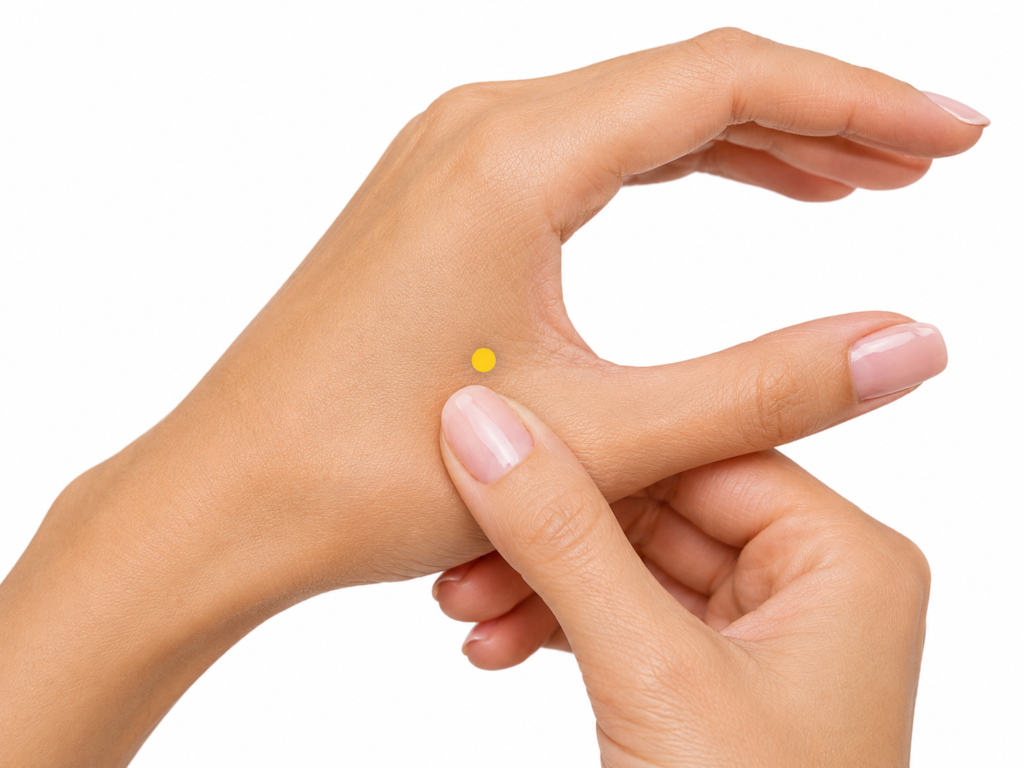
6. Press on LI4 on the back of the hand to release tension. LI4 sits in the webbing between the thumb and index finger, at the highest point of the muscle when the two are pressed together. Press firmly with the thumb of your other hand for one to two minutes on each hand. LI4 is called “Hegu,” the “Joining Valley.” LI4 is avoided during pregnancy.
LI4 is one of the key points for easing tension throughout the body. Paired with LR3, it forms the Four Gates, a classic combination for calming the whole body. It also gives tightly gripping hands something to do.
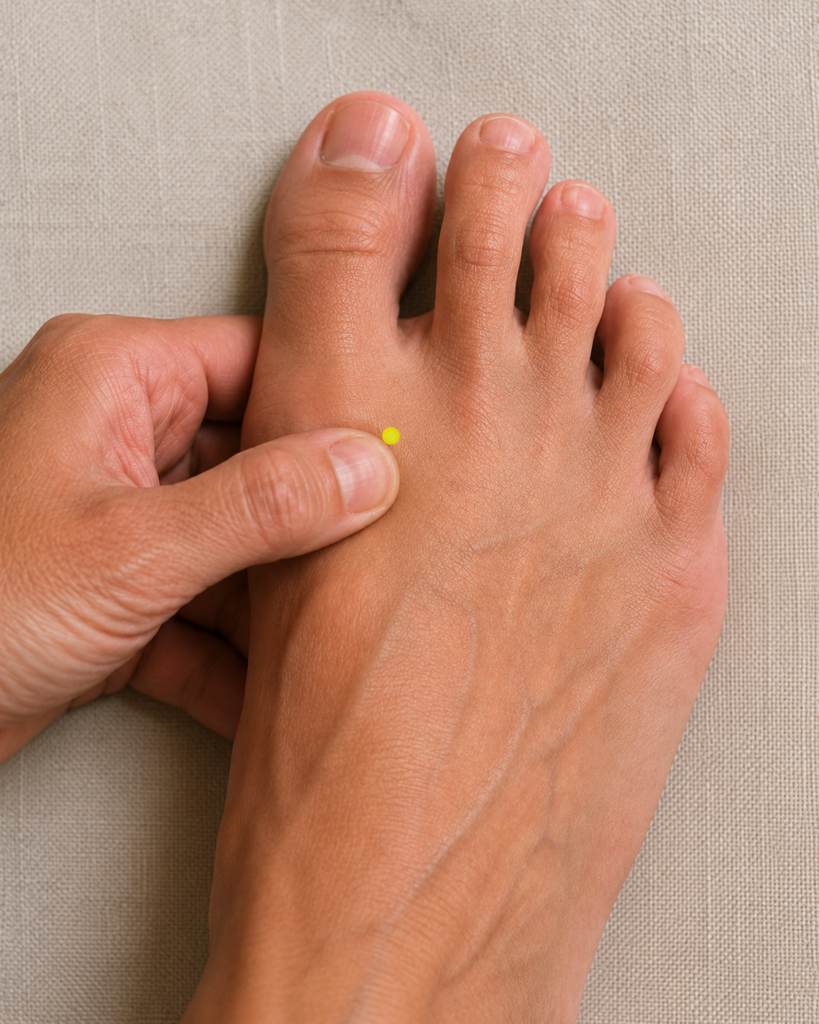
7. Press on LR3 on the top of the foot to release stress and frustration. LR3 sits on the top of the foot, in the hollow where the bones of the big toe and second toe meet, about two finger-widths above the web between the toes. Press firmly with your thumb for one to two minutes on each foot, before the flight or with the shoes slipped off in the seat. LR3 is called “Taichong,” the “Great Surge.”
LR3 is the source point of the Liver, helping keep Qi flowing smoothly. Fear of flying often comes with a strong need for control. LR3 can help release the tension and frustration that build when you have no control.
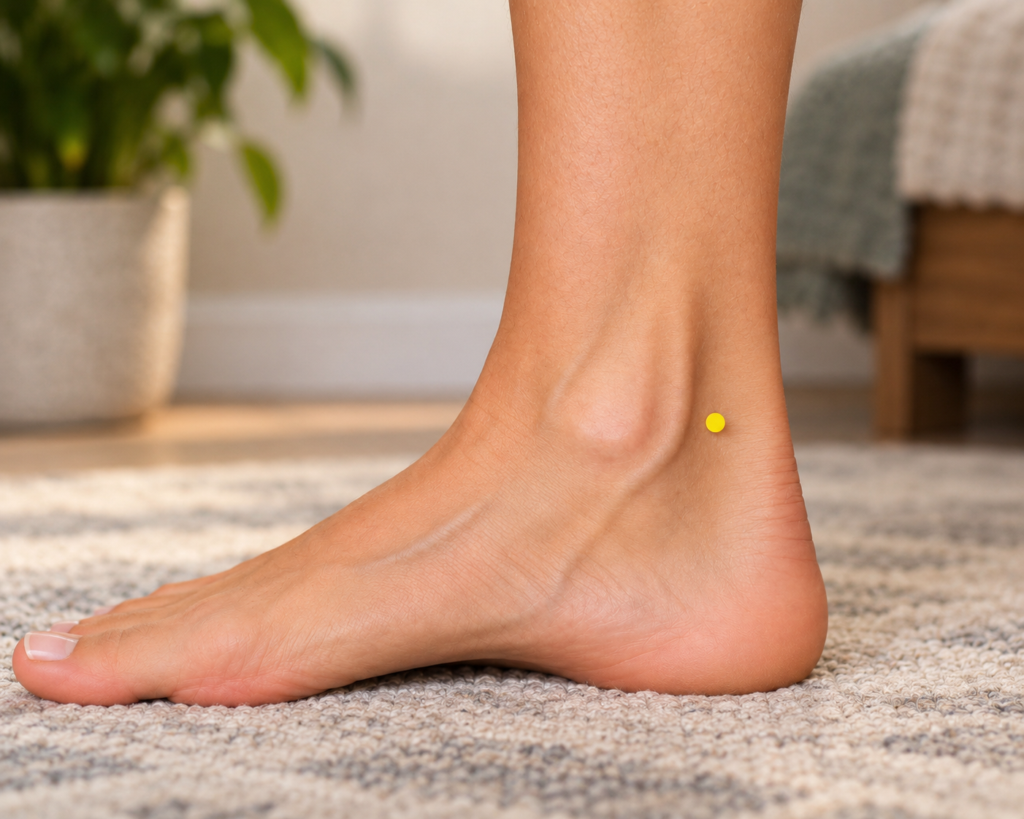
8. Press on KI3 beside the inner ankle to steady fear at its root. KI3 sits on the inside of the ankle, in the hollow between the inner ankle bone and the Achilles tendon. Press gently with your thumb for one to two minutes on each ankle. KI3 is called “Taixi,” the “Great Stream.”
KI3 is the Kidney’s source point. In Traditional Chinese Medicine, fear most directly affects the Kidney. KI3 strengthens the Kidney and helps steady the weak, wobbly feeling that occurs when fear causes Qi to drop.
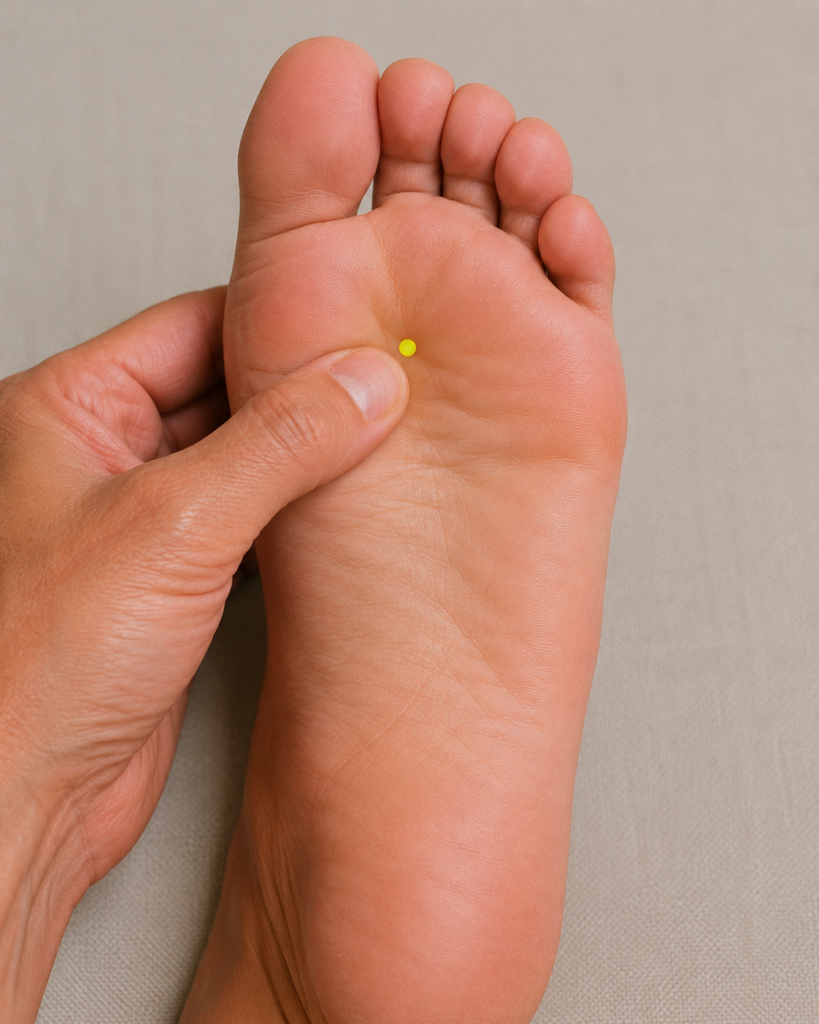
9. Press on KI1 on the sole of the foot to ground the body. KI1 sits on the sole of the foot, in the depression about one-third of the way from the base of the second toe to the back of the heel, where a small hollow forms when the toes curl. Press firmly with your thumb for one to two minutes on each foot before boarding, or roll the sole over a small ball under the seat in front of you. KI1 is called “Yongquan,” the “Bubbling Spring.”
KI1 is the body’s lowest point and the first point on the Kidney channel. Traditionally, it’s used to draw energy downward and ground a mind that feels as though it’s floating away. This makes it one of the most grounding points for fear and panic.
Why These Acupressure Points Work
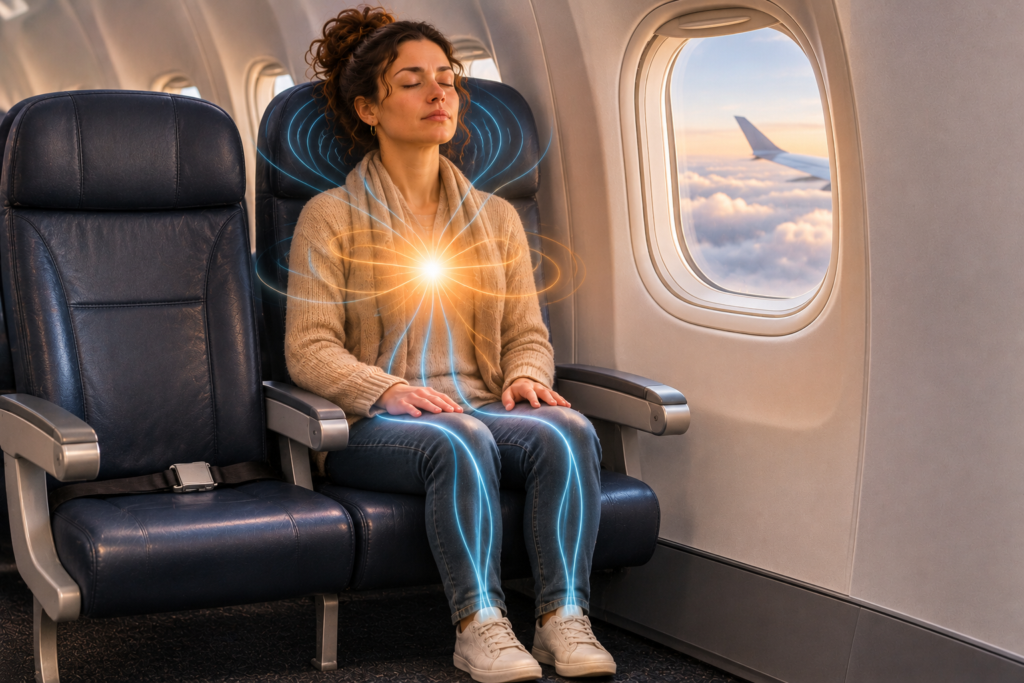
In Traditional Chinese Medicine, fear of flying is seen as fear disturbing the Kidney and scattering the Qi, while the Heart loses its anchor and the chest becomes tight. The approach is to calm the mind, open the chest so breathing can slow, release tension, and steady the Kidney, grounding the body even when you’re thousands of feet up in the air.
The nine points work together to alleviate fear and help ground the body:
- The calming points (PC6, HT7) ease panic, a racing heart, and a nervous stomach.
- The chest and head points (CV17, Yintang, GV20) open the chest, slow the breath, and quiet racing thoughts.
- The Four Gates (LI4, LR3) release tension and the need for control.
- The grounding points (KI3, KI1) steady fear at its root and anchor the body.
How to Properly Use These Acupressure Points
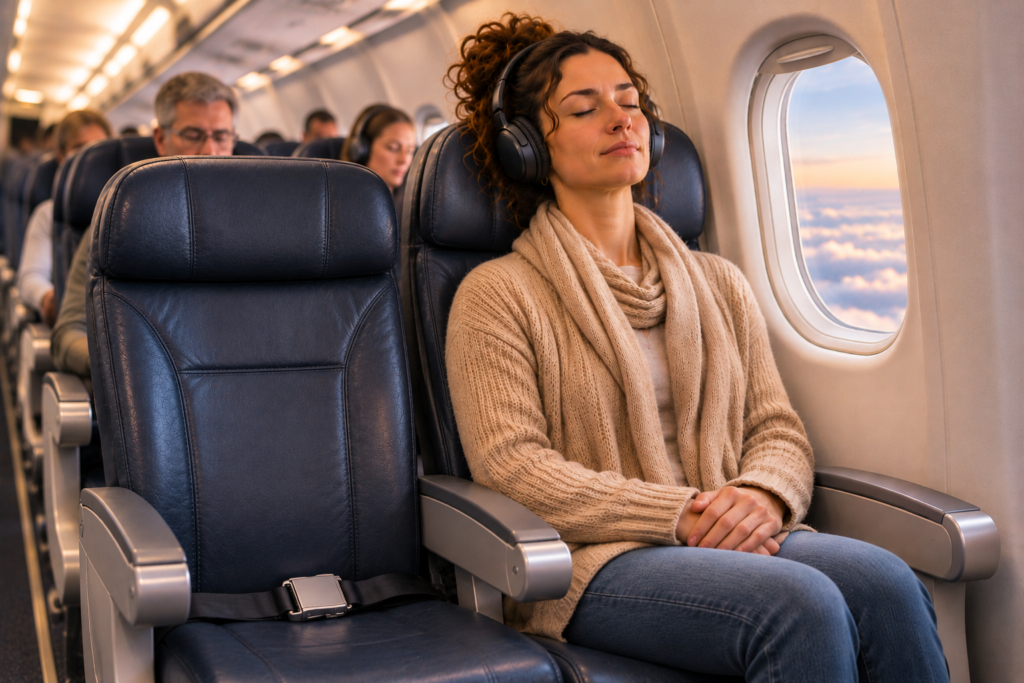
Acupressure for fear of flying is most effective when practiced at home before the trip and then used as a quiet routine while seated.
- Practice all nine points once daily for a week before your flight, holding each point for one to two minutes to ensure the routine feels familiar on the day of travel.
- At the gate, before boarding, press KI1, LR3, and KI3 while the feet and ankles are easy to reach.
- During takeoff, landing, or turbulence, press PC6 or HT7 on one wrist as you breathe in for four counts and out for six, then close your eyes and add Yintang.
- Apply gentle pressure to the head, chest, and wrist crease, and firmer pressure to the forearms, hands, and feet.
Daily routines can help calm your nerves before and during a flight. Book an aisle seat near the front or over the wing, where turbulence is generally less severe, and arrive early to avoid feeling rushed. Get a good night’s sleep before your flight, eat a light meal, and avoid caffeine and alcohol, as both can worsen anxiety. Bring headphones, a favorite playlist or audiobook, and a small snack. Let the flight attendants know you’re fearful; they’re trained to help in these situations. Keep your breathing slow and low in your belly, and remember that turbulence can be uncomfortable but is perfectly normal. If your fear starts to turn into panic, follow a step-by-step approach to stopping a panic attack.
When to Get Professional Help

Talk to a therapist or doctor if fear of flying prevents you from traveling for work or family, causes panic attacks, or leaves you dreading a trip for days beforehand. Cognitive behavioral therapy, exposure therapy, and fear-of-flying courses help most people. Ask a doctor before taking medication for a flight, and never mix sedatives with alcohol. During a flight, alert the crew immediately if you have chest pain, trouble breathing that doesn’t ease with slow breathing, fainting, or confusion, as these symptoms need medical attention.
Acupressure is a gentle, supportive practice for fear of flying. It complements, and does not replace, diagnosis and medical care.
For related concerns, acupressure for fear, acupressure for motion sickness, and acupressure for ear pressure and clogged ears are companion articles. If long flights leave you tired and off schedule, learn about acupressure for jet lag.
Above and Beyond Acupuncture offers acupuncture, cupping, and lifestyle coaching at the North Frank Lloyd Wright Boulevard location in Scottsdale.
Schedule an appointment online to start your healing journey.

The points above are only as effective as the technique used to apply them. Where to press, how firmly, and for how long all affect the result. For a full breakdown of how to perform acupressure properly at home, read Performing Acupressure in 3 Easy Steps.
About the Publisher
Paul Kerzner, L.Ac., is a licensed acupuncturist and board-certified herbalist, as well as the founder of Above and Beyond Acupuncture in Scottsdale. His own journey from chronic patient to practicing acupuncturist shapes his commitment to providing honest, clinically grounded information about acupuncture and Traditional Chinese Medicine. Learn more about Paul and his clinical approach on the About Us page.