
Key Takeaways
- Myofascial pain syndrome causes persistent pain from trigger points in muscles that can lead to referred pain in other areas.
- The core technique is steady pressure at about five to seven out of ten, held for thirty to ninety seconds, followed by a gentle stretch.
- Traditional Chinese Medicine views myofascial pain as Qi and Blood blockages, often treatable through acupressure techniques.
- Common acupressure points include Ashi points, GB20, GB21, SI11, and GB30, which target tight muscles and improve blood flow.
- Preventing trigger points requires good posture, regular movement, stress management, and adequate hydration.

Do you have stubborn knots in your neck, shoulders, or back that cause deep aches or even pain in other parts of your body?
These knots are often signs of myofascial pain syndrome, which happens when small, tight, and tender spots called trigger points form in your muscles. Pressing on these knots can cause pain that spreads to other areas. For example, a knot at the top of your shoulder might give you a headache at your temple, a knot in your buttock could send pain down your leg, and a knot under your shoulder blade might make your arm hurt. Because pain often appears away from the real source, many people spend months treating the area that hurts without finding the knot that is actually causing the problem. Acupressure can help because pressing and holding on trigger points helps release them, especially when you can reach the points yourself.
In this article, you’ll learn what myofascial pain syndrome is, how Traditional Chinese Medicine views it, which points can help and why, and how to create a routine to keep knots from coming back.
What Is Myofascial Pain Syndrome?
Myofascial pain syndrome is a condition characterized by persistent pain and the presence of trigger points. A trigger point is a small, highly sensitive area within a tight band of muscle. Applying pressure to it may feel like a firm lump, a stringy band, or a particularly tender spot compared to the surrounding muscle. Usually, pressing on a trigger point triggers a familiar aching sensation and can lead to pain spreading along a specific pathway, known as referred pain.
The muscles around these trigger points often feel stiff, weak, and hard to move. Common signs include:
- A deep, persistent ache in a specific muscle or group of muscles
- Tender knots that reproduce your pain when pressed
- Pain that travels in a consistent pattern from the knot
- Stiffness and reduced range of motion, such as trouble turning your head
- Muscle weakness or fatigue without true nerve damage
- Tension headaches, jaw pain, or arm pain linked to knots in the neck and shoulders
- Pain that worsens with stress, poor sleep, cold, or holding one position too long
Myofascial pain differs from fibromyalgia, which causes widespread pain, because it usually impacts specific muscles. Although the two conditions can coexist, long-term myofascial pain may lead to a more sensitized nervous system, highlighting the importance of early treatment.
What Causes Trigger Points
Trigger points generally result from bad posture, repeated movements, muscle overuse or injury, staying seated for long periods, stress, or inadequate sleep. When a muscle is overloaded or held in a shortened position for an extended time, it protects itself by tightening; as a result, a small part of the muscle remains contracted, loses blood supply, and becomes increasingly sensitive.
The typical causes are well known: spending long hours at a desk with the head pushed forward, driving, carrying a child on one shoulder, sleeping in an uncomfortable position, engaging in repetitive work or sports movements, and the habit of tightening the shoulders and jaw when under stress. Exposure to cold air from air conditioning affecting the neck and shoulders, dehydration, and deconditioning all increase the strain. The areas most frequently affected are the top of the shoulders, the base of the skull, the regions between and on the shoulder blades, the lower back, and the buttocks.
How Chinese Medicine Views Myofascial Pain
In Traditional Chinese Medicine, myofascial pain is considered to be a kind of blockage called Bi syndrome, in which Qi and Blood become stuck in the muscles. Factors that contribute to this include overuse, bad posture, injuries, exposure to cold, and stress, since all of these interfere with the flow and thus cause knots and discomfort. Most people have a combination of the patterns listed above, and identifying which ones apply to you will help you decide where to focus.
- Blood stagnation. Persistent knots typically signal Blood stagnation. The pain is fixed in one place, boring or sharp, tender to firm pressure, and often worse at night or after sitting still. Old injuries that never fully settled usually fall here. BL17 and the Ashi points are the main tools for this pattern.
- Stuck Liver Qi. Tension associated with stress indicates Liver Qi stagnation. Knots settle in the neck, shoulders, jaw, and between the shoulder blades, and they flare with deadlines, frustration, and long days. LR3, LI4, GB20, and GB21 address this pattern.
- Sinews lacking nourishment. The sinews, regulated by the Liver, become tight when they lack proper nourishment. Muscles feel tired, tight, and crampy, knot up easily after overwork or poor sleep, and are slow to recover. GB34 and steady rest, warm food, and sleep matter most here.
- Cold lodged in the muscles. Stiffness and aching are worse in cold weather, air conditioning, and first thing in the morning, and clearly better with heat. Warmth before pressing is especially important for this pattern.
Traditional Chinese Medicine also describes the sinew channels, the network of muscle and connective tissue pathways that follow the main channels across the body. Trigger points tend to line up along these sinew channels, which helps explain why referred pain travels in such consistent paths.
What the Research Shows
Trigger points frequently coincide with acupuncture points, several of which are traditional acupressure locations.
In Traditional Chinese Medicine, there are sensitive areas referred to as “Ashi” points, which are similar to trigger points, and it has long been observed that common trigger points closely match up with the traditional point locations. Both acupuncture and dry needling have demonstrated promising short-term relief from myofascial pain. Moreover, applying continuous pressure to trigger points, a method known as ischemic compression, is a typical one used in self-care and manual therapy, and research into this technique has shown that it can reduce pain and tenderness at the treated area. The best results are achieved when pressure treatment is combined with stretching, movement, and modifications to the habits that originally caused the knots, which is precisely the approach taken in the routine below.
Here are nine acupressure points that can help release knots, support Qi and Blood flow, relax sinews, and reduce stress-related muscle tension.
What Acupressure Points to Press and Why
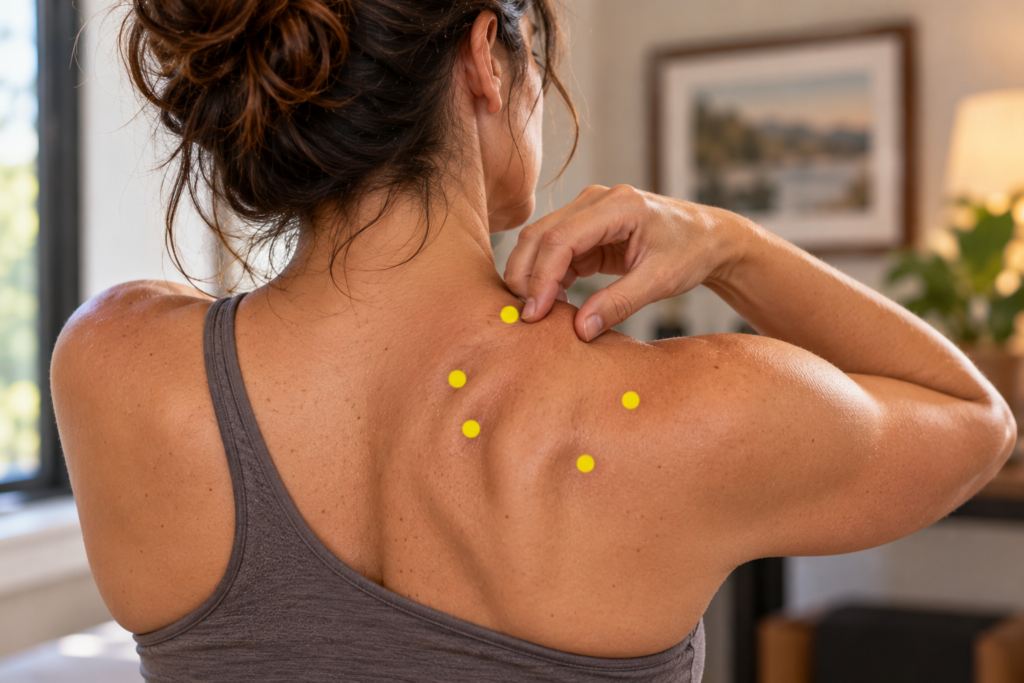
1. Press your Ashi points, the knots themselves. Ashi points are the tender knots you find by feeling along a sore muscle. Explore the muscle slowly with your fingertips or a tennis ball until you find a spot that is distinctly tender and may send pain elsewhere. Press steadily into it, at a pressure that is uncomfortable but tolerable, and hold for thirty to ninety seconds until you feel it soften or the tenderness ease. “Ashi” roughly means “Ah, yes,” the sound people make when the sore point is found.
The ashi points are the main focus of this procedure because they act as trigger points; applying steady pressure helps release them. While you are pressing, breathe slowly and try to achieve a discomfort level of about five to seven out of ten, without causing any sharp or intolerable pain. After that, gently stretch the muscle which you have just exercised. A good indication that you’ve found the right spot is that pressing it brings on the same kind of pain you have been experiencing, though it may be in a different location. Recognizing this is what the name refers to, and it shows the pressure is being applied in the right place.
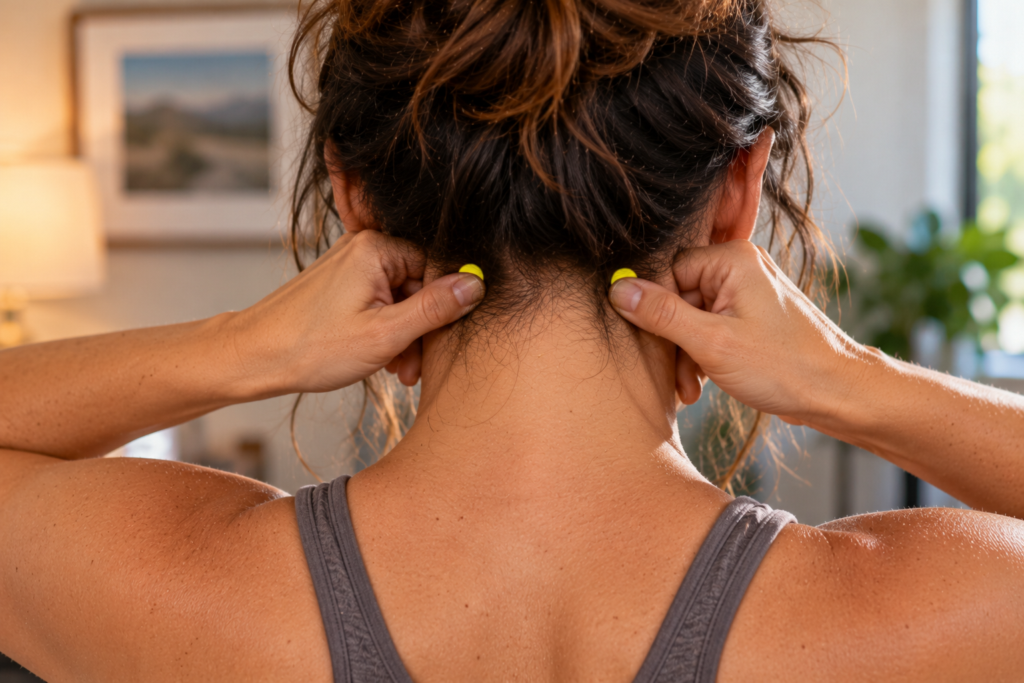
2. Press on GB20 at the base of the skull for neck and head pain. GB20 sits in the two hollows at the base of the skull, between the two large vertical neck muscles and the outer edge, roughly level with the tops of the ears. Tip your head back slightly and press firmly up and inward with your thumbs for one to two minutes. GB20 is called “Fengchi,” the “Wind Pool.”
The small muscles at the base of the skull often develop trigger points that cause pain, leading to headaches behind the eyes and in the temples. The GB20 point is positioned directly above these muscles and can therefore help relieve neck tension and reduce cases of tension headaches. These muscles work constantly throughout the day to keep the head elevated, and they tend to tighten quickly when the head moves forward toward a screen. In Chinese medicine, GB20 is also considered the point where cold and wind enter the body, which is the reason why a stiff neck often occurs after sleeping under a fan or an air conditioner.
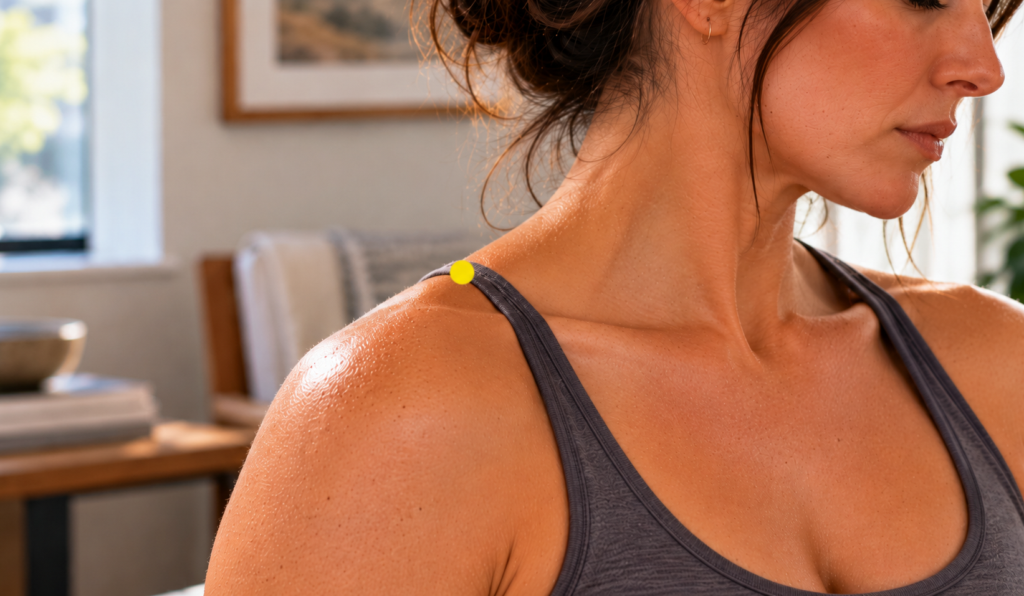
3. Press on GB21 on top of the shoulder, the most common trigger point. GB21 sits at the highest point of the shoulder, midway between the base of the neck and the shoulder tip, on the trapezius ridge. Squeeze the muscle firmly between your fingers and thumb, or press down, and hold for thirty to ninety seconds on each side. GB21 is called “Jianjing.” GB21 is avoided during pregnancy.
The upper trapezius often has trigger points because GB21 lies directly on it, and tension in this area usually causes pain to spread up the neck and into the temple. It is possible to greatly reduce the shoulder and neck pain caused by working at a desk by applying light pressure to the point and keeping it pressed until the muscle relaxes. This is the muscle that moves toward the ears under stress, so GB21 is usually the first point people try, even if they don’t know it’s called GB21.
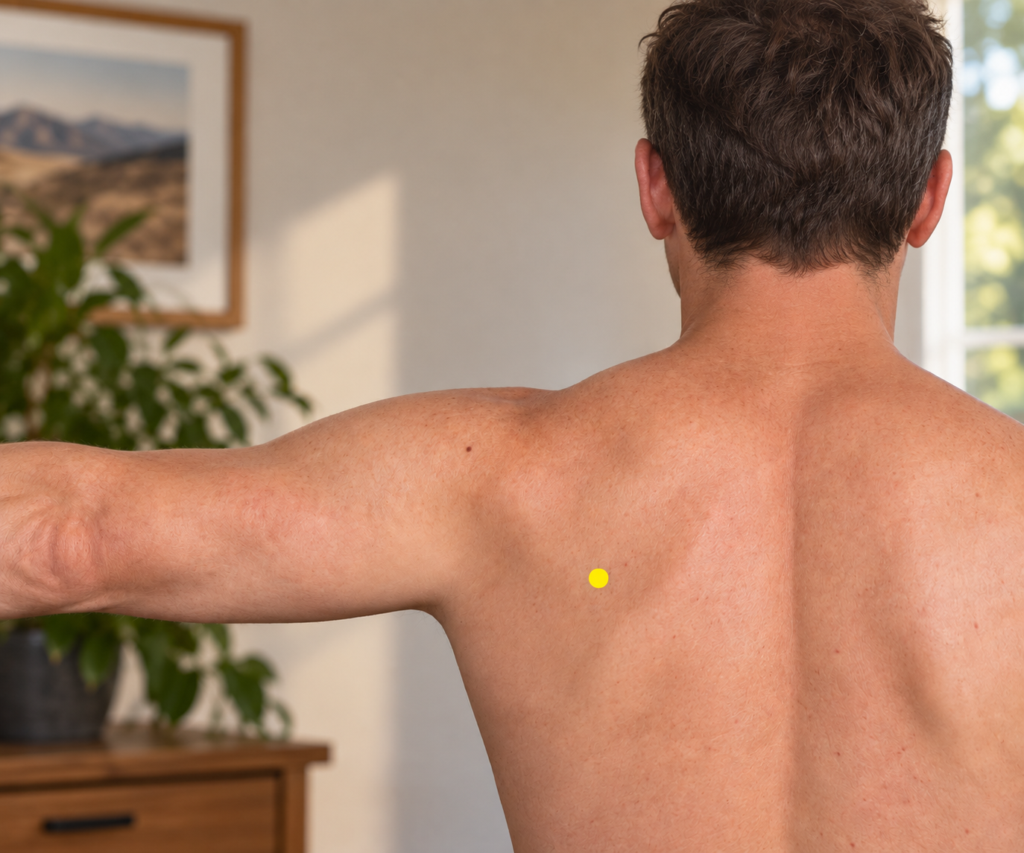
4. Press on SI11 on the shoulder blade for deep shoulder and arm pain. SI11 sits in the center of the shoulder blade, in a tender hollow in the middle of the flat, triangular bone. Lean against a wall with a tennis ball over the point and press into it for thirty to ninety seconds. SI11 is called “Tianzong.”
The muscle at the back of the shoulder blade often forms trigger points, causing deep pain in the front of the shoulder that radiates down the arm. Since SI11 is situated over this muscle, many people are surprised by how tender it is and the fact that applying pressure there can alleviate pain in other areas. If you have shoulder pain that feels like it is within the joint or have difficulty reaching behind your back, it is worth checking this point before concluding the problem lies in the shoulder itself.
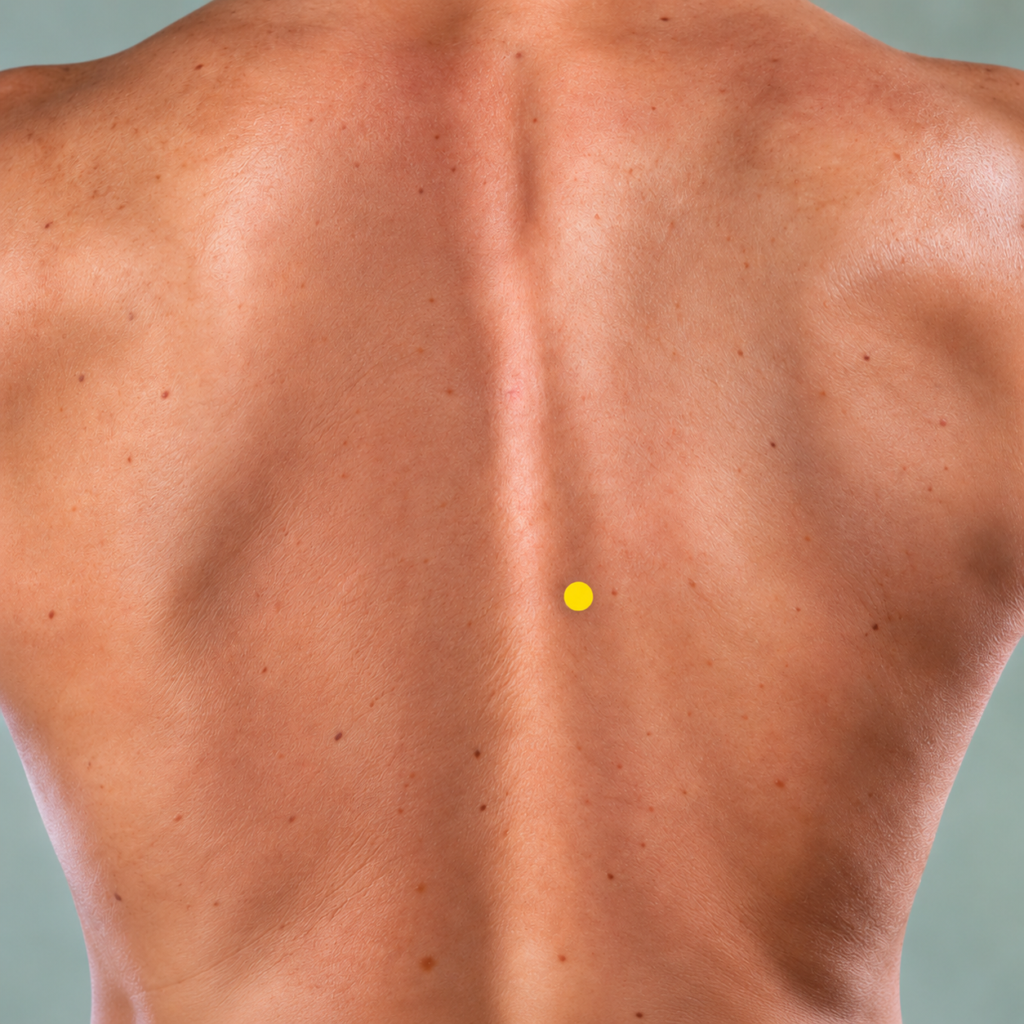
5. Press on BL17 on the mid-back to move stagnant Blood. BL17 sits on the mid-back, about two finger-widths out to each side of the spine, roughly level with the bottom tips of the shoulder blades. Lie on your back with a tennis ball under each point for one to two minutes. BL17 is called “Geshu,” the influential point for the Blood.
In Traditional Chinese Medicine, persistent knots indicate blood stagnation, making BL17 one of the main points for treating this condition; it also helps relax the tight muscles in the middle of the back that result from slouching or stress. A tennis ball can help you reach this area more easily since BL17 is at a level comparable to the diaphragm; when you rest on the ball and breathe slowly and deeply, it can relax the middle back and often relieve tightness throughout.
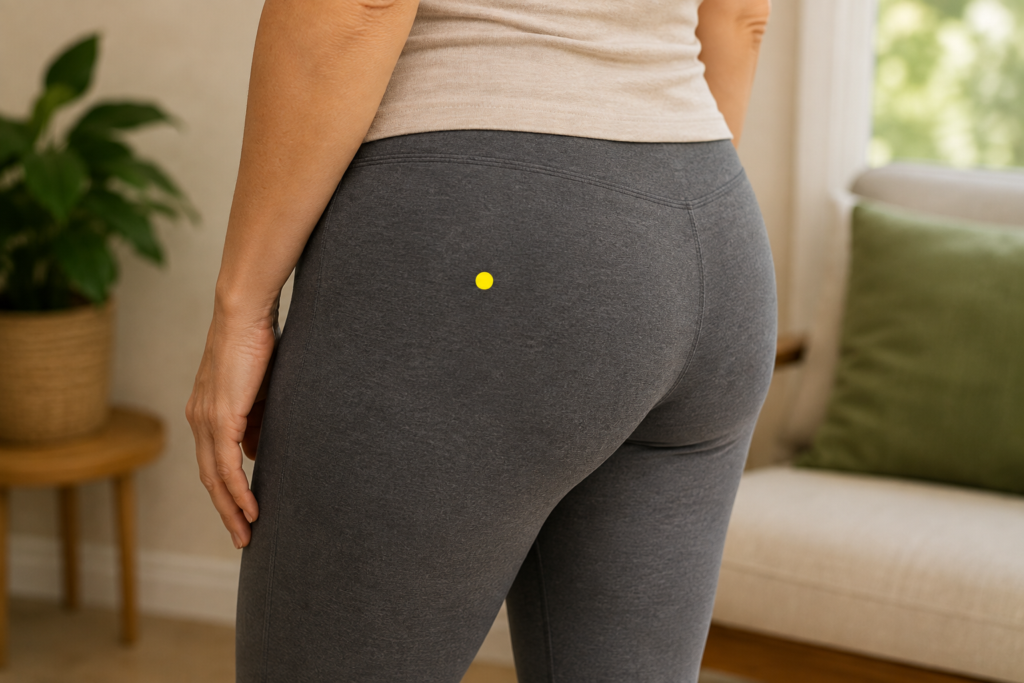
6. Press on GB30 in the buttock for low back and hip pain. GB30 sits on the side of the buttock, about a third of the way along an imaginary line from the bony bump at the top of the outer thigh to the base of the tailbone. Lie on a tennis ball and let your weight press into it for thirty to ninety seconds, rolling slowly to find the most tender spot. GB30 is called “Huantiao.”
Trigger points in the muscles of your buttocks often lead to pain spreading into your lower back, hip, and leg. The GB30 point is located above these muscles and is well known for helping to relieve pain in this area. It is a simple and effective way to treat it: apply steady pressure with a tennis ball. Knots in this area are a common cause of pain similar to sciatica and tend to form quickly when you spend long hours sitting or driving.
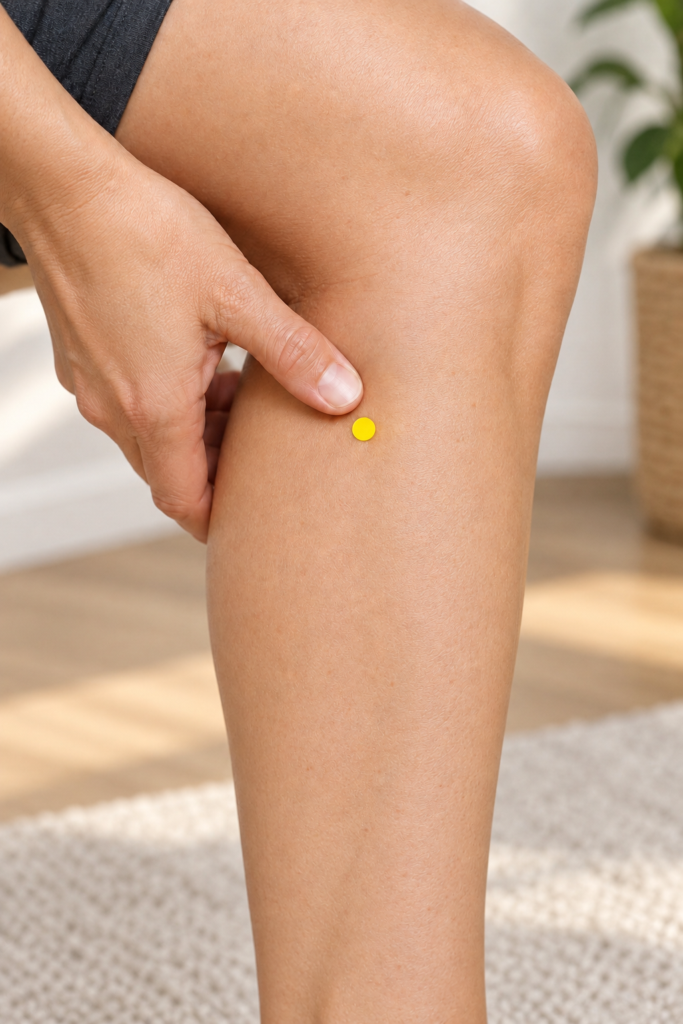
7. Press on GB34 below the outer knee to relax the sinews. GB34 sits on the outer lower leg, in the hollow just below and in front of the head of the fibula, the bony knob below the outer side of the knee. Press firmly with your thumb for one to two minutes on each leg. GB34 is called “Yanglingquan,” the influential point for the sinews.
GB34 supports the body’s sinews, muscles, and connective tissues by helping relax tight muscles throughout the body and may release trigger points even when they are located away from this area; thus, it works no matter where your knots are. It is suitable to use as the final point since it enables the entire body to retain the release you have just achieved.
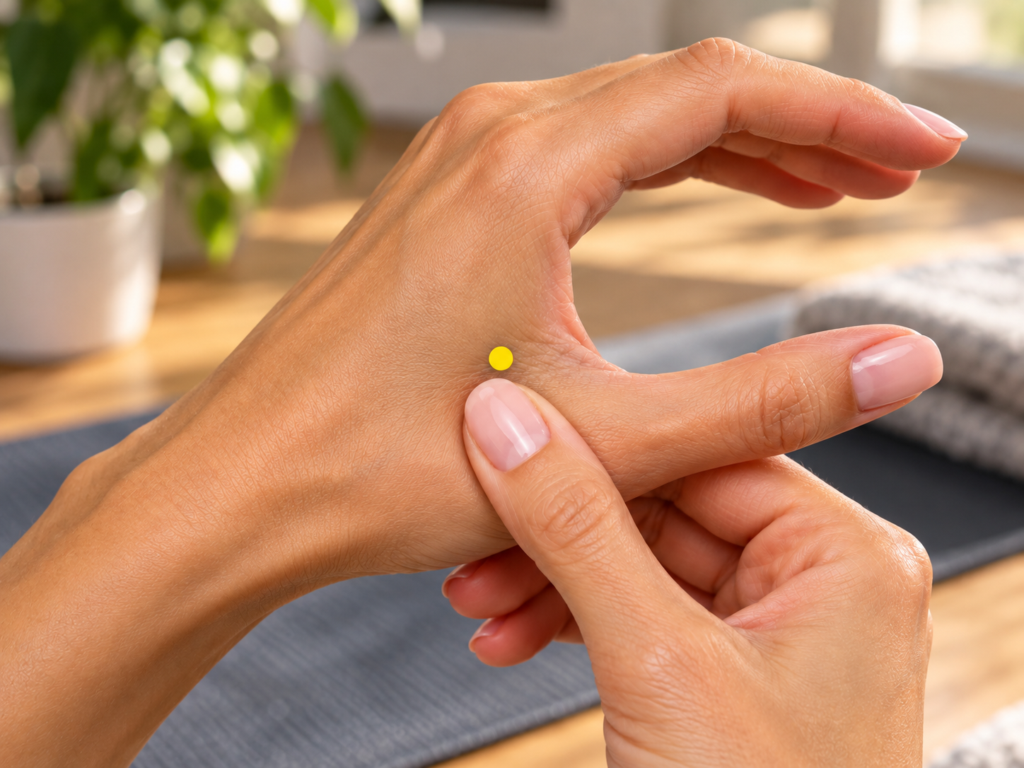
8. Press on LI4 in the hand to ease pain. LI4 sits in the webbing between the thumb and index finger, at the highest point of the muscle when you bring the thumb and index finger together. Press firmly with the thumb of your other hand for one to two minutes on each hand. LI4 is called “Hegu.” LI4 is avoided during pregnancy.
LI4 is very effective at relieving pain, especially in the head, neck, and shoulders; when it is used together with LR3, the Four Gates are formed, a traditional pair employed to move stagnant Qi and reduce pain throughout the body, and since LI4 is easy to access, it can be used during the workday when one is unable to lie on a tennis ball.
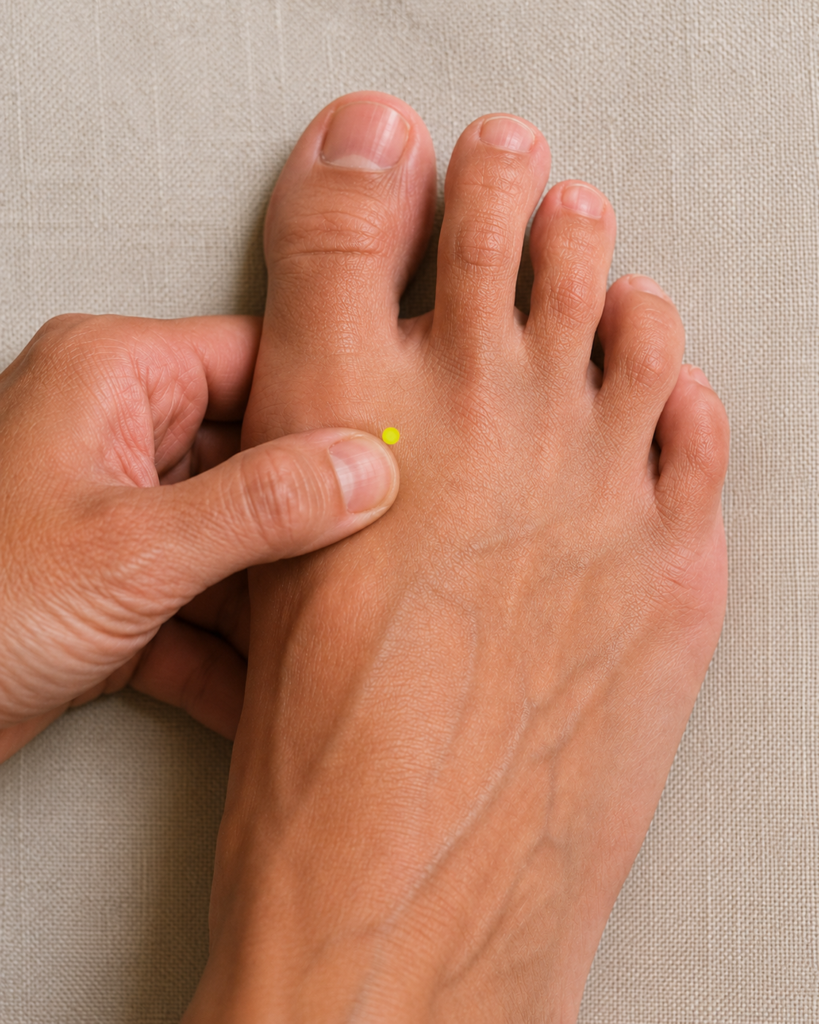
9. Press on LR3 on the top of the foot to release stress-held tension. LR3 sits on the top of the foot, in the webbing between the big toe and second toe, about two finger-widths back from the webbing, in the hollow just before the two bones meet. Press firmly with your thumb for one to two minutes on each foot. LR3 is called “Taichong.”
Stress can lead to muscle tension and the development of trigger points, especially in the jaw, neck, and shoulders. LR3 aids in releasing blocked Liver Qi, reduces tension, and enables the sinews to relax. Together with LI4, it forms the Four Gates. If your knots tend to become more noticeable during weeks when you are under stress, then LR3 should be included in your daily routine even on those days when the pain is not present.
Why These Acupressure Points Work
In Traditional Chinese Medicine, myofascial pain is viewed as Qi and Blood becoming trapped in the muscles, accompanied by tight sinews and stress-induced tension. The nine points mentioned above aim to target and resolve these problems.
- The trigger point areas, Ashi points, GB20, GB21, SI11, and GB30, help release the knots where myofascial pain usually starts.
- The Blood and sinew points, BL17 and GB34, help move stagnation and relax muscles throughout your body.
- The Four Gates, LI4 and LR3, help ease pain and release the stress that keeps your muscles tight.
How to Properly Use These Acupressure Points
- Start by warming the area with a heat pack or a warm shower. This helps your muscles relax and makes it easier to release knots.
- For each knot, press steadily so the discomfort is about five to seven out of ten. Hold for thirty to ninety seconds, until the tenderness lessens or the knot softens. Remember to breathe slowly the whole time.
- If you cannot reach a point comfortably with your hands, use a tennis ball or a firmer massage ball against a wall or the floor.
- After you release a knot, gently stretch that muscle through its full range of motion to help it stay relaxed.
- Never press so hard that the pain becomes sharp. Avoid pressing on areas that are bruised, swollen, or injured.
- End your routine by working on GB34, LI4, and LR3. Do this routine once a day, or twice a day if you have stubborn knots.
It’s normal to experience mild soreness the day after working on a stubborn knot, similar to the feeling after a deep massage. If an area feels bruised or more painful, take a day off and apply lighter pressure during your next session.
Sample routines
- Daily routine (ten to fifteen minutes): Warm up with heat, then work your Ashi points and the trigger point areas that match your pain, followed by BL17, and finish with GB34, LI4, and LR3.
- Desk break (three minutes): GB21 on each side, GB20, then LI4. Follow with a slow shoulder roll and a gentle chin tuck. Repeat every couple of hours on long workdays.
- During a flare: Use heat first, then gentler pressure, around four to five out of ten, on the Ashi points near the pain. Add LI4 and LR3 for the Four Gates, and keep moving gently rather than holding still.
- Before bed: Lie on two tennis balls at BL17, then shift one ball to SI11 or GB30, depending on where you hold tension. Finish with LR3 to settle the stress of the day.
Preventing Trigger Points From Returning
It is just as important to prevent trigger points as it is to release them. Arrange your workstation so that the screen is at eye level and your shoulders are relaxed. Take a break involving movement every thirty to sixty minutes. Where possible, vary your repetitive tasks. Stay active by doing regular light exercise and stretching, and work on strengthening the muscles that help to maintain good posture. Control your stress because tension can lead to trigger points, and ensure that you get sufficient sleep since bad sleep can make the muscles more sensitive and exacerbate pain. Drink enough fluids, especially in the Arizona heat.
Use warmth instead of ice for muscles that are always tight, as Chinese medicine recommends. Ice tightens the tissue and slows circulation, which is the opposite of what a knot needs; reserve brief icing for the first moments after an acute injury, then switch to heat. We explain the reasoning behind why Traditional Chinese Medicine does not like ice.
The few principles of Chinese medicine include keeping the back of the neck and shoulders covered when the air conditioning is strong and avoiding sleeping with a fan blowing on them. It is better to eat warm, cooked food since this helps the Spleen and the blood which nourish the sinews. Find a daily way to relieve stress, for example, by taking a walk, doing tai chi, or practicing slow breathing, since stagnant Liver Qi is one of the most common causes of recurring knots.
How Acupuncture Can Help
For stubborn or recurring trigger points, treatment in the clinic can go further than home acupressure. Acupuncture works directly on the knot and on distant points that address the pattern behind it, and gentle electroacupuncture can strengthen the release in long-standing cases. Cupping lifts and releases tight tissue across the back and shoulders, and running cupping works along whole muscle chains.
If you have been offered dry needling, our guide to dry needling vs acupuncture explains the differences in training and approach.
When to Get Professional Help
See a doctor if your muscle pain is severe, persistent, or not improving with self-care. This helps confirm the diagnosis and rule out other causes. Seek immediate medical attention if you experience pain along with a fever, nighttime pain that doesn’t improve with rest or position changes, unexplained weight loss, pain after a fall or injury, a swollen, red, or hot joint, or numbness, tingling, or weakness in your limbs. If your pain is widespread and you also feel tired, have trouble sleeping, or difficulty concentrating, consult your doctor about fibromyalgia. Call emergency services if you have chest pain, pressure, or pain spreading to your left arm, jaw, or back, especially if accompanied by shortness of breath or sweating, as these could indicate heart problems that sometimes mimic muscle pain.
Acupressure offers a practical method to release trigger points and reduce myofascial pain, and it can be combined with medical and physical therapy treatments as needed.
Above and Beyond Acupuncture offers acupuncture, cupping, and lifestyle coaching at the North Frank Lloyd Wright Boulevard location in Scottsdale.
Schedule an appointment online to start your healing journey.
If your pain is widespread rather than in specific areas, acupressure for fibromyalgia is the better fit; for long-standing pain more broadly, acupressure for chronic pain is a companion piece. For specific regions of the body, acupressure for neck pain and acupressure for upper back pain are more specific.
The points above are only as effective as the technique used to apply them. Where to press, how firmly, and for how long all affect the result. For a full breakdown of how to perform acupressure properly at home, read Performing Acupressure in 3 Easy Steps.

About the Publisher
Paul Kerzner, L.Ac., is a licensed acupuncturist and board-certified herbalist, as well as the founder of Above and Beyond Acupuncture in Scottsdale. His own journey from chronic patient to practicing acupuncturist shapes his commitment to providing honest, clinically grounded information about acupuncture and Traditional Chinese Medicine. Learn more about Paul and his clinical approach on the About Us page.