Key Takeaways
- Gentle touch is among the first ways babies learn to feel comfort. Infant massage may also help them fall asleep faster, sleep longer, and experience fewer colic and digestive problems.
- Babies respond best to gentle, slow, rhythmic touch in a warm room when they’re awake, rested, and at least 30 minutes past a feeding.
- In Traditional Chinese Medicine, a baby’s digestion and Lung are still delicate, and their spirit is easily startled. That’s why many common baby concerns involve the belly, nose and chest, or sleep.
- Nine acupressure points across the face, arms, hands, belly, legs, and feet create an easy daily routine to support calm, digestion, and overall strength.
- Acupressure may help keep a baby comfortable, but it doesn’t replace care from a pediatrician. Any baby under three months with a temperature of 100.4°F or higher needs immediate medical attention.

The first few months with a baby are full of little worries, from short naps and a gassy tummy to a blocked nose, teething, or a cry that just won’t stop. Most of these things pass with time, but in the moment, you may be looking for something gentle you can do yourself. Acupressure is one option. It uses the same gentle touch your baby is already used to.
According to Children’s Wisconsin, infant massage may help babies fall asleep faster, sleep longer, and gain weight more quickly. It may also ease colic and digestive problems. Children’s Wisconsin recommends massaging the baby in a warm, comfortable room when they are awake, rested, and playful. Wait 30 minutes after feeding, and start with three to five minutes twice a day, gradually increasing to about 20 to 30 minutes a day. If the baby becomes upset, stop and try again later.
Acupressure builds on infant massage by focusing that gentle touch on specific points. For a baby, the pressure is always much lighter than for an adult, more like a soft fingertip resting on the skin than a firm press. A few minutes a day, worked into a diaper change, bath, or bedtime routine, is enough to create a calming ritual for both baby and parent.
Traditional Chinese Medicine has a long history of caring for babies and young children. A baby’s Spleen and Stomach are considered delicate, so changes in feeding, swallowed air, or feeding too much at once can easily lead to gas, spit-up, and changes in stool. The Lung is also delicate, making babies prone to a stuffy nose and cough when exposed to Wind and Cold. Babies are full of Yang energy and easily startled, so a little extra Heat or a busy day can quickly lead to fussiness, crying, and restless sleep. A short set of points that calms the mind, settles digestion, and strengthens the body addresses nearly every common baby concern.
The points below start on the face, move to the arms and hands, continue to the belly, and finish on the legs and feet. On a baby, all distances are measured using the baby’s own finger-widths, not an adult’s.
What Acupressure Points to Press and Why
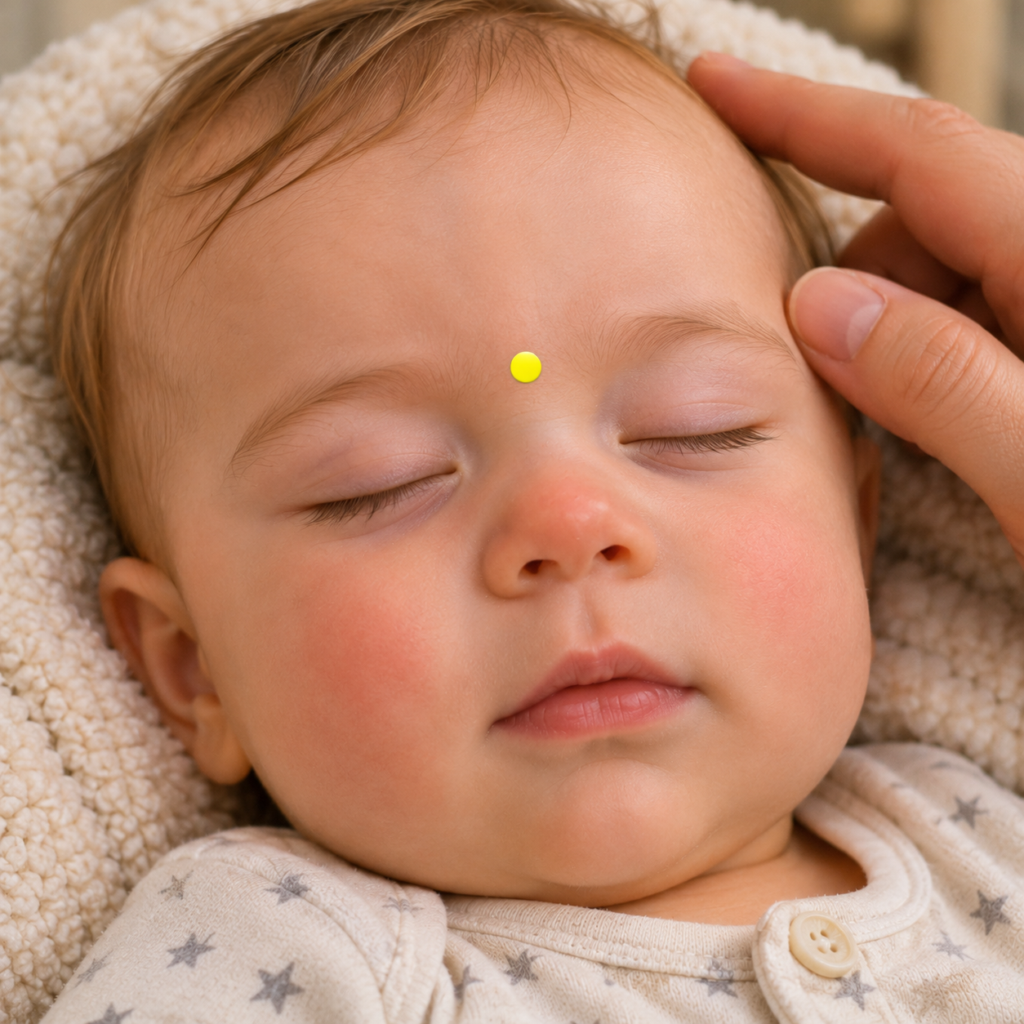
1. Stroke Yintang between the eyebrows to calm the mind. Yintang sits at the midpoint between the baby’s eyebrows. With the pad of your thumb, stroke gently upward from Yintang toward the hairline, alternating thumbs, for 30 seconds to one minute. Yintang means the “Hall of Impression.”
Yintang is an extra point traditionally used to promote calm, alleviate restlessness, and relieve nasal congestion. It offers a gentle starting point for any routine and may help babies settle for sleep.
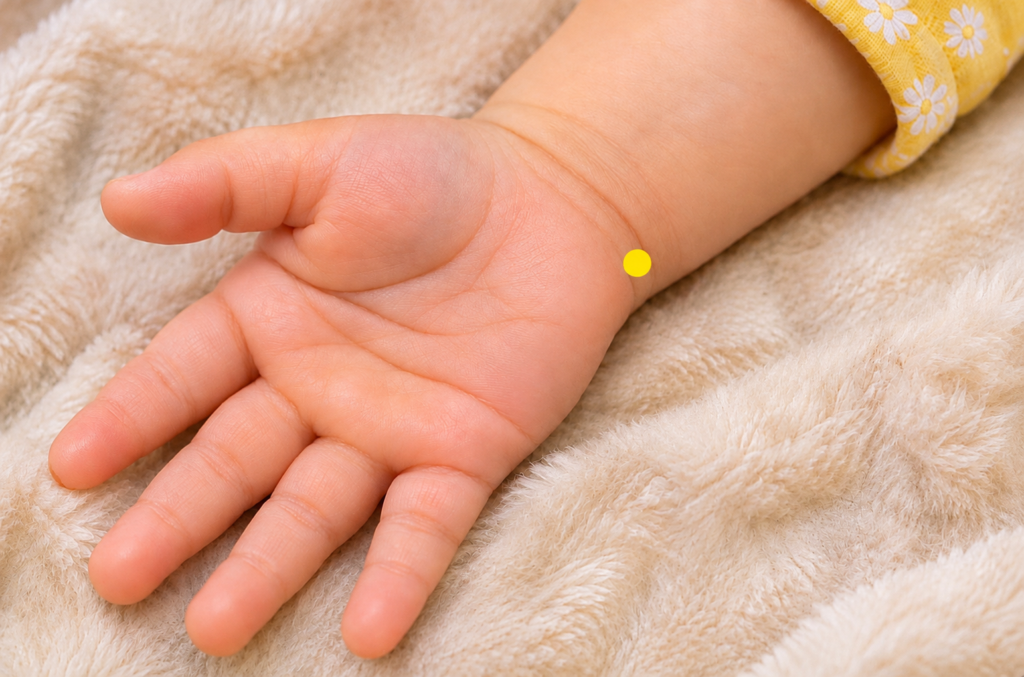
2. Press HT7 on the wrist crease to settle the spirit. HT7 sits on the inner wrist crease, on the little finger side, in the small hollow just inside the tendon. Hold the baby’s hand palm up and rest your fingertip on the point with very light pressure, or make tiny circles, for 30 seconds on each wrist. HT7 is called “Shenmen,” the “Spirit Gate.”
HT7 is the source point of the Heart. It is traditionally used to calm the Shen and address crying, restlessness, and difficulty falling asleep.
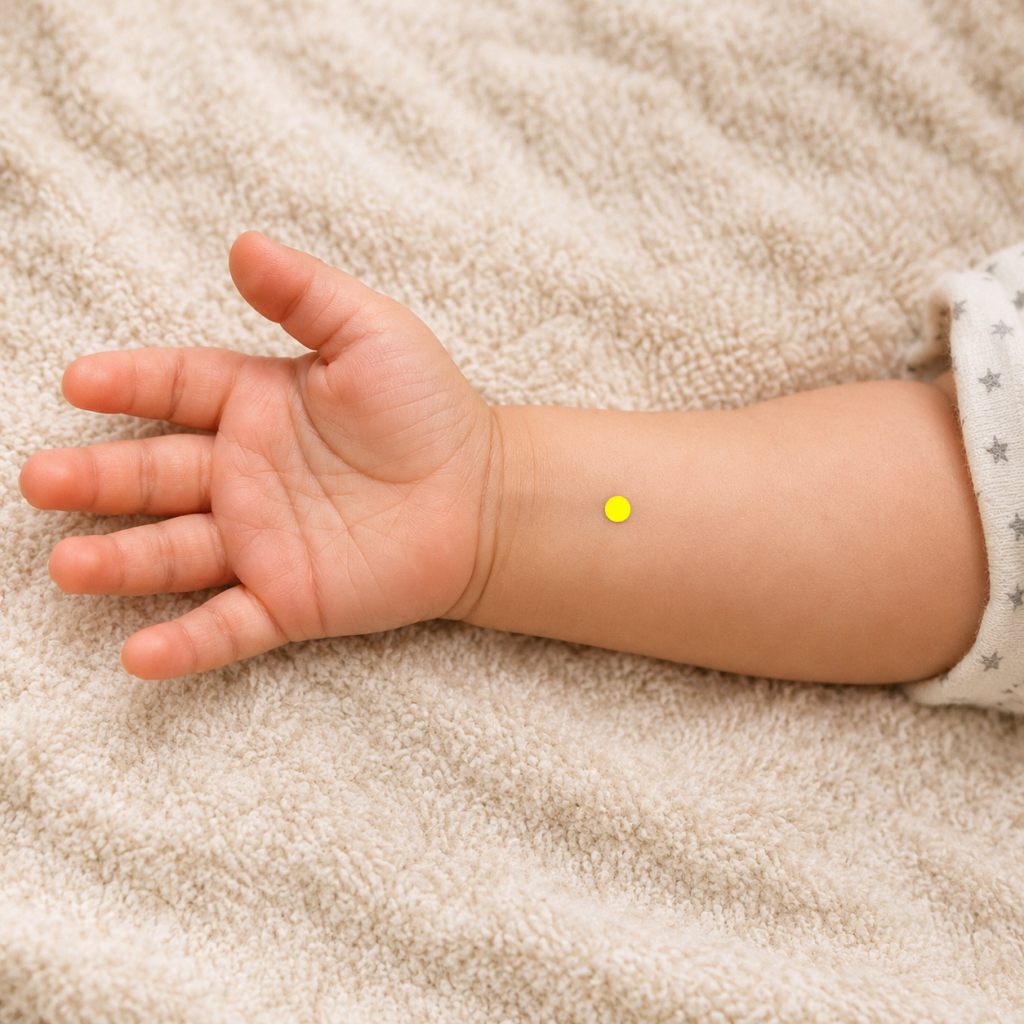
3. Press PC6 on the inner forearm to settle the stomach. PC6 sits on the inner forearm, about two of the baby’s finger-widths above the wrist crease, between the two tendons in the middle of the forearm. Make tiny, light circles with your fingertip for 30 seconds on each arm. PC6 is called “Neiguan,” the “Inner Gate.”
PC6 is the connecting point of the Pericardium. It is traditionally used to calm the Stomach and mind and to address regurgitation, hiccups, and stomach discomfort.
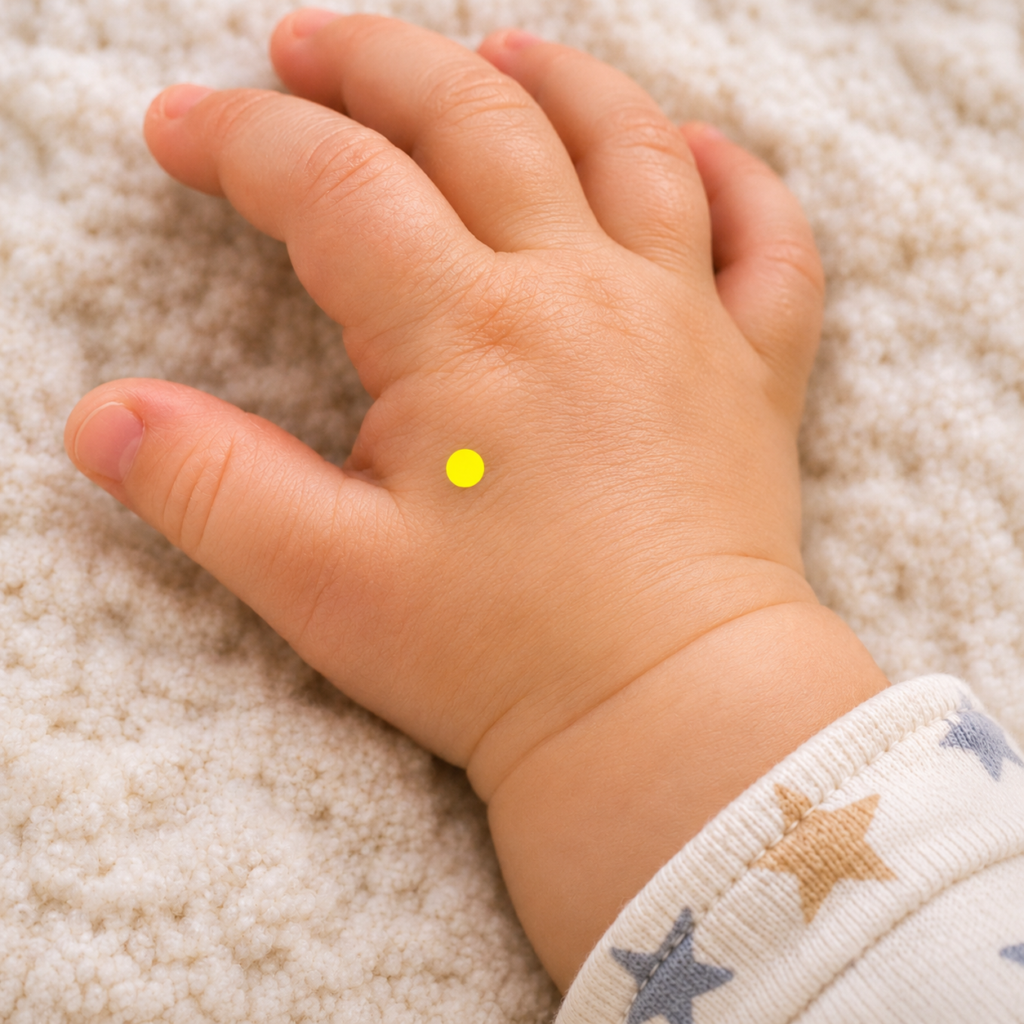
4. Press LI4 on the back of the hand to ease discomfort. LI4 sits on the back of the hand, in the fleshy web between the thumb and index finger. Hold the baby’s hand and make tiny, light circles on the point for 30 seconds on each hand. LI4 is called “Hegu,” the “Joining Valley.”
LI4 is the source point of the Large Intestine. It is traditionally used to dispel Wind at the onset of a cold and to alleviate discomfort in the face, mouth, and gums, including discomfort associated with teething.
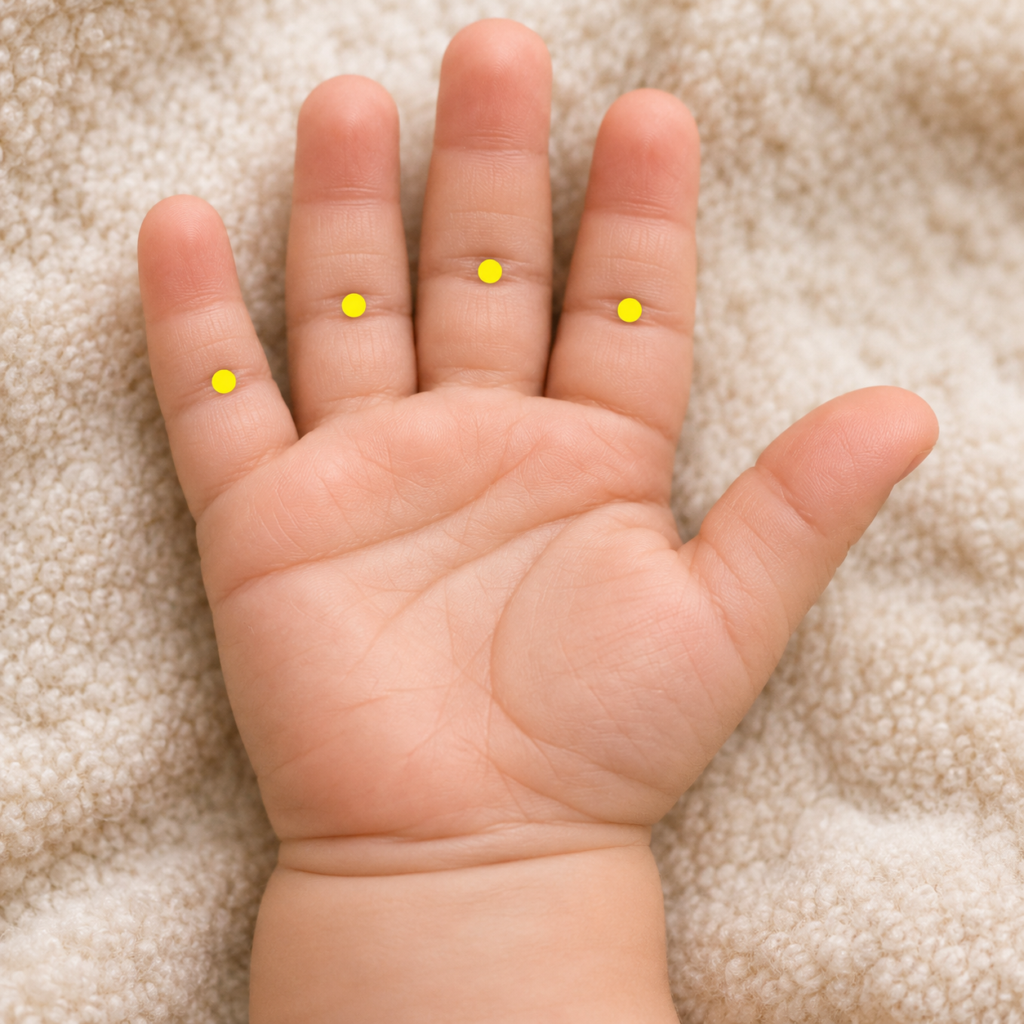
5. Press Sifeng on the fingers to ease digestion. Sifeng is a group of four points on the palm side of the index, middle, ring, and little fingers, at the center of the crease closest to the middle of each finger. Gently press or stroke each crease with your fingertip for a few seconds, moving from finger to finger, for 30 seconds on each hand. Sifeng means the “Four Seams.”
Sifeng is an extra point traditionally used in children to address poor digestion, bloating, and food stagnation.
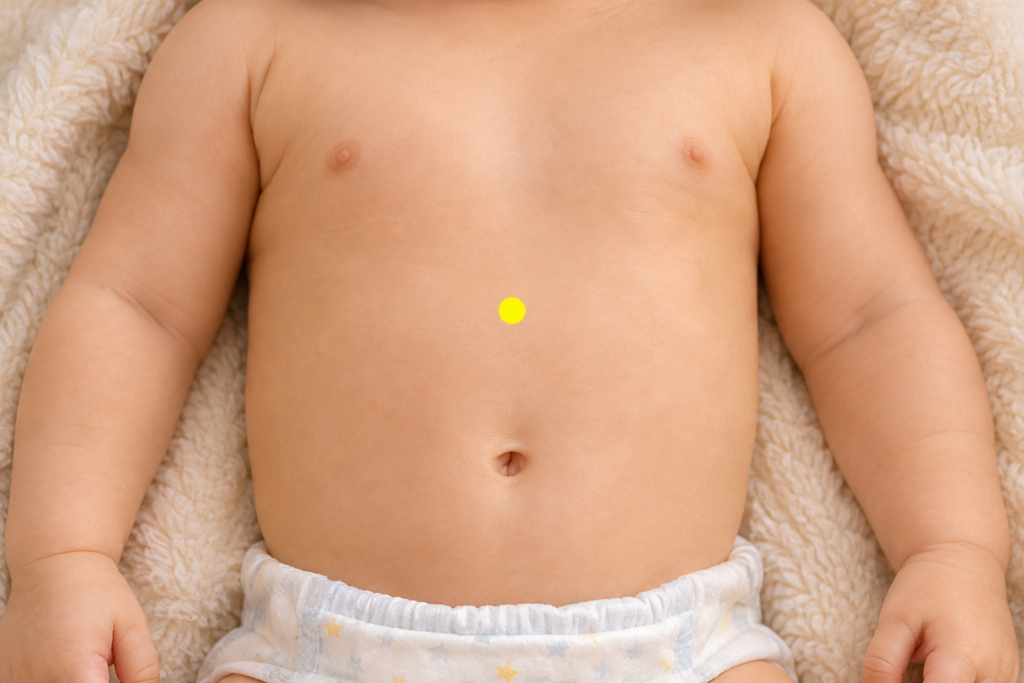
6. Circle CV12 on the belly to settle digestion. CV12 sits on the midline of the belly, halfway between the navel and the bottom of the breastbone. Rest your whole palm lightly on the belly and make slow clockwise circles around the navel, passing over CV12, for one to two minutes. CV12 is called “Zhongwan,” the “Middle Cavity.”
CV12 is the alarm point associated with the Stomach. Gentle circular abdominal massage may help relieve gas and reduce fullness after feeding.
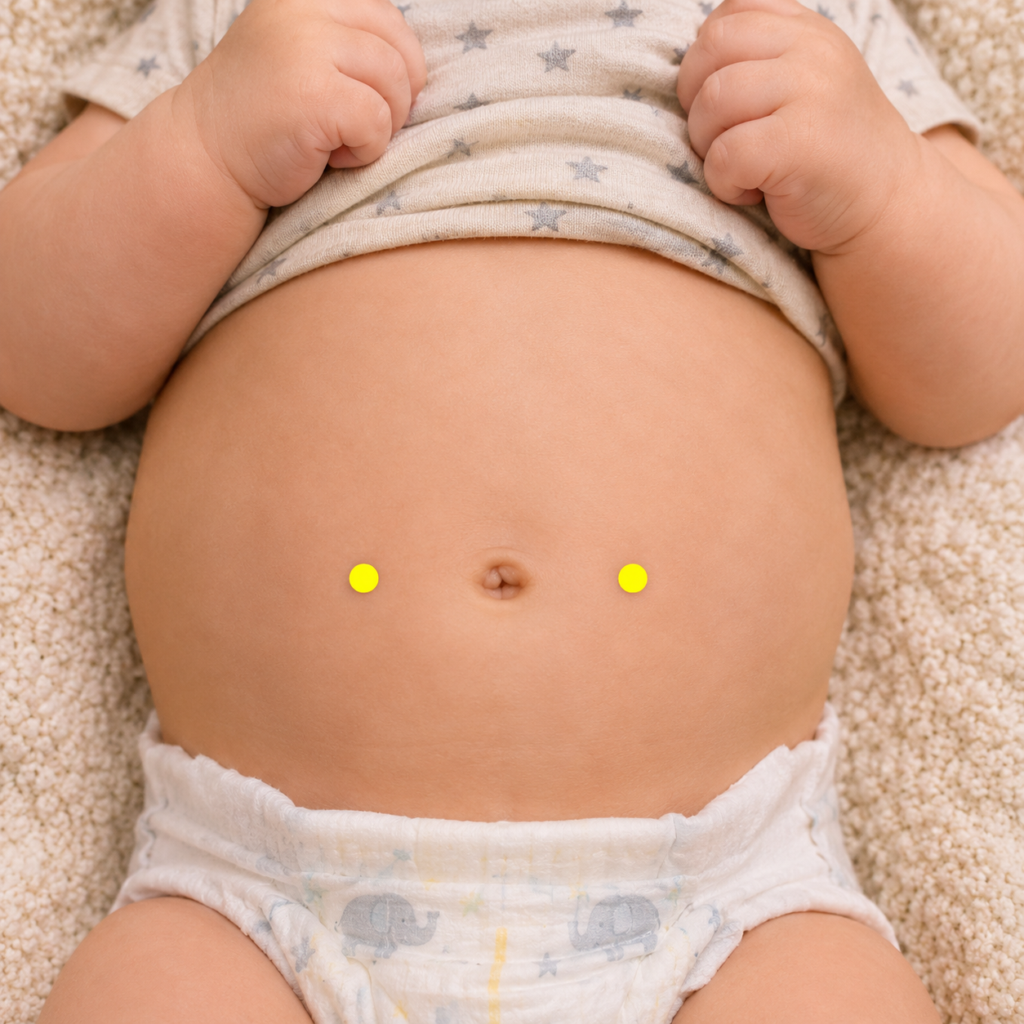
7. Press ST25 beside the navel to regulate the bowels. ST25 sits on both sides of the navel, about two of the baby’s finger-widths out from the center of the navel. Rest your fingertips on both points at the same time with very light pressure for 30 seconds. ST25 is called “Tianshu,” the “Heavenly Pivot.”
ST25 is the alarm point of the Large Intestine. It helps regulate intestinal function and is traditionally used to address gas, constipation, and loose stools.
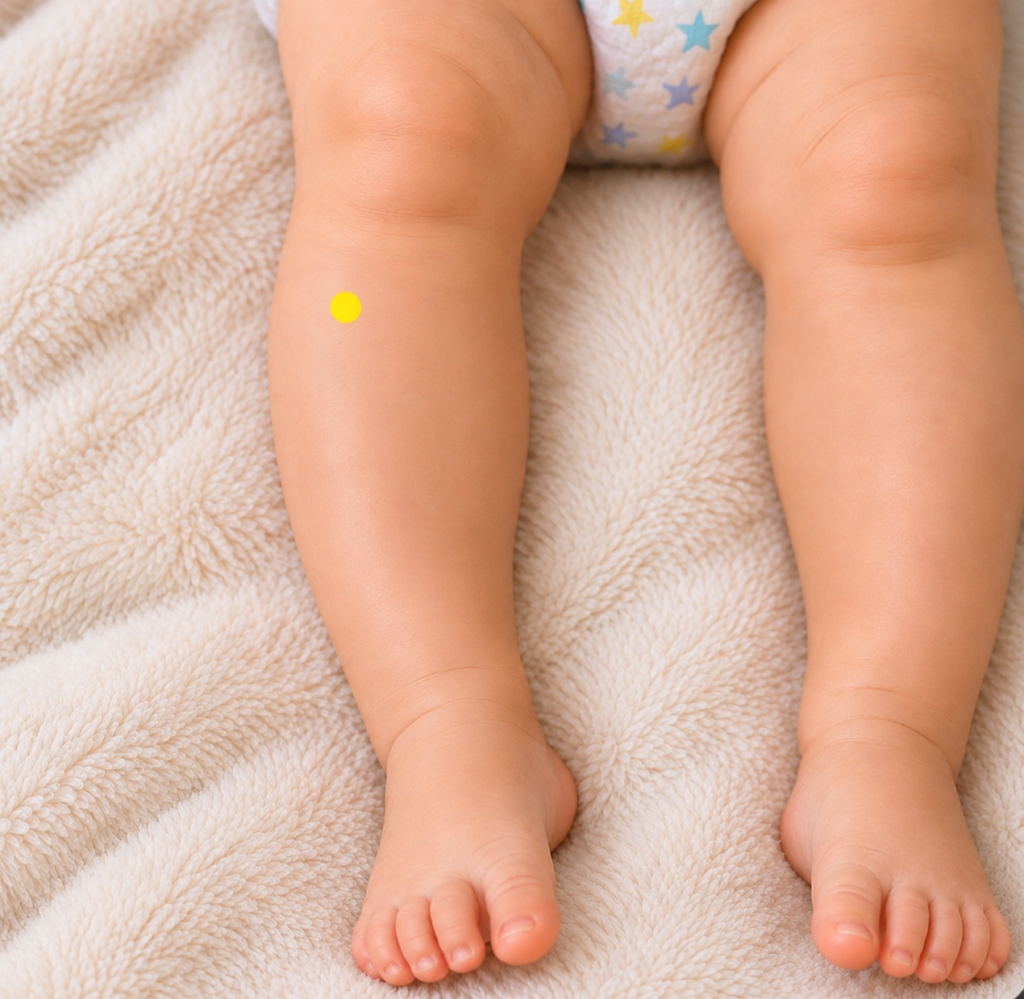
8. Press ST36 below the knee to strengthen the body. ST36 sits on the front of the lower leg, about four of the baby’s finger-widths below the bottom of the kneecap and one of the baby’s finger-widths out from the edge of the shinbone. Make tiny, light circles with your fingertip for 30 seconds on each leg. ST36 is called “Zusanli,” the “Leg Three Miles.”
ST36 is the sea point of the Stomach and one of the most important points in Traditional Chinese Medicine for strengthening the body. It is believed to support an infant’s digestion, appetite, and overall vitality.
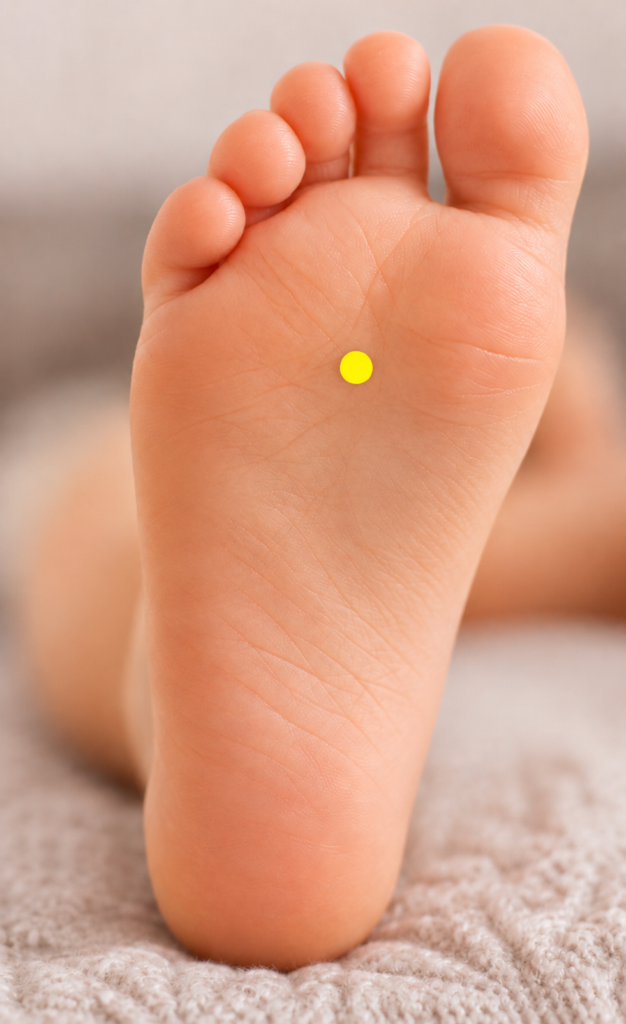
9. Rub KI1 on the sole of the foot to draw energy down. KI1 sits on the sole of the foot, in the small hollow near the front of the foot, about one-third of the way from the base of the toes to the back of the heel. Rub gently with your thumb in small circles for 30 seconds on each foot. KI1 is called “Yongquan,” the “Bubbling Spring.”
KI1 is the body’s lowest point and the well point of the Kidney. Gently rubbing the soles of the feet helps draw energy downward, away from a busy mind, and provides a soothing way to conclude.
Why These Acupressure Points Work

From the perspective of Traditional Chinese Medicine, many common concerns in infants are associated with delicate digestion, a sensitive Lung, or a spirit that is easily startled. Points on the face and wrist are used to calm the mind; points on the arm and hand are used to settle the Stomach and release Wind; points on the abdomen are used to regulate digestion; and points on the legs and feet are used to strengthen the body and direct energy downward.
The nine points collectively form a daily routine for infants:
- Yintang, HT7, and KI1 calm the mind and support sleep.
- PC6, Sifeng, CV12, and ST25 settle digestion.
- LI4 releases Wind and relieves facial and gum discomfort.
- ST36 strengthens the body and supports appetite.
How to Properly Use These Acupressure Points

For best results, practice acupressure with your baby in a warm, quiet room, on a soft, safe surface, when they’re calm and awake and at least 30 minutes after feeding.
- With the baby lying on their back, begin by applying gentle, upward strokes to Yintang.
- Proceed to the arms and hands, applying light pressure to HT7, making small circular motions over PC6 and LI4, and using gentle strokes across Sifeng.
- Make slow, clockwise circular motions over CV12, then lightly rest your fingertips on ST25 on both sides of the navel.
- Conclude with gentle circular motions on ST36, followed by a light rub of KI1 on both soles.
- Use only light, slow fingertip pressure, much lighter than you would on an adult. Stop if the baby fusses, stiffens, or seems uncomfortable. Avoid the soft spots on the top of the head. Do not use these points on broken, irritated, or rashy skin, or on the navel area until the umbilical cord stump has fully healed.
For a specific concern, each of these guides offers its own set of points and home care:
- acupressure to help a baby sleep
- acupressure for a crying baby
- acupressure for colic
- acupressure for baby gas
- acupressure for baby reflux
- acupressure for baby hiccups
- acupressure for baby constipation
- acupressure for baby diarrhea
- acupressure for teething
- acupressure for baby cold
- acupressure for baby cough
- acupressure for baby fever
Simple habits can support these recommendations. Children’s Wisconsin recommends maintaining a warm room; choosing a time when the baby is awake, rested, and playful; beginning with short sessions of three to five minutes twice daily; and stopping and trying again later if the baby becomes upset. Parents of babies with epilepsy or a seizure disorder, recent surgery, or special health care needs should consult the baby’s doctor before beginning. Always place babies on their backs to sleep. Traditional Chinese Medicine also recommends keeping the baby’s belly and feet comfortably warm, feeding in a calm, quiet setting, and reducing noise and activity in the evening.
Learn more about whether acupressure is safe for kids.
When to Get Professional Help

Call 911 if a baby has difficulty breathing, develops blue or gray discoloration around the lips, experiences a seizure, or is limp or extremely difficult to wake. Seek immediate medical care for any baby under three months of age with a temperature of 100.4°F or higher; signs of dehydration, such as a dry mouth, absence of tears, or significantly fewer wet diapers than usual; green, forceful, or repeated vomiting; or blood in the stool. Contact the pediatrician if the baby is feeding poorly, gaining weight inadequately, crying in a high-pitched or unusual manner, or seems unusually sleepy or irritable, or if any concern does not improve. Parents who feel overwhelmed, hopeless, or unable to cope should contact their own doctor, as support for parents is also important.
Acupressure is a gentle, supportive practice for babies. It complements, and does not replace, diagnosis and medical care.
For related health concerns, acupuncture for kids, acupressure for postpartum anxiety, and acupressure for postpartum depression are companion articles.
Above and Beyond Acupuncture offers acupuncture, cupping, and lifestyle coaching at the North Frank Lloyd Wright Boulevard location in Scottsdale.
Schedule an appointment online to start your healing journey.
The points above are only as effective as the technique used to apply them. Where to press, how firmly, and for how long all affect the result. For a full breakdown of how to perform acupressure properly at home, read Performing Acupressure in 3 Easy Steps.

About the Publisher
Paul Kerzner, L.Ac., is a licensed acupuncturist and board-certified herbalist, as well as the founder of Above and Beyond Acupuncture in Scottsdale. His own journey from chronic patient to practicing acupuncturist shapes his commitment to providing honest, clinically grounded information about acupuncture and Traditional Chinese Medicine. Learn more about Paul and his clinical approach on the About Us page.