Key Takeaways
- The wrist is the most commonly injured body part in pickleball and the most frequent site of pickleball fractures, usually resulting from falls onto an outstretched hand.
- Older players are more likely to break a wrist in a fall, while younger players more often sprain it. Players of every age develop tendonitis from repetitive swings and a tight grip.
- In Traditional Chinese Medicine, overuse and impact leave Qi and Blood stuck in the six channels that cross the wrist. The thumb side, pinky side, and back of the wrist each have their own points.
- Nine acupressure points around the wrist, forearm, hand, and leg help ease pain, swelling, and stiffness from tendonitis, sprains, and during recovery after a fracture has healed.
- A wrist that is deformed, severely swollen, or tender in the hollow at the base of the thumb after a fall needs an X-ray first, and acupressure should wait until a doctor has ruled out a fracture.
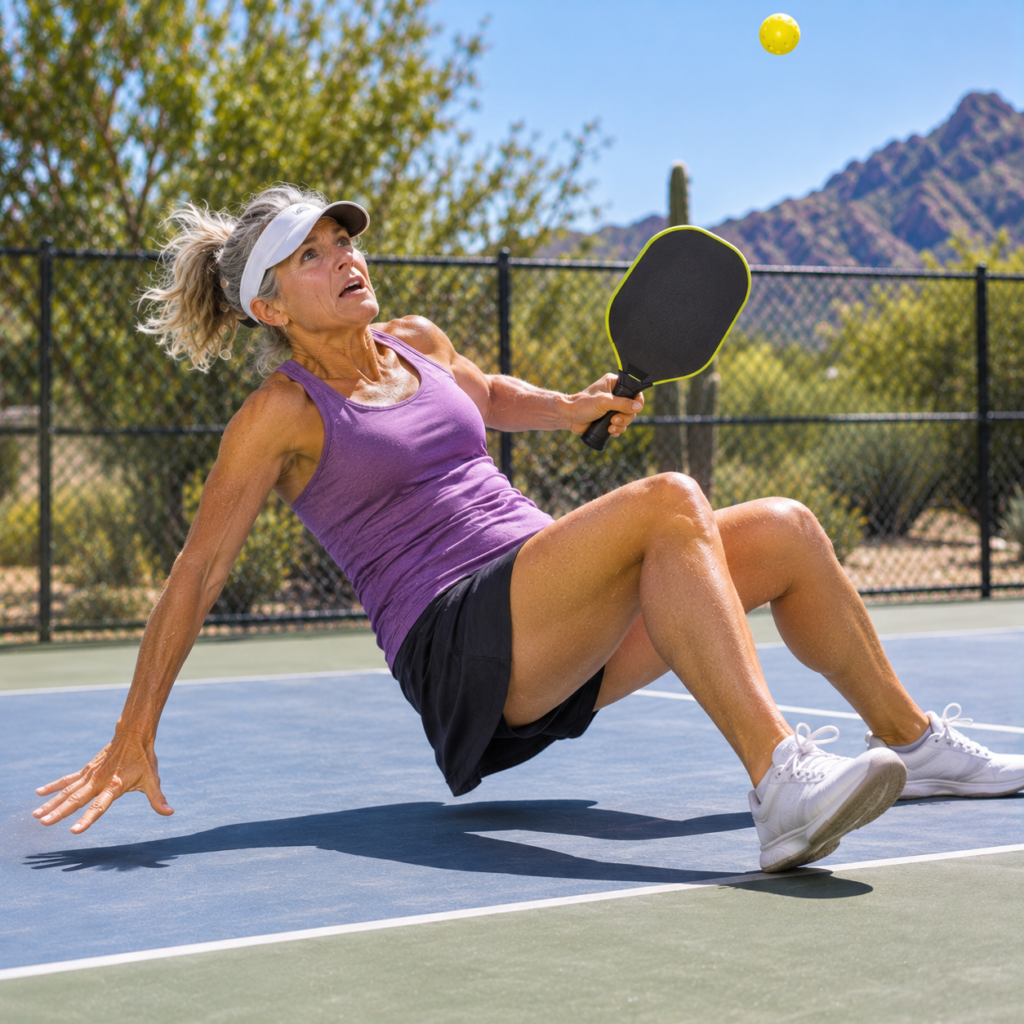
It can happen in a split second: a player backpedals for a lob, catches a heel, and falls, throwing out a hand to break the fall. Other times, there’s no fall at all. A wrist simply starts aching after weeks of fast hand battles at the net and a grip that tightens around the paddle with every game. Either way, the paddle hand takes the hit.
According to the Deseret News, a study published in the Orthopaedic Journal of Sports Medicine reviewed 1,100 pickleball injuries and found that the wrist was the most commonly injured body part. It accounted for 29.2 percent of all fractures, making it the most common site of broken bones. Whitney Meier, physical therapy coordinator at the University of Utah Orthopaedic Center, notes that older players are more likely to suffer traumatic injuries, such as wrist fractures from falls, while younger players more often sprain a wrist.
Overuse also plays a major role. Baptist Health lists wrist sprains and strains among the most common acute pickleball injuries and describes tendonitis as a common overuse injury that causes pain, tenderness, and limited motion. Repeated awkward shots, diving for balls, and gripping and swinging a paddle that does not suit the player can all strain the hands and wrists, especially the paddle hand.
Traditional Chinese Medicine views the wrist as a busy crossroads, where six channels pass on their way to the hand. The Lung and Large Intestine channels run along the thumb side; the Heart and Small Intestine channels, along the pinky side; and the Pericardium and San Jiao channels, through the middle of the front and back. A fall jolts Qi and Blood from their normal flow, leaving them pooled in the joint and causing swelling and sharp pain. Thousands of repetitive swings, meanwhile, gradually wear down the tendons governed by the Liver.
The nine points cover all three sides of the wrist, extend up the forearm to the muscles that control the paddle, and end with two distal points to support the healing process.
What Acupressure Points to Press and Why
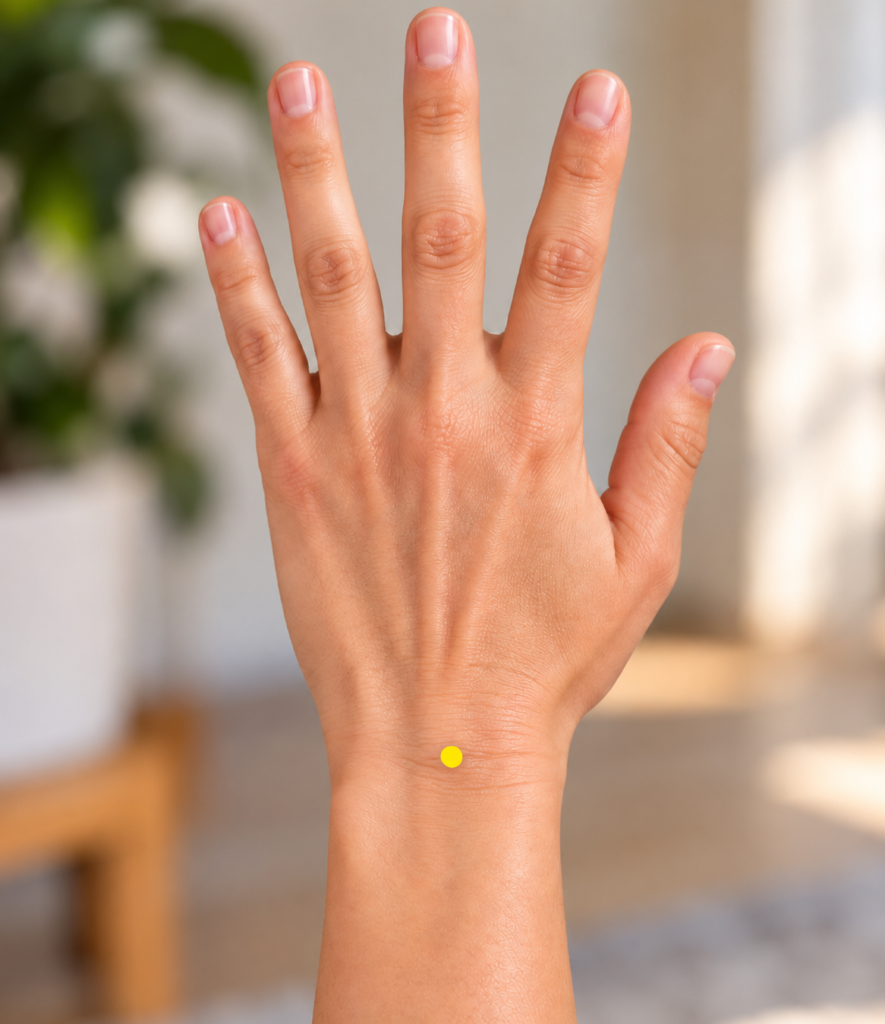
1. Press on TE4 at the back of the wrist to ease pain in the joint. TE4 sits on the back of the wrist crease, in the small hollow near the middle, just toward the pinky side of the tendons that straighten the fingers. Press with moderate pressure for one to two minutes on the sore wrist. TE4 is called “Yangchi,” the “Yang Pool.”
TE4 is the source point of the San Jiao channel and a key local point for wrist pain and stiffness. It lies directly over the back of the joint, where sprains and overuse tend to cause discomfort.
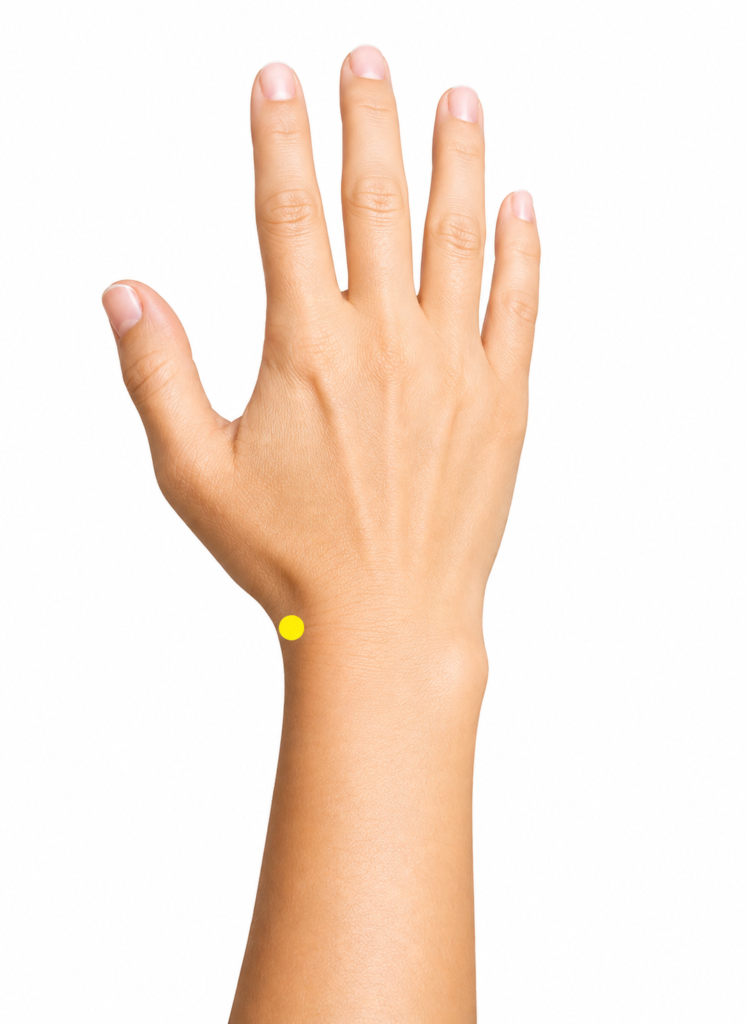
2. Press on LI5 on the thumb side of the wrist to free stiff thumb-side tendons. LI5 sits on the thumb side of the back of the wrist. Lift the thumb up and back, and the point is in the small hollow that forms between the two tendons at the base of the thumb. Press gently for one to two minutes on the sore wrist. LI5 is called “Yangxi,” the “Yang Stream.”
LI5 is used for pain and weakness on the thumb side of the wrist. Because this hollow also lies over a small wrist bone that can break in a fall, press gently and avoid it if it’s sharply tender after a fall.
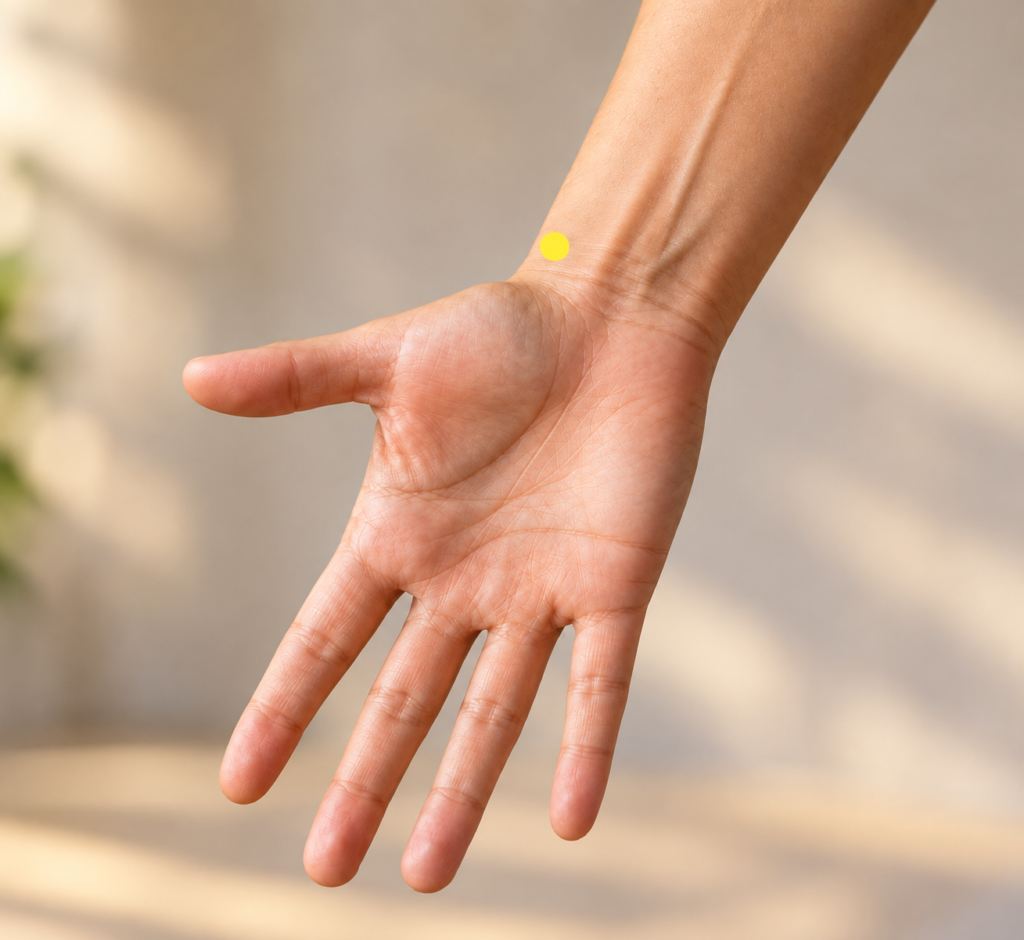
3. Press on LU7 above the wrist to ease thumb-side tendonitis. LU7 sits on the thumb side of the forearm, about two finger-widths above the wrist crease. To find it, interlace the thumbs and index fingers of both hands, and the tip of the top index finger will rest in a small groove just above the bony bump of the wrist. Press gently for one to two minutes on the sore arm. LU7 is called “Lieque,” the “Broken Sequence.”
LU7 lies directly over the tendons that move the thumb, which can become inflamed from repetitive gripping. It can help ease aching on the thumb side of the wrist with each swing or when lifting a pan.
4. Press on SI5 on the pinky side of the wrist to relieve outer wrist pain. SI5 sits on the pinky side of the back of the wrist, in the hollow between the bony knob at the end of the forearm and the small bones of the hand. Press with moderate pressure for one to two minutes on the sore wrist. SI5 is called “Yanggu,” the “Yang Valley.”
SI5 is a classic point for pain on the pinky side of the wrist, where the cartilage and tendons that stabilize the wrist during twisting motions can become irritated. It often feels like an ache when you turn a doorknob or rotate a paddle.
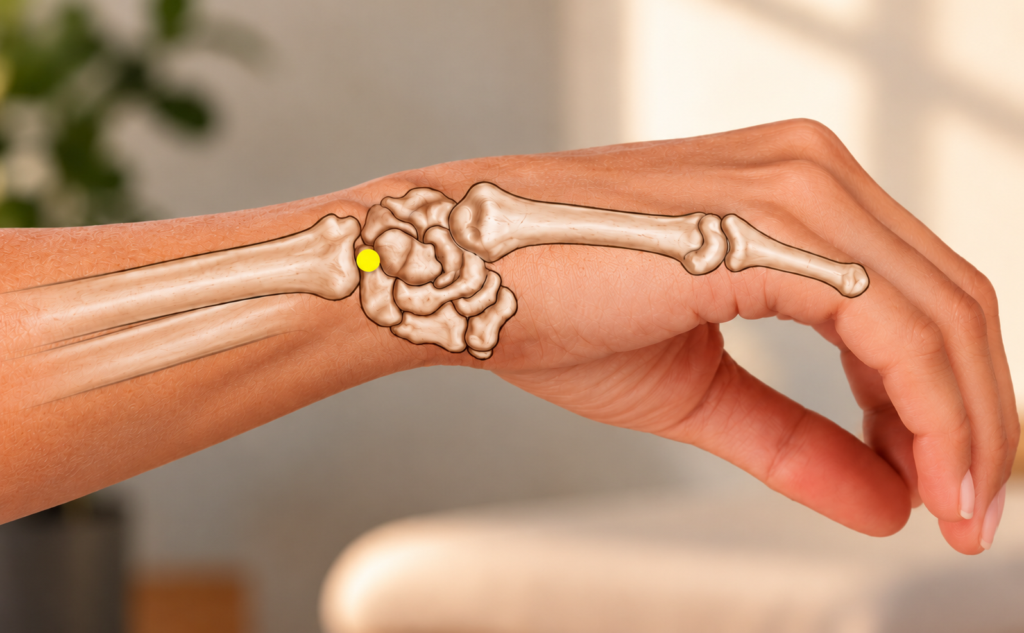
5. Press on SI6 above the pinky side of the wrist for stubborn wrist and forearm pain. SI6 sits on the back of the forearm, on the pinky side, just above the bony knob at the end of the forearm. Turn the palm toward the chest, and the point drops into a small groove at the edge of that knob. Press with moderate pressure for one to two minutes on the sore arm. SI6 is called “Yanglao,” the “Nursing the Aged.”
SI6 is the cleft point of the Small Intestine channel, a type of point used for acute pain. It is also used for lingering wrist and forearm pain, and its name reflects its long use for the aches and stiffness that come with aging.
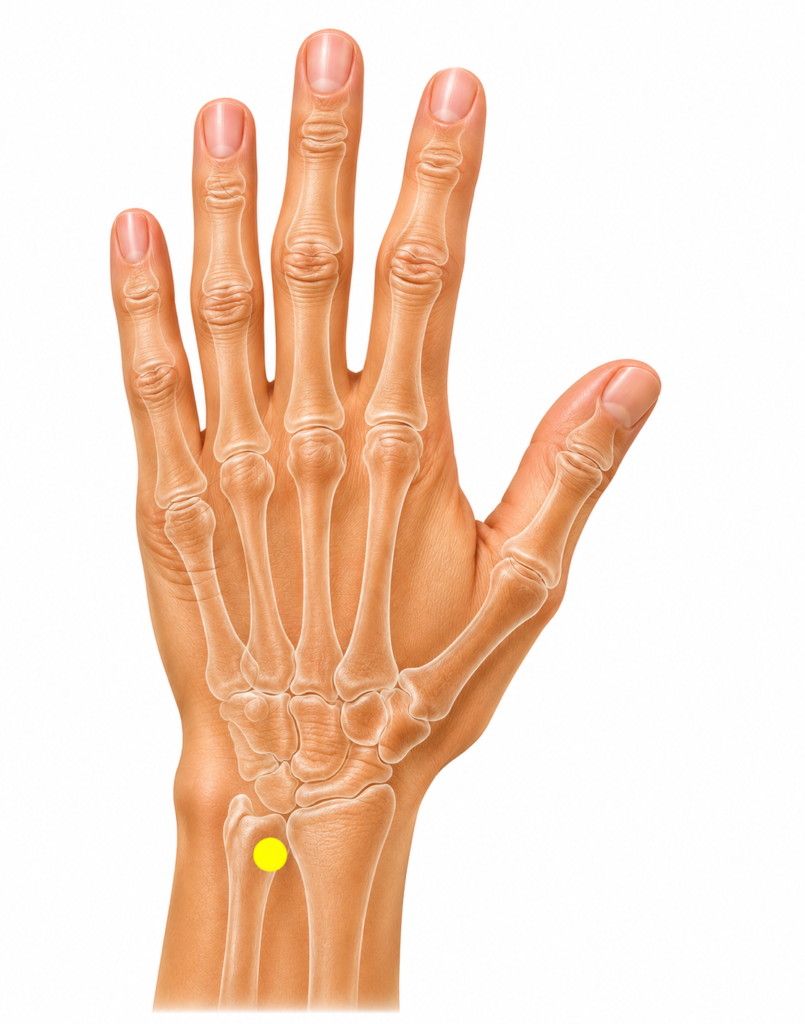
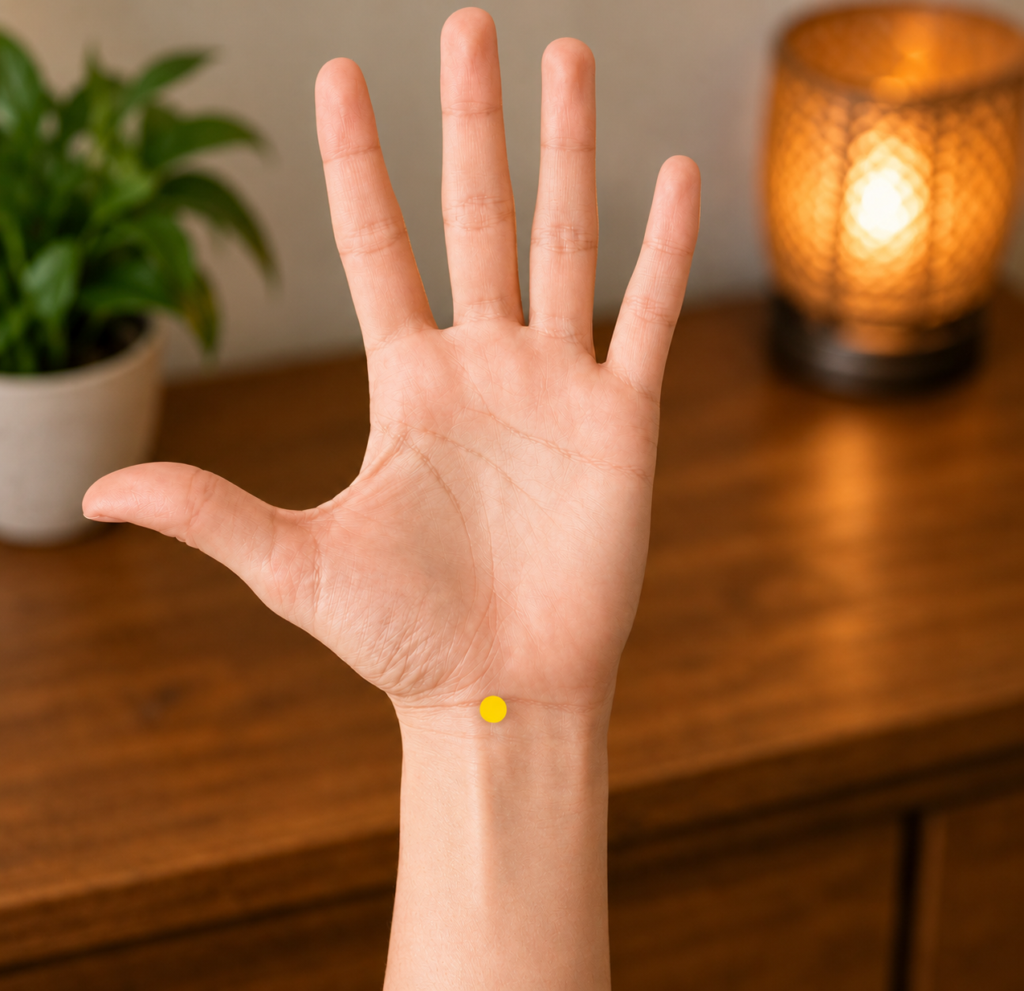
6. Press on PC7 at the center of the inner wrist crease to ease front-of-wrist pain. PC7 sits in the middle of the inner wrist crease, between the two tendons. Press gently for one to two minutes on the sore wrist. PC7 is called “Daling,” the “Great Mound.”
PC7 is the Pericardium’s source point and the primary point for pain at the front of the wrist. It lies over the carpal tunnel, making it useful for a sore wrist accompanied by tingling in the fingers.
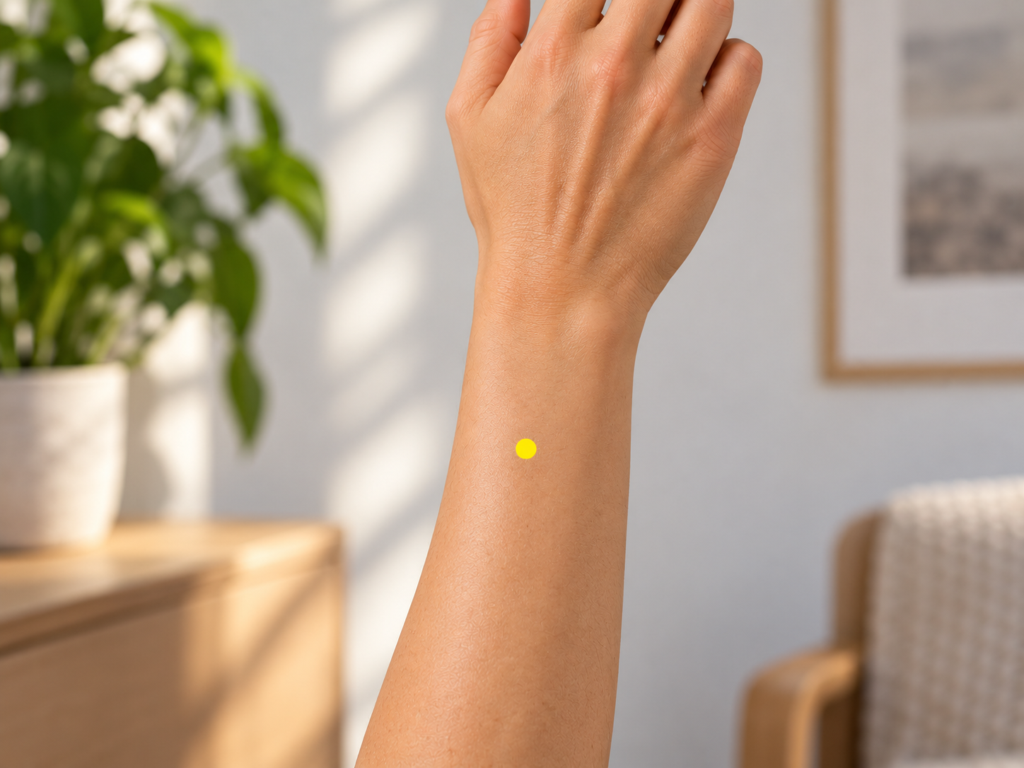
7. Press on TE5 on the back of the forearm to relax the paddle muscles. TE5 sits on the back of the forearm, about three finger-widths above the wrist crease, in the groove between the two forearm bones. Press firmly with your thumb for one to two minutes on the sore arm. TE5 is called “Waiguan,” the “Outer Pass.”
TE5 lies over the muscles that control your wrist and fingers with every stroke. Relaxing these muscles reduces pressure on the tendons as they pass across the wrist.
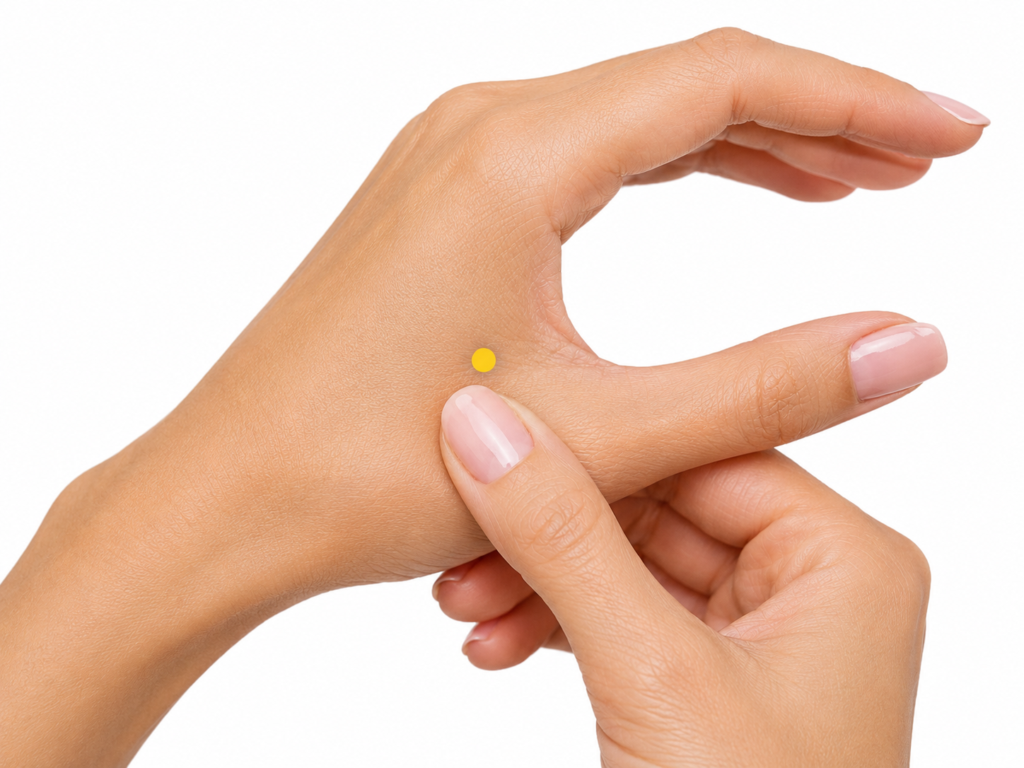
8. Press on LI4 on the back of the hand to reduce pain and grip tension. LI4 sits in the webbing between the thumb and index finger, at the highest point of the muscle when the two are pressed together. Press firmly with the thumb of your other hand for one to two minutes on each hand. LI4 is called “Hegu,” the “Joining Valley.” LI4 is avoided during pregnancy.
LI4 is the go-to point for pain in the hand, wrist, and arm. It also releases tension that builds up in the hand from all the squeezing during long rallies.
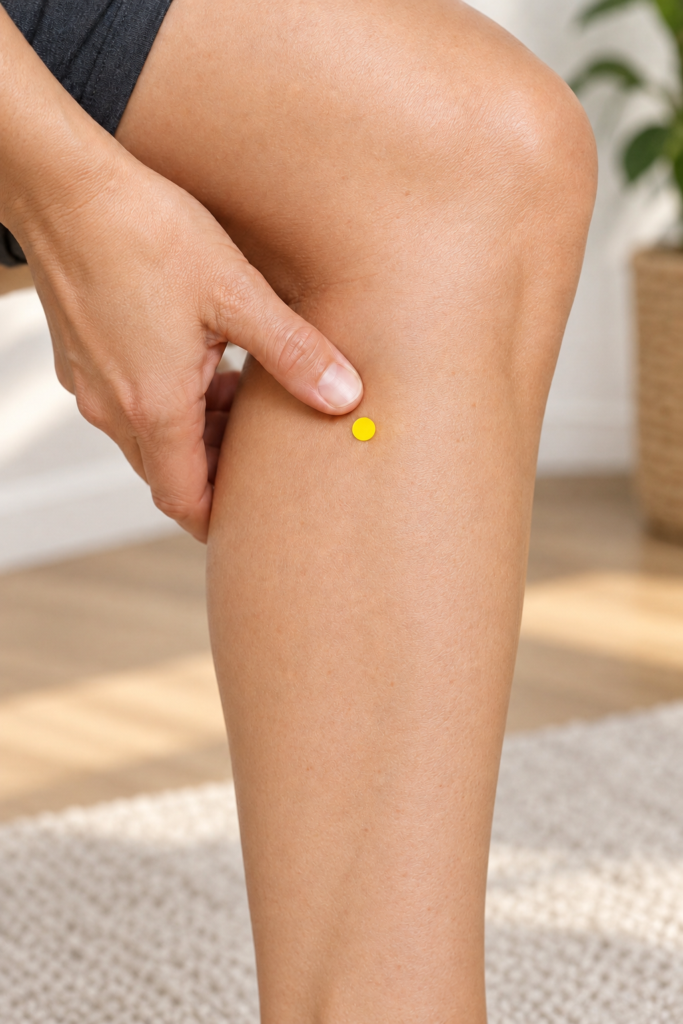
9. Press on GB34 below the outer knee to support the tendons. GB34 sits on the outer lower leg, in the hollow just in front of and below the small bony knob below the outer knee. Press firmly with your thumb for one to two minutes on each leg. GB34 is called “Yanglingquan,” the “Yang Mound Spring.”
In Traditional Chinese Medicine, GB34 is the influential point for tendons. It supports tendon and ligament healing from a distance, making it especially useful when a wrist is braced or too tender to touch.
Why These Acupressure Points Work
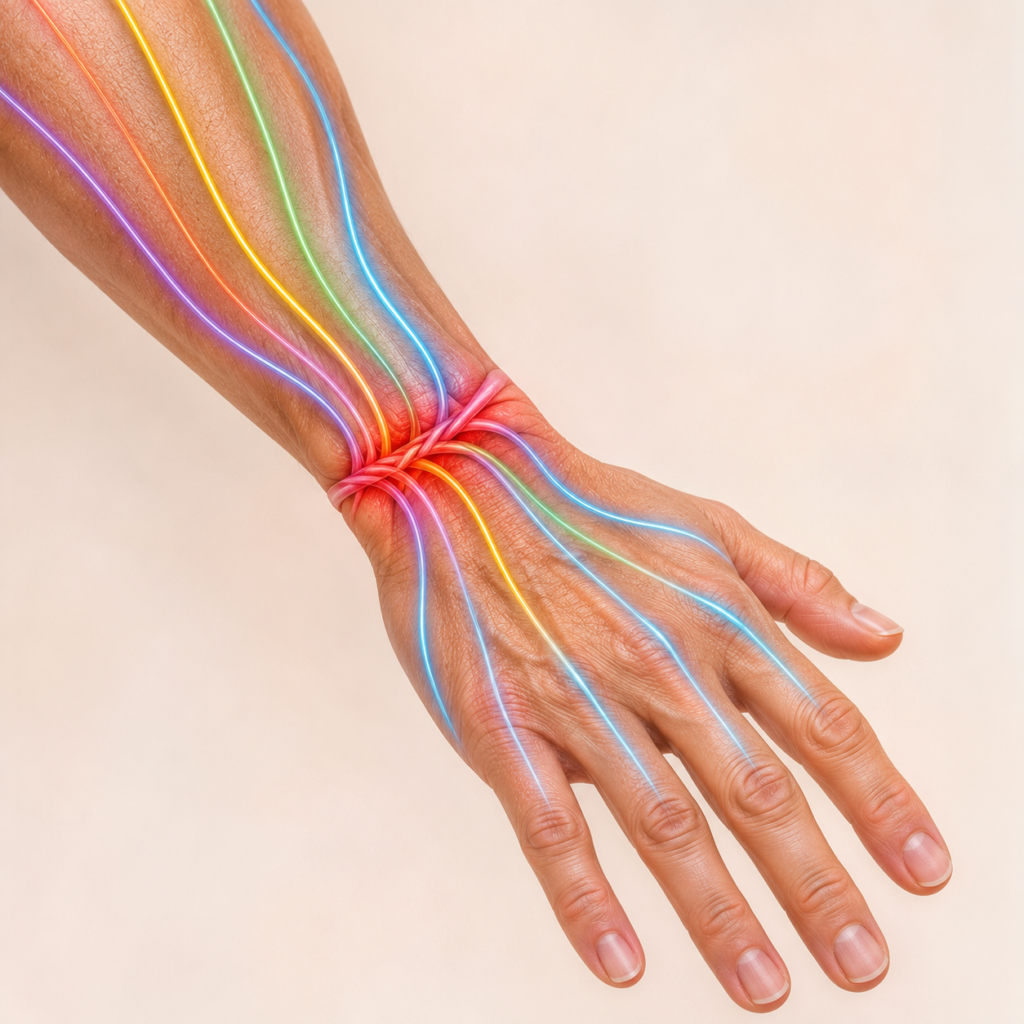
From a Traditional Chinese Medicine perspective, pickleball can injure the wrist in two ways. A fall can disrupt the normal flow of Qi and Blood, causing them to pool in the joint and lead to swelling and pain. Repetitive gripping and swinging can gradually wear down the tendons, leaving them stiff and tender. Treatment focuses on moving what has become stuck around the joint and supporting the tendons and ligaments as they heal.
The nine points work together to treat the wrist from every angle:
- TE4 and PC7 work on the back and front of the joint.
- LI5 and LU7 ease the thumb side, while SI5 and SI6 ease the pinky side.
- TE5 relaxes the forearm muscles that drive the paddle.
- LI4 and GB34 relieve pain and support tendon healing from a distance.
How to Properly Use These Acupressure Points
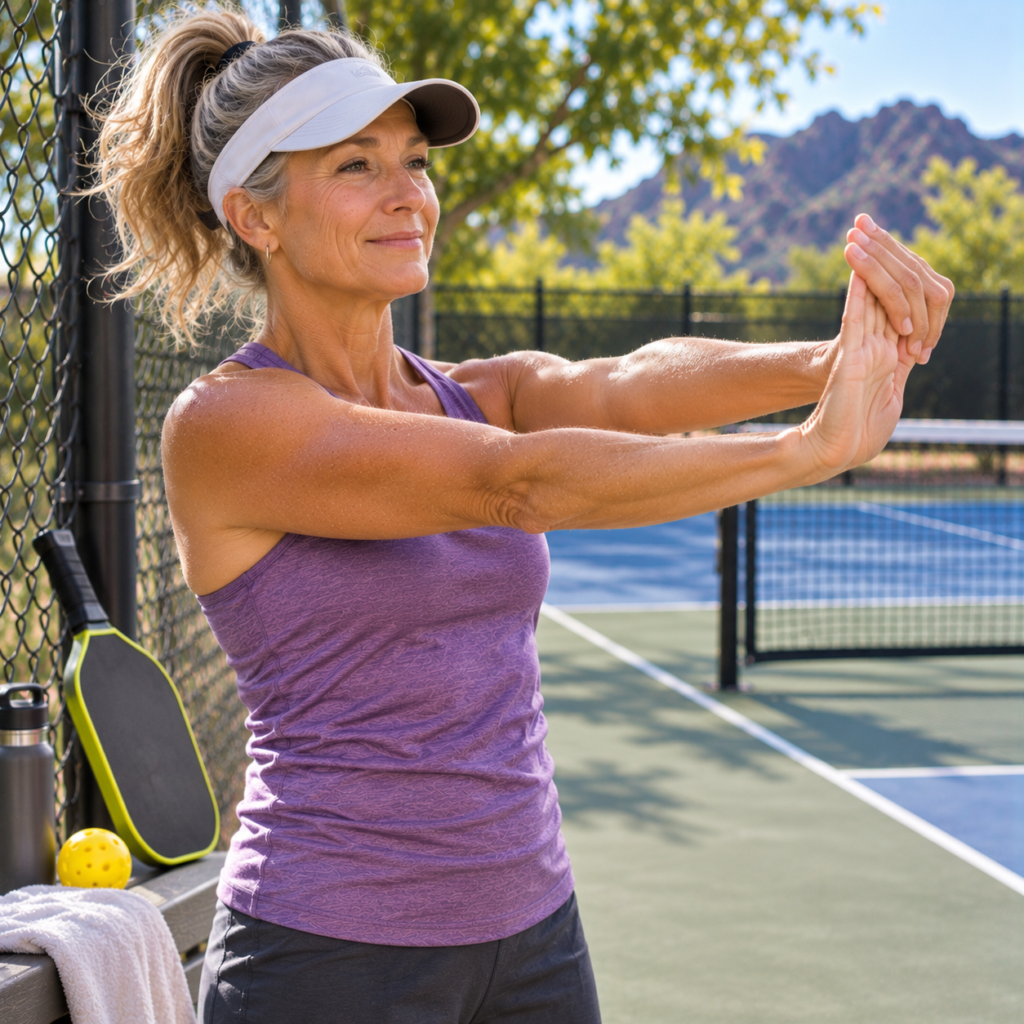
Acupressure can help with pickleball-related wrist pain from tendonitis, mild sprains, or lingering stiffness after a fracture has healed and a doctor has cleared the wrist for normal use.
- Rest the forearm on a table. Begin by working on TE4, LI5, SI5, and PC7, followed by the points just above the wrist: LU7 and SI6.
- Finish with TE5 on the forearm, LI4 on both hands, and GB34 on both legs.
- Apply gentle pressure to the points directly at the wrist, where small bones and tendons sit, and firmer pressure to the forearm, hand, and leg.
- If the wrist is braced or too sore to touch, work only on LI4 on the other hand and GB34 on both legs until the tenderness subsides. Repeat once or twice daily for at least four to six weeks.
The best way to protect your wrists is to stay on your feet. Let difficult shots go rather than diving or lunging off balance, and use good footwork to avoid overreaching. Older players may benefit from balance and leg-strength exercises, since most wrist fractures happen after a fall. Hold the paddle with a relaxed grip and keep your wrist steady during strokes instead of flicking it. Choose a paddle that fits your size and style, as gripping and swinging one that isn’t right for you can strain your wrist. Stretch your wrists and hands before and after playing, take rest days between sessions, and consider wearing a wrist brace if you’ve had a previous injury. If you have a new sprain, apply ice for the first day or two to reduce swelling, then switch to heat to help Qi and Blood move.
Learn more about inflammation and how it affects healing.
When to Get Professional Help

Get an X-ray immediately if the wrist is deformed after a fall, severely swollen or bruised, impossible to move, or sharply tender in the hollow at the base of the thumb. A fracture of the small scaphoid bone in this area is easy to miss and can heal poorly if left untreated. See a doctor or hand specialist if the sprain is not clearly improving within a week, you have pain on the pinky side of the wrist with clicking or weakness when twisting, your fingers are numb or tingling, or your wrist feels weak or unstable when gripping. Do not press directly on a wrist that may be fractured or is still healing in a cast.
Acupressure is a gentle, supportive practice for pickleball wrist pain. It complements, and does not replace, diagnosis and medical care.
For related health concerns, acupressure for wrist pain, acupressure for carpal tunnel syndrome, and acupressure for de Quervain’s tenosynovitis are companion articles.
Other posts in the pickleball series include acupressure for pickleball knee pain, acupressure for pickleball shoulder pain, acupressure for pickleball elbow, acupressure for pickleball ankle pain, acupressure for pickleball back pain, and top acupressure points for pickleball players.
Above and Beyond Acupuncture offers acupuncture, cupping, and lifestyle coaching at the North Frank Lloyd Wright Boulevard location in Scottsdale.
Schedule an appointment online to start your healing journey.
The points above are only as effective as the technique used to apply them. Where to press, how firmly, and for how long all affect the result. For a full breakdown of how to perform acupressure properly at home, read Performing Acupressure in 3 Easy Steps.

About the Publisher
Paul Kerzner, L.Ac., is a licensed acupuncturist and board-certified herbalist, as well as the founder of Above and Beyond Acupuncture in Scottsdale. His own journey from chronic patient to practicing acupuncturist shapes his commitment to providing honest, clinically grounded information about acupuncture and Traditional Chinese Medicine. Learn more about Paul and his clinical approach on the About Us page.